
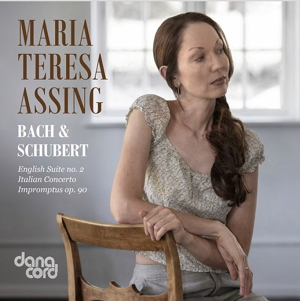
Johann Sebastian Bach (1685-1750)
English Suite No.2 in A minor, BWV 807 (c.1715-1723)
Franz Schubert (1797-1828)
Four Impromptus, op.90, D.899 (1827)
Johann Sebastian Bach
Italian Concerto in F major, BWV 971 (c.1734-1735)
Maria Teresa Assing (piano)
rec. 2026
Danacord DACOCD1022 [63]
One thing about Bach’s English Suites is that they are not particularly English in mood or effect. The title may reflect a lost dedication to an English patron or a connection with Charles Dieupart, a French composer active in London. In fact, commentators suggest that the English Suite No.2 in A minor shows Bach synthesising French, Italian and German elements into a unified, highly idiomatic keyboard work, rather than aligning itself with any single national style or the supposed “Englishness”. The Suite follows the conventional Baroque order: an expansive Prelude, an Allemande, a Courante, a beautiful Sarabande (it survives in a plain and an ornamented version, both played here), Bourrées I & II, and a sparkling concluding Gigue.
Like many listeners of a certain age, I encountered Schubert’s Four Impromptus on the celebrated album that Alfred Brendel recorded for Philips in 1972. This “benchmark” account has served me well, but I loved Maria Teresa Assing’s performance. The “song without words”, the Impromptu No.3 (Andante in G flat major), has a definite magic with Assing’s beautiful singing legato line. Yet she does not sentimentalise. The opener of the set, Allegro molto moderato in C minor, is more like a variation fantasy form than a regular salon piece. Much of it is thoughtful, though the writing gains a marked vitality in the stretches with repeated left‑hand chords.
The Impromptu No.2, Allegro in E flat major, is a rip-roaring “toccata” with accidentals scattered widely, and then a hugely contrasting marcato middle section. The final impromptu, Allegretto in A flat major, is perhaps the least popular of the set. The technicians would describe it as a “right hand rotational study”. That is a little damning with faint praise for an unexpectedly attractive etude. The lyrical “trio” section is delightful.
An Impromptu is usually considered as a short, self‑contained piano piece with an improvisatory character, typically lyrical or rhapsodic; it suggests free invention while remains fully composed. Assing’s performance always preserves this dichotomy of apparent spontaneity set within firm structural control. She lets the music sound freshly conceived while she keeps its underlying architecture clear and steady.
Bach’s Italian Concerto was first published in the Clavier‑Übung II (1735). It is a remarkable solo concerto without the band. In its harpsichord incarnation, the two manuals are used to imitate the tutti/solo contrasts of the Italian concerto grosso. On the piano, that contrast becomes a matter of touch and weight. The performer shapes the “tutti” with a firm, bright forte, and the “solo” with a lighter, more yielding touch, keeping the alternation consistent enough that the concerto dialogue remains unmistakable. The rhapsodic slow movement, by contrast, nods to the First Brandenburg Concerto. It is played here with heart-easing beauty. The finale is a fast, high-energy perpetual motion. It drives the piece toward its inevitable conclusion, where scales and gigue-like rhythms abound as the pianist makes fine, nuanced judgments between loud and soft dynamics.
The liner notes, such as they are, are a let‑down. One half is taken up by a photograph of the soloist walking in the woods; the other offers a handful of quotations from the composers and the performer. Dates for the works are omitted, and there is no discussion of the repertoire. Nor is any biographical information about the artist provided.
Danish pianist Maria Teresa Assing trained in Norway, Germany and Denmark. She performed widely across Europe as a soloist and chamber musician. Known for her interpretations of Bach, Schubert, Chopin and Messiaen, she has collaborated with leading conductors. She released acclaimed recordings of Chopin’s works and Bach’s Partitas.
Taken together, this programme shows the pianist’s command of three very different keyboard worlds, each approached with clarity, structural sense and an unfussy musical intelligence. Nothing is pushed beyond scale: each piece speaks in its own terms, and the playing keeps the line, the contrasts and the character of each score firmly in view.
John France
Availability: Danacord













