
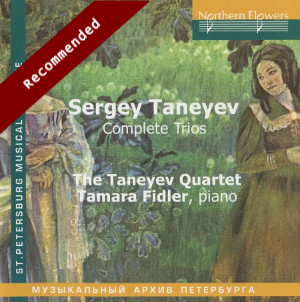
Sergei Taneyev (1856-1915)
Complete Trios
String Trio in D major (1879-1880)
Trio for Two Violins and Viola in D major, Op. 21 (1907)
Piano Trio in D major, Op.22 (1908)
String Trio in E flat Major, Op.31 (1910-1911)
S. I. Taneyev Quartet, Tamara Fidler (piano)
rec. 1978 (Op.22), 1969 (others), Leningrad Conservatory, USSR
The St. Petersburg Musical Archive series
Northern Flowers NFPMA9958/9 [2 CDs: 119]
The Taneyev Quartet, formed in 1946 by four students of the Leningrad Conservatory, still exists today. Naturally, there have been personnel changes, and the name of the group has been through several versions. At various times, they have performed the complete quartets of Beethoven, Shostakovitch and Miaskovsky, and a number of premieres. As for their namesake composer, there are recordings of all Taneyev’s chamber works: nine string quartets, four trios, three quintets, violin sonata and piano quartet. The only exception is his B minor string trio left unfinished at his death. The Taneyev series contains live concert recordings, mostly from 1977-1981, though three of the four trios here were recorded in the late 1960s. They have been previously released on Olympia and Northern Flowers.
The string trio holds an unusual place in Taneyev’s output. The work from 1880 was his first significant chamber work, almost three decades before he wrote another string trio. Even after 27 years, the newer piece shares an interesting feature with its predecessor: both are tributes to Mozart. It is de riguer when speaking of Taneyev to mention his interest in the Renaissance masters and his close friendship with Tchaikovsky. Little is made of his great admiration for Mozart but, as we shall see, it was integral to the string trios.
The above does not mean that there is no influence of Tchaikovsky in the older trio, or of the composer’s interest in Renaissance music. But a Mozartian clarity informs the entire piece, especially in the opening Allegro. The development in this movement is beautiful and forceful, and fully justifies the composer’s stated intent to combine Russian musical style with Western theory. He is even more successful with the Scherzo, where his use of invertible counterpoint does not stop the Russian dance element from sounding totally authentic. The Adagio ma non troppo is also Russian in feeling, as much as anything of Borodin or Rimsky-Korsakov. It plumbs depths that were admired by Tchaikovsky himself. The Finale brings the work to a joyous close.
The newer trio, as said above, is even more Mozartian. In fact, Taneyev set out to create a work such as Mozart could have written if he had been alive in 1907. This intention could have produced a work that was either a pastiche or a moribund homage. Instead, we have a Neo-classical work that is true to Mozart without being in any way untrue to Taneyev. Another interesting feature is the scoring for two violins and viola, an instrumental ensemble that seems more Baroque than Classical. The opening Allegro movement begins strongly, but it is the second theme that truly charms the listener, as well as the composer’s skillful use of his unusual instrumental ensemble.
There follows a minuet rather than a scherzo, although it comes before rather than after the slow movement. Again, there is no pastiche, just one composer writing in admiration of another. The main theme of this movement, very beautiful, is developed with Taneyev’s usual skill. The Andante has more of the Russian element than its predecessors; Mozart himself would have been proud of the coda. The viola, especially prominent in the succeeding Vivace,helps provide an enchanting end to the whole work.
Taneyev’s only piano trio is one of four chamber works with piano that resulted from a tour he made with the Bohemian Quartet. The others are the Piano Quartet Op.20, the Piano Quintet Op.30, and the Violin Sonata. The trio’s opening Allegro more or less follows sonata form, but with a multiplicity of themes, and its lightness may remind the listener of Fauré’s late chamber works. It is certainly one of the most beautiful movements in Taneyev’s chamber output. The Scherzo movement is unusual in that the first part presents a theme is then put through a series of mini-variations in the trio. Several of the variations show the whimsical side of the composer’s personalty, while others are folk-like. The Andante expressivo is simple and song-like, and magnificently written for the three instruments. The Finale follows without a break; a humorous treatment of the main theme of the Andante expressivo precedes a forceful conclusion.
The three trios already discussed are all in the key of D major, perhaps one that Taneyev associated with the trio format, but Trio Op.31 is in the key of E flat Major. It is noteworthy that the composer was again experimenting with the instrumentation: Op. 31 was originally scored for violin, viola and tenor violin. The tenor violin, popular in the 17th and 18th century, lies between the viola and the cello in range. Its part nowadays is usually taken by a cello, as in this recording.
The Trio Op. 31 is contemporaneous with Taneyev’s Piano Quintet Op.30, one of his finest works. I do not find the Trio quite up to the level of the Quintet, but it is still an important piece. It begins brilliantly with an arresting Allegro con brio theme, followed by an even more memorable second them; both themes are brilliantly developed. With the Scherzino that follows, one is forced to wonder if it would sound better with a tenor violin, although the middle section is very enjoyable. The following Adagio expressivo,elegiac in feeling,is the high point of the work and one of the composer’s most moving slow movements. The Finale, as with many of the composer’s concluding movements, is a complex synthesis both musically and emotionally.
As said above, the Taneyev Quartet had numerous personnel changes through the years. The “classic” complement in 1968-1984 consisted of Vladimir Ovcharek (first violin), Grigori Lutzki (second violin), Vissarion Solovyev (viola) and Josif Levinson (cello). These are the performers we hear on these discs. Tamara Fidler, heard in the Piano Trio, was the wife of Levinson’s predecessor Benjamin Morozov, and a fine pianist in her own right. She is appears in the Quartet’s recordings of the Violin Sonata and the Piano Quintet.
There have been more recent recordings of all four trios, except Op.21, but as a set these discs cannot be equaled, due both to the magisterial performances and to the Quartet’s unique understanding of the composer.
William Kreindler
Buying this recording via the link below generates revenue for MWI, which helps the site remain free













