
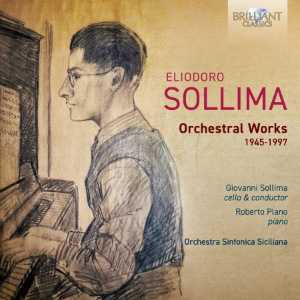
Eliodoro Sollima (1926-2000) Orchestral Works
Rondò burlesco for piano and orchestra (1951)
Concerto per archi (1968)
Aria for cello and strings (1945)
Ouverture da camera for piano and chamber orchestra (1948, rev. 1950)
Nenia e Recitativo for cello and strings (1976)
Attesa (1997)Giovanni Sollima (cello)
Roberto Plano, Riccardo Scilipoti (piano)
Salvatore Greco (violin)
Orchestra Sinfonica Siciliano/Giovanni Sollima
rec. 2022, Teatro Golden, Palermo, Italy
Reviewed as a digital download
Brilliant Classics 96725 [58]
Many classical listeners will no doubt associate Sicily with Vincenzo Bellini, the “swan of Catania,” whose long-breathed melodies changed the world of 19th-century opera. Fans of contemporary music might be aware that Salvatore Sciarrino also hails from Palermo. His style is rather more cerebral than Bellini’s, abounding in extended techniques, string harmonics and silences.
Here is a little-known Sicilian composer for fans of colourful, interesting 20th-century music: Eliodoro Sollima. Born in Marsala, Sollima studied piano under Arthuro Benedetti Michelangeli before directing the Palermo conservatoire for sixteen years. His son, Giovanni, is a cellist and composer as well, and can be heard, for example, on the Brilliant Classics recording of Offenbach’s cello duets (review), and as one of the contributing writers on a Rumi tribute album (review) on BRIDGE records, among other projects. He is the conductor and cello soloist on this present disc.
The elder Sollima has not yet been widely recorded. There was an album in 2021 dedicated to his chamber music, performed by Ensemble Kinari, and very occasionally he will turn up on other discs, but I’ve only been able to find a few of these. Not to pre-empt my conclusion about his orchestral music, but I think Eliodoro Sollima would easily make for interesting programming. His compositional style is eclectic, highly varied, and predominantly serious. It is tonal, but in an interesting, modernist sort of way. He would sound especially stimulating when placed next to other composers. I say this with all love and respect, I rush to add, just in case it sounds as if I’m slighting him: Sollima reminds me of the kind of composer who would be very well-placed in the first half of an evening that will go on to feature a repertory staple. People who frequently attend symphony concerts know what I mean. If anyone reading this happens to be in charge of setting programmes somewhere, take my advice: try something like Sollima’s Ouverture da Camera before Beethoven’s Eroica.
The title of this album is Orchestral Works: 1945-1997, but I’m not entirely sure why the dates were included. If Sollima (born 1926, died 2000) had compositional ‘phases’ either before or after the range featured on this album, they must have been rather short. Instead, what links the six pieces on this disc is that they are all ‘concertante’ works; that is, they feature one soloist or more against some kind of ensemble backdrop. Often, though, it is not a question of virtuosity or showmanship but of having more colours and textures available with which to compose.
Leading off the album is the previously unrecorded Rondò burlesco. It roars to life with a jazzy, leaping cadenza for the pianist, which Roberto Plano handles superbly, while the orchestra contributes with a festive, rhythmically piquant basis. If only the piano parts existed, it would sound like Kapustin, but together, it is reminiscent of Stravinsky. The booklet essay calls this piece a trial for his 1958 concerto, which I don’t believe has ever been recorded. The Rondò burlesco is arranged fast-slow-fast, and gets a surprising amount done in just five minutes. Here and elsewhere, Sollima can be a ‘restless’ composer, who allows an idea only as much airspace as it needs before he’s off to the next thing.
His 1968 Concerto per archi makes quite a contrast. The inspiration for this piece was the assassination of Robert Kennedy, but Sollima left off the dedication “in light of the sensitive issue of the Vietnam War.” Across a single 14-minute movement, Sollima is dark, intense, and finds all sorts of interesting string sonorities. I think the Schnittke Concerti Grossi makes a good benchmark, if you are familiar with them. The difference, really, is that Sollima is slow throughout, and more consistently lyrical than Schnittke, even if his melodic ideas are often short and unconventional.
If Giovanni Sollima needed to release a ‘lead single’ for this album, the way artists in rock and pop used to, I have no doubt that he would have picked Aria. Eliodoro composed it as a 19-year-old in 1945, saying of the work that it expresses “the poignant, finally fulfilled desire to be able to breathe the open air again after being forced to take refuge in underground shelters to escape the bombs.” Aria was originally scored for string quartet, but the composer revised it at some point for cello and strings. For my money, it’d make a great cello concerto encore (or CD bonus track) in the way From the Bohemian Forest often does. Sollima sounds genuinely late-Romantic in Aria; I thought of Strauss’s Metamorphosis, although maybe the date and subject matter helped. Either way, it is a gorgeous piece, and the highlight here for me. I believe it has been performed a few times in its other incarnations, for example, by Ensemble Kinari on the previously mentioned chamber music disc.
The 1948 Ouverture da camera takes us back to the Rondò burlesco, although it is a little less inspired by Jazz. It, too, begins with a bang, and features lots of staccato writing for both piano and orchestra. There is a strong woodwind flavour here as well, especially in the slower sections. I always think it is a cop-out to describe music as ‘cinematic’, because any piece of music could work perfectly well in a film with the right context, but I do agree that the Ouverture is “evocative of the sound atmospheres of the cinema of those years,” to quote the booklet. The driving rhythms of the final two minutes give a sense of adventure – it’s a really delightful piece.
We catapult from ‘classic Hollywood’ to something quite different in Nenia e recitativo. According to the booklet, the 1970s were Sollima’s most experimental period – so, perhaps, one might have wanted it to be represented by more than a single five-minute work on this disc… no matter. A ‘nenia’ is a funeral dirge: Brahms (after Schiller) spelt it Nänie for his Op. 82. The genesis of the work lies in a 1968 Variations on a Sicilian Lullaby, which developed somehow into this lament for cello and strings. It is an eerie, very intense piece. Some musical laments feel a bit listless, but this one captures the sheer energy of fresh grief. Kudos to Giovanni Sollima, too, who conveys the mood perfectly while keeping up with a demanding solo part.
Our final work, Attesa, is reminiscent of the Concerto per archi despite being composed some thirty years later. It, like the Nenia, is dark and gripping. Even without considering the title, though, there is a palpable difference in mood. If the Concerto and Nenia both dealt with elegy, Attesa is much more a work of anxiety. The title translates to “waiting” or “expectation” – because of this, I had Schoenberg’s Erwartung on my mind at first, but actually Sollima is doing something else. The piece is dedicated to the memory of Joseph O’Dell, executed by electric chair in the United States in 1997 after four years on Death Row. O’Dell had become something of a cause célèbre in Italy, because, in part, of the work journalist Lori Urs had done in petitioning the Vatican to ask that he be spared. In fact, Urs and O’Dell were married the day of his execution, with Sister Helen Prejean serving as one of the witnesses. She had already written Dead Man Walking, which was turned into an opera by Jake Heggie a few years later; I highly recommend it to anyone who is touched by Attesa, although their musical idioms differ.
The mayor of Palermo offered O’Dell honorary citizenship, which is, perhaps, why Sollima first heard of the case. Sollima wanted to chronicle the “frantic sequence of images, memories and emotions that torment the last hours of a condemned man’s life.” He takes on a substantial compositional risk in trying to portray not only the emotions but the nightmarish agony of waiting; you can easily imagine how that might go wrong. I don’t think it does here, which is truly a testament to Sollima’s craft. It is a heavy, heavy piece of music, unrelenting and bleak, but very skilfully executed. I really could not help but feel moved. Sollima passed away only a few years later, and he and O’Dell are buried in the same cemetery in Palermo.
All in all, I found the disc to be a genuine success. I do, however, have a few very minor quibbles. There are places where Giovanni Sollima’s breathing is captured in vivid high-definition, which I could have done without. The booklet essay contains the occasional hagiographic hyperbole and leaves rather a lot of my questions unanswered – but at least it informs me that “[Eliodoro Sollima]’s wife Giuseppina…by a bizarre twist of fate, bore his surname without being related to him.” Well, that’s good to know, I suppose.
I came away from this disc a fan of both Eliodoro and Giovanni Sollima. If you like late 20th-century music that is eclectic, melodically-oriented, and original, you’ll like Sollima.
Aidan Gray
Buying this recording via the link below generates revenue for MWI, which helps the site remain free













