
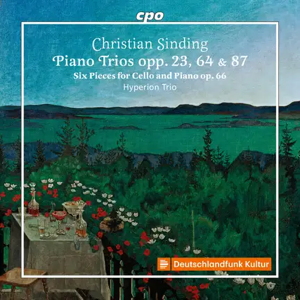
Christian Sinding (1856 -1941)
Piano Trio No.1 in D major, Op.23 (publ. 1894)
Piano Trio No.2 in A minor, Op.64 (1902)
Piano Trio No.3 in C major, Op.87 (1908)
Six Pieces for Cello and Piano, Op.66 (1903)
Hyperion Trio
rec. 2020-2023, Deutschlandfunk Kammermusiksaal, Köln, Germany
cpo 555375-2 [2 CDs: 121]
I am sure that most people have heard (or heard of) Sinding’s once ubiquitous piano piece, Frühlingsrauschen (“Rustle of Spring”, Op.32 no.3, part of his 6 Stücke, Op.32), but he also wrote plenty of other music including four symphonies (already reviewed on this site, here) and a lot of chamber and piano music besides, much of it still unknown and unrecorded.
The three trios date from the middle part of Sinding’s life, before his retirement from composition around the start of the First World War. The first of these works starts with a cheerful, sunny ‘Allegro’. This is the longest of the three movements and launches straight into a theme that permeates the whole movement. There is heavy reliance on the piano; however, there is also plenty of opportunity for the ‘cello and violin to take centre stage, too. All three performers bounce nicely off one another in some wonderful music making. As the movement continues, some very interesting tension is built among all three instruments, especially about 3’30’’. This eventually resolves into a much darker dialogue led by the ‘cello before paring down to a beautiful, mournful section for the cellist alone. This doesn’t last long and soon the opening theme tentatively starts to appear across all three instruments before joyfully bursting out and continuing its development. Overall, this is a great way to start off a trio and it doesn’t outstay its welcome in any way.
The following ‘Andante’ is very different in tone; it’s far more restrained and opens very simply with a lovely tune on the piano, later joined by the other instruments. This whole movement is more thoughtful and questing than the preceding powerful movement, creating a good contrast. There is something touching about the frequent duos between the instrumentalists; this movement seems to consist of a series of dialogues between them in various combinations. Mostly, these are restrained in nature; however, the most impassioned section is about half way through and involves all the instruments spinning a lovely theme. The movement doesn’t evolve; it just meanders along, continuing on its merry way before leading to a quiet, peaceful ending. Again, it is masterfully played and the ensemble work together very well.
The finale, marked ‘Con Fuoco’ is a tour de force for all the instrumentalist. The piano starts at a fair pace, then the violin and ‘cello join promptly and take up a jolly, energetic tune that will put a smile on your face. There is a strange “interlude” early on in this movement which is for piano alone and sounds (to my ears), more modern than the date of the trio. It does not last long but provides a really interesting contrast to the rest of the conservative style of the movement. As with the previous movements, all three soloists play magnificently and this movement makes a suitably rousing conclusion to this wonderful trio. I am not familiar with any other piano trios that are similar to this one and date from around this time, Sinding is very content to do his own thing and in so doing, has created a special work that deserves to be heard more often.
The second trio in A minor, dates from a few years later on; the first movement continues in a similar vein to the finale of the first trio. It’s a more assured work and this ‘Allegro con brio’ is by turns, powerful and lilting. There are plenty of memorable themes here to get your ears attuned to and also ample opportunities for the soloists to shine. As with the first trio, it’s uncomplicated, cheery and very well put together. The instrumentalists also play with plenty of commitment to the music and this shows up very well. The second movement starts solemnly in A minor with the piano and later the ‘cello joins in with a tender, mournful tune that sounds to me like a song without words. The violin joins in after this, interleaving with the other instruments in a life-affirming section which is clearly in a major key. This dissipates and leaves the piano on its own played a tender melody before the other instruments join in. This pattern is repeated and the movement ends wistfully and beautifully calmly. The whole atmosphere of the movement is one of peaceful reflection with occasional outbursts of joy. I am paraphrasing the interesting and informative notes in calling this movement “nostalgic reflections on middle 19th century compositions” and I do not disagree with this assessment. The finale is a spirited ‘Non troppo allegro’ and starts with a bouncing piano motif which includes everyone from the outset. Here, the notes mention Schumann as an influence and I can hear why. There is much of interest here; there are lots of difficult trills for the violin and more sinuous playing from the ‘cello, all underpinned by a very difficult sounding piano part. As before, the overall atmosphere is joyous with some sections that are darker, making for excellent contrast to the remainder of the movement. The volume and power levels grow as this movement continues and it grows increasingly fraught. However, at about 7’40’’, all the tension evaporates leaving a pretty little tune for the ‘cello and piano that gradually builds once more with some lovely scurrying passages for the piano. From here, the work increases in jollity and good cheer and finishes with a happy, rousing conclusion.
Sinding’s third and final trio dates from a few years later and is the longest of the works for this combination of instruments. This starts with another assured first movement, again joyful and commanding. There is a mad bit for the violin and piano (mostly) about a minute and a half in and this is certainly music which will put a smile on your face. It slowly winds down to a more reflective section which sounds almost hymn-like in construction. The movement consists of these very nicely contrasted moods and (again, according to the notes) imitates the Hardanger Violin, in memoriam to Grieg, who died during the composition of this work. The piano has plenty to do here, providing powerful support to the other instruments and, as with the other trios, there is a gradual building up of tension as the movement progresses – something which Sinding seems to have been very good at doing. There is nothing outlandish here, just rather interesting and jolly music that will stick in your head for a long time. The movement, predictably ends with an authoritative and strong sounding theme with some crazy trills for all three instruments.
The following slow movement is a delightful “Romanze”, with the tempo marking Andante. The ‘cello takes the lead after a quiet, reflective introduction for piano alone. The violin joins in soon after with a movement that initially put me in mind of a walk in the moonlight, until the key changes a couple of minutes in where there is more stormy music. This brief interlude does not last long before we are back in more peaceful territory with a sort of off kilter waltz that then settles into something calmer, albeit temporarily. The movement proceeds along happily and then, just before ending becomes introspective and peaceful. The finale is described in the notes as dance like and is in 3/2 time – and it is completely bonkers!
This set concludes with a set of Six Pieces for ‘Cello and Piano which were published around the same time as the second trio. There’s a sort of Bach-like structure to this suite; it starts with a “Praeludium” and includes an “Intermezzo” and ends with a “Ritonell”. The opening Prelude begins with a lovely tune on the ‘cello with minimal accompaniment from the piano. The ‘cello holds the melodic line throughout and here is played magnificently. It’s another happy creation aside from a slightly more melancholy section in the middle which reminds me slightly of Schumann. Secondly, we have an “Andante funebre” which is very different. The piano leads off here with a very tragic theme that the ‘cello develops; the central part and the closing minute or two are much less despondent but somehow still sound tragic. The opening sad music returns briefly after a brief, passionate outburst to calm things down again. Weirdly, this piece reminded me of Alkan in places, perhaps due to the unexpected use of accidentals and the full range of the keyboard. Third is an “Intermezzo” – this really is fun. The minimal piano accompaniment gives the ‘cellist plenty to do and I’d really like to hear this as an encore in a concert as I think it would go down very well. It’s witty and slightly off-kilter and will make you smile. Again, Schumann seems to be lurking in the wings here. An “Impromptu” follows next. To my ears, this isn’t very ‘Impromptu like’ but it has a very nice lilt to it and the piano part, with lots of tiny chromatic runs, is splendid played. The short “Romanze” follows, this is just a superb little piece. The opening melody is beautiful and the slightly more agitated middle part makes a perfect contrast. This is another piece that really should be heard more often. Lastly, we have a very energetic “Ritornello”. Again, this is another super, jolly little work with a very busy ‘cello part – not that this presents Ms. Troe with any problems. It’s something that will certainly make you laugh as it bounces along its merry way and the ending is wonderful. Sinding has written a thoroughly charming set of six pieces here and I feel that more ‘cellists should take them up forthwith.
The members of the Hyperion Trio play magnificently throughout, sparking very nicely off one another in this rarely heard repertoire. The recording is clear and bright and the details stand out excellently, especially with headphones. I look forward to further recordings by them in other obscure works.
Jonathan Welsh
Buying this recording via the link below generates revenue for MWI, which helps the site remain free













