
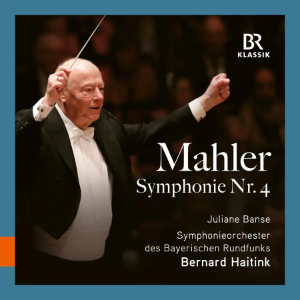
Gustav Mahler (1860-1911)
Symphony No. 4 in G Major (1899-1901)
Juliane Banse (soprano)
Bavarian Radio Symphony Orchestra/Bernard Haitink
rec. live 3-4 November 2005, Philharmonie in Gasteig, Munich, Germany
No text or translation
BR Klassik 900237 [57]
Bernard Haitink returned repeatedly to his core repertoire of Bruckner and Mahler, partly with his Philips contract and partly, when that ended, because the orchestras he worked with were keen to put his live performances on their own labels. I have traced six audio recordings of the Mahler fourth symphony by him, and there is also at least one on DVD. These are as follows; dates are of recording, not of issue:
– 1967 Elly Ameling, Concertgebouw, studio (Philips)
– 1982 Maria Ewing, Concertgebouw, live (Kerstmatinee series) (Philips)
– 1983 Roberta Alexander, Concertgebouw, studio (Philips)
– 1986 Maria Ewing, Concertgebouw, live DVD (Arthaus Musik) (review)
– 1992 Sylvia McNair, Berlin Philharmonic, studio (Philips)
– 2005 Juliane Banse, Bavarian Radio Symphony Orchestra, live (BR Klassik)
– 2006 Christine Schäfer, Concertgebouw, live (RCO live)
What we have here is the 2005 live recording with the BRSO. This is its first separate issue. However, it has already appeared in two anthologies: the first is a Mahler cycle, all with the BRSO but under different conductors (review), and the second is a compilation of Haitink recordings, Bernard Haitink Portrait Vol 1 (review).
Although I have heard a good deal of Haitink’s Mahler, I happen not to have heard his other versions of this symphony, and so I take this one on its own terms. It shows the familiar Haitink virtues of symphonic strength and cohesion. Although this is, in general, the lightest and most cheerful of the Mahler symphonies, it does have its darker moments, and Haitink does not stint on these, such as the massive climax at the end of the first movement’s development section or the impassioned passage at the centre of the slow movement. Nor does he miss the sardonic character of the scherzo second movement, inspired by the folklore character Freund Hein, who is a Pied Piper figure who leads his followers to the world beyond. Death plays the fiddle, as often in folklore. There is a solo part here for the first violin, who tunes his instrument up a tone to sound like a village fiddler.
The finale is a setting of a poem from the folklore collection Des Knaben Wunderhorn portraying a child’s vision of heaven. The choice of Juliane Banse to sing the setting may be controversial. No one doubts her intelligence, her artistry or the beauty of her voice, but my colleague Simon Thompson, reviewing the Bernard Haitink Portrait collection noted above, said, ‘the only slightly sour note is provided by soprano Juliane Banse, who lacks the necessary innocence and wonder in the finale. In fact, she sounds slightly put upon at the top of her range, and even slightly matronly at times, which is the exact opposite of what this movement should be.’ On the other hand, Michael Cookson, reviewing the Concertgebouw symphonies box, said: ‘With the child’s innocent vision of heaven, Juliane Banse’s superb singing [is] praiseworthy, endearingly fresh and expressive.’ I am with Cookson on this. I don’t hear any strain in her voice at the top of the range required, which is only to G above the stave, and she also handles with ease the low B which occurs several times. Yes, her voice is that of an adult woman, not a child, but, although the poem is a child’s vision, it does not work as a song when sung by a child, as Bernstein unintentionally demonstrated when he recorded it with a boy treble. It is a child’s vision written by an adult and performed by an adult and, to my mind, it works perfectly well as such.
The playing throughout is quite superb, and Haitink subtly balances the constantly varying instrumental combinations. The woodwind is very characterful and the brass – apart from the horns there are only three trumpets – kept well under control. The recording is good; you can even hear the harp when you need to. Perhaps the performance does not have the last ounce of charm, such as Kubelik brought to this work, but that was not Haitink’s priority.
The booklet, rather inconveniently, does not give the text of the poem, let alone a translation. If you do not have one to hand, I suggest acquiring a copy of Deryck Cooke’s Gustav Mahler: An Introduction to his Music (Faber), which has texts and translations of all Mahler’s vocal works as well as discussions of them and all the symphonies.
There are, of course, many other recordings of this work, apart from the several by Haitink himself. If you want Haitink but do not care for Juliane Banse, I gather you might prefer Roberta Alexander. Among older conductors I like Bernstein’s first recording (the New York one with Reri Grist on Sony, not the Concertgebouw one with a boy treble on DG), Kubelik, and Maazel in Vienna, and among more recent ones, Ivan Fischer. There are many others. But if you choose this one or would simply like to have Haitink in this work in your collection, you will not be disappointed.
Stephen Barber
Buying this recording via the link below generates revenue for MWI, which helps the site remain free













