
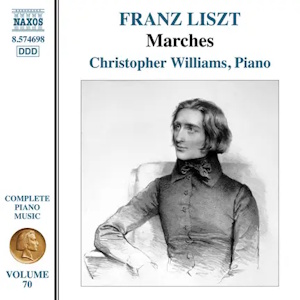
Franz Liszt (1811 – 1886)
Complete Piano Music Vol.70: Marches
Christopher Williams (piano)
rec. 2025, Cardiff University Concert Hall, Cardiff, Wales
Content under review
Naxos; 8.574698 [73]
I favourably reviewed Christopher Williams’ previous recording in the ongoing Naxos Liszt series back in 2025 (volume 65, see here), praising both his clarity of playing and his virtuosity. In this latest disc, he turns his attention to the rarely played (or recorded) Marches that Liszt composed throughout his long life. Many of these are self-transcriptions and haven’t been recorded in the original, orchestral versions, either. It’s a shame that Martin Haselböck and the Orchester Wiener Akademie in their 9 CD orchestral boxed set “The Sound of Weimar” (reviewed by me in 2018 here) did not record some of these still unrecorded orchestral pieces.
Anyway, this disc begins with the Goethe-Festmarsch written in celebration of Goethe’s anniversary; it exists in two versions and this is the second, based on the orchestral version. After a virtuosic introduction, the main theme emerges and this wonderful creation bounces along cheerfully for nearly ten minutes. There is a subtler and rather more relaxed, reflective section in the middle which sounds almost Wagnerian. The earlier version is heard on this disc as track 14 and it is fascinating to compare the two: the later version is more worked out and actually slightly simpler – not that it’s easy, just more pianistic. The later version also contains some interesting harmonies that are more in line with later Liszt. As expected, both are excellently played throughout with a suitable sense of ceremony.
The second track could not be further in mood from the festive nature of the march that precedes it. This short work was written by Liszt as a reaction to the death of his father, Adam, at the age of only 51. Liszt’s response was this short, austere little march which is not a million miles away in feeling from the works that he was to pen some fifty or sixty years later in his old age. It’s wonderfully played here with an apposite level of melancholy and depth of feeling.
Thirdly, we have the “Seconde marche hongroise” (subtitled the “Hungarian Storm March”) – the earlier version is also recorded later on this disc as track 11. The two works are quite different but contain many of the same themes; this later version is more fully worked out and, to my ears, flows better. Both versions are full of difficulties and contain a rather earwormy tune. The work was extensively revised for the later version and again it’s interesting to compare the two. Personally, I rather like the total disregard for difficulty that is found in the earlier version. The extremely clear pedalling throughout this performance of this work really enables the harmonic changes to clearly stand out – magnificent.
A tiny Hungarian march follows; it’s a strange little work that barely lasts a minute, disappearing almost as soon as it starts. It strikes me that it could be part of something larger; however, no manuscript of a larger work containing this motif has yet come to light so it’s just really an Album leaf.
Track 5 is the rather fun “Ungarischer Geschwindmarsch” (literally translated as “Hungarian Quick March”) and that is certainly an apt description. The four pages of this work (with a few repeats) whizz past very rapidly and is splendidly played throughout. Liszt once again has written a piece that has plenty of thematic material that will stick in your head. The last thirty seconds or so of the work start to veer off into very strange harmonic territory before an emphatic conclusion in A major – great stuff again!
I’ve long liked the “Heroischer Marsch im ungarischen Styl” (“Heroic March in the Hungarian Style”, track 6) and spent roughly a year trying to learn it. As I personally found out, it’s very far from easy to play, full of minute details and some incredible flights of virtuosity. Obviously, none of this difficulty shows up in this performance and the little appoggiaturas that occur frighteningly frequently in this piece add a special Hungarian flavour to this rarely heard work. Liszt later turned this into the basis of his excellent ninth Symphonic Poem, Hungaria (S103, in its orchestral guise) and it’s wonderful in any version.
Liszt’s jolly “Vom Fels zum Meer” comes next. This is one of those totally bonkers works that sticks in your head – it’s completely over the top and joyful. The slightly more restrained middle section is delightful and full of interesting key changes. It’s another work that sadly does not turn up on disc or in concert halls very often which is a shame, especially when it is played as well as it is here.
I’m inclined to agree with Liszt expert Dr. Leslie Howard’s opinion of the Bülow-Marsch, even when played very well (as it is here); it’s not a piece that stays with you. There’s plenty of late-Liszt use of tonality here but it just doesn’t work somehow. There is also an earlier draft version (not recorded here, presumably because of the playing time of a CD) that was recorded by Dr. Howard on the fourth CD of his New Discoveries on Hyperion (reviewed here). It’s worth a listen for those (like me) who are interested in the way Liszt develops and evolves his musical ideas over time.
Track 9 is simply entitled “Ungarischer Marsch” and begins with a splendidly evocative piece of Hungarian themed pomp. Unlike some of the other works on this disc, it doesn’t zoom past particularly rapidly; it’s more sedate than that. It’s also one of the unusual late works of Liszt in that it is cheerful. The central section (1’10 onwards) is even more restrained and late-Liszt-like but this soon ushers in a repeat of the happy opening theme to round off this 3’08’’ of jollity.
The 10th work on this disc is the “Siegesmarsch” with the appropriate subtitle of “Marche triomphale”; it’s a heroic, powerful little work that launches unexpectedly before jumping about all over the keyboard in a most joyful manner. As with the earlier “Ungarischer Marsch” (track 9), there is a restrained central section that contains some unsettling late Lisztian harmonies but this is soon banished as the opening music returns – but not for long. The final minute or so is a combination of all of the earlier themes and the work ends with some powerful tremolandos and bare octaves, in E flat.
The twelfth piece on this super disc is the “Huldigungsmarsch” (“Homage March”) which also exists in two piano versions; this is the later one. The earlier one isn’t included on this disc but will presumably be recorded in due course. The opening is suitably powerful and heroic but the middle section that starts at 1’40’’ is more restrained and reverential, sounding almost like a hymn. This meanders around interestingly for a couple of minutes before some late-Liszt pyrotechnics bring back the opening themes with slight variations from the first time, making them even more difficult to bring off – but not here. The ending is suitably commanding and rounds the work off appropriately.
The penultimate work on this generously filled disc is the rather long-named “Ungarischer Marsch zur Krönungsfeier in Ofen-Pest am 8ten Juni 1867”. This was apparently composed for the Hungarian coronation in 1867 but wasn’t finished in time. Bearing in mind Liszt’s phenomenal work ethic, I’m not surprised that things were sometimes not ready. This is a strange work that seems to be a mixture of middle period Lisztian virtuosity and late-Liszt atmosphere. There are some disconcerting changes of key and direction that make a rather interesting and compact little work with plenty of interest. It’s persuasively played here with the right amount of feeling balanced with power when indicated in the score – superb stuff, again.
As with the other disc I reviewed previously, the recorded sound is excellent, clear and bright. Williams also doesn’t pedal too much, which is very useful for making the myriad difficulties and interesting harmonies stand out clearly. As before, I found the cover notes a little short but they provide some interesting background to this rarely heard music. I also really like the way that Naxos have now started putting the sources for the music on the back cover so that people can seek out the music, if they wish to do so. Overall, this is a brilliant recording of some rarely heard Liszt, all splendidly played. As before, I look forward to his next recording.
Jonathan Welsh
Buying this recording via the link below generates revenue for MWI, which helps the site remain free
Contents:
Goethe-Festmarsch, S.521 (Second Version)
Marche funèbre, S.226a
Seconde marche hongroise (Ungarischer Sturmmarsch), S.524 (Second Version)
Marche hongroise, S.233b
Ungarischer Geschwindmarsch (Magyar Gyors induló), S.233
Heroischer Marsch im ungarischen Styl, S.231
Vom Fels zum Meer (Deutscher Siegesmarsch), S.229
Bülow-Marsch, S.230
Ungarischer Marsch, S.229a
Siegesmarsch-Marche triomphale, S.233a
Seconde marche hongroise (Ungarischer Sturmmarsch), S.232 (First Version)
Huldigungsmarsch, S.228 (Second Version)
Ungarischer Marsch zur Krönungsfeier in Ofen-Pest am 8ten Juni 1867, S.523
Festmarsch zur Säkularfeier von Goethes Geburtstag, S.227 (First Version)













