
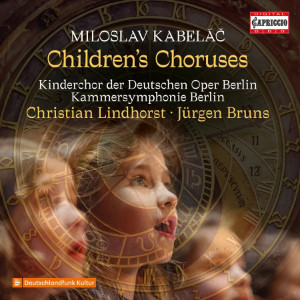
Miloslav Kabeláč (1908-1979)
Children’s Choruses
Children’s Choir of German Opera Berlin
Irina Loskova and Elda Laro (pianos)
Berlin Chamber Orchestra/Christian Lindhorst, Jürgen Bruns
rec. 2023-24, Deutsche Oper, Berlin and Philharmonie Kammermusikaal, Berlin
Texts included
Capriccio C5566 [2 CDs: 96]
The music of Miloslav Kabeláč has been well served by Capriccio which has recorded the Second Symphony, the complete Chamber Music, his Mystery of Time and other works. Now Capriccio turns to the cycles of Children’s choruses that occupied him from 1944 to 1961.
Initially he was stimulated to write for children because of the birth of his daughter in 1946 and he regarded such writing as a touchstone, as an index of a composer’s sensitivity and human qualities. As he once wrote ‘it represents in my music a note of tenderness, joy and light – the light of our future’. In the cycles he makes a lot of use of onomatopoeia and revisits motifs frequently, often subtly changed, vesting them with slightly changed meaning. He is playful, alert and crafts identifiably personal ideas in these cycles. The individual movements being so short, they never outstay their welcome but are charged with deceptive richness.
Children’s Games is deftly orchestrated and folklorically based. It also contains a charming innocence alongside other elements of the Czech imagination – forests and valleys, wind sonorities and balletic orchestral interjections. In We Sing, one detects more off-kilter elements too. Some may hint at Janáček but more often Martinů in their occasionally odd density. They’re also tuneful and droll and draw on perky animal characterisation – the portrait of the sparrowhawk’s cry, for example, is a winner. There’s a lot to enjoy about Children’s Song, Op.16 which features a number of solo voices, all named in the booklet, which put across the lyrics with admirable clarity.
To Nature is based on folk poetry and has a richer quotient of folk influence than any other of these cycles though often cast in simplified form. The cycle ‘From the World of Birds’ is Children’s Songs, Op.23 and feasts on echo effects, contrasts, imitations and is suffused with an inventive sense of colour and imagination
They are largely free of the angst that occupied him in, say, the Second Symphony, though there is overlap in compositional date not least in the early Children’s Songs, Op.16 N16. The Berlin Chamber Orchestra under either Christian Lindhorst or Jürgen Bruns accompanies in the Children’s Games, Op.21, the Suite of Sung Pictures from Blue Sky Op. 19a and in For Children, Op.22 which is a strictly orchestral suite. Otherwise, the two expert piano accompanists are Irina Loskova and Elda Laro, who play on the cycles noted in the headnote.
The star of the disc is the Children’s Choir of German Opera Berlin, which sings with innocence and tonal purity as well as a huge unspoilt commitment. The recordings were made over several days in the studio in April 2024 and September 2023 and live in the Philharmonie Kammermusikaal, Berlin in June 2023.
The accompanying booklet is 70-pages long and includes Czech texts with translations into German and English. The production fits into a slip case which makes removal of the booklet tricky – but then if you get rid of the slipcase, you might lose the booklet.
Jonathan Woolf
Buying this recording via the link below generates revenue for MWI, which helps the site remain free
Contents
Children’s Games, Op.21 N27 (1952)
We Sing, Op.43 N56 (1961)
Children’s Songs, Op.16 N16 (1944-49)
Suite of sung pictures from Blue Sky Op. 19a N23 (1950)
To Nature, Op.35 N47 (1957-58)
Children’s Songs, Op.23 N30 (1954)
For Children, Op.22 N29 (1955)













