
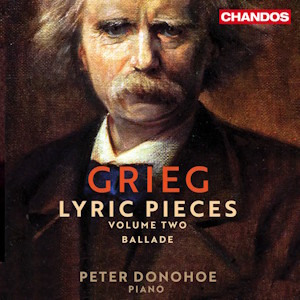
Edvard Grieg (1843-1907)
Lyric Pieces Volume Two
Peter Donohue (piano)
rec. 2025, Potton Hall, Dunwich, UK
Chandos CHAN20464(2) [2 CDs: 104]
The first Book of Grieg’s Lyric Pieces Op. 12, appeared in 1867, but it was sixteen years before Volume Two appeared. Struggling against repeated creative blocks, the Norwegian composer eventually managed to complete a total of sixty-six individual pieces in ten volumes. It is this substantial series of short lyric pieces which is perhaps most representative of Grieg; his beloved homeland, friends and family, and the landscape, folktales and lives of simple people all enrich his work. The English pianist Peter Donohue has a special love of these works, and this is the second double CD of his Complete Lyric Pieces. You can find Volume One also on Chandos.
Grieg is a composer who is too often treated unfairly, even dismissed by the ignorant. Like Dvorak, his music has sometimes been sidelined as pretty country folk tunes with no real weight or importance, and him as a composer of songs and one or two suites like the Holberg, with an accidental masterwork, his great piano concerto being viewed almost as a one-off.
Here, in the second volume of his two-volume set of Grieg’s lyric pieces, Peter Donohue, like Leif Ove Andres, Stephen Hough and others before him, proves beyond any doubt that Grieg’s wasn’t just a one-work wonder, but merely the tip of a shifting Norwegian iceberg, the majority of whose riches lay under the surface. The lyric pieces are a substantial part of this mass and go a long way towards re-habilitating Grieg’s reputation as a mere writer of pretty dances, ignoring the variety and often the good taste of his music. Hopefully, fine pianists like these three will encourage more recordings of these wonderful pieces and more adventurous programming in concerts.
Having three such excellent and individual pianists, comes in very handy when assessing Peter Donohue’s own contribution to the furthering of the understanding and appreciation of these works. I always think it’s a good idea to approach a solo recording by hearing how an artist begins it. Whereas Peter Donohue has already completed the lyric pieces in Volume One, Stephen Hough (review) and Leif Over Andsnes have so far limited themselves to a single CD with a carefully chosen variety of their favourites. There is also a fine complete set with Vladimir Feltsman on Nimbus Alliance (review).
For openers, the last two open their accounts with the opening piece of Volume One, the familiar and exquisite arietta, which can last between only one minute and six seconds to about one minute and twenty. Peter Donohue begins this set with an additional piece, the sixteen minute ballade in G minor op 24, of which more in a moment. He follows it with the aforementioned arietta and then the rousing National Song, also from Book One, op 12.
Of all three ariettas, I prefer Donohue’s approach. Much as I am used to the version by Andsnes, I just think he is a trifle heavy for such a light aria, and Stephen Hough pulls it about too much, a bit stop-start, as if to make an immediate impact, which is most unlike him. Donohue has a delicacy as well as a sense of the dance which suits it just right.
The above ballade is also a clever opportunity for Peter Donohue to flex his pianistic muscles before launching into a host of much smaller pieces. Like so many of the lyric pieces themselves, its moods switch from joy to melancholy with intermittent darkness. Following that priceless arietta, the National Song is then played out in all its braying bombast. Hun Danser Op Six No 57 is a gentle lyrical waltz in Peter Donohue’s hands, with a few bars venturing briefly into sadder territory, as if there are secrets beyond the outward glamour. All is well by the end, as it should be. This takes us into a short allegretto melody tinged with regret from Book 4 Op 47. As I hear the way Peter Donohue catches these elusive emotions, I realise just how much richness of mood and depth there is in these lyric pieces, as well as mere notes, Donohue is equal to all of them. In Homesickness from Book 6 Op 57, his playing of this gentle lilting andante evokes more of a full-blown sadness than the preceding piece, before bursting into a joyful, fairy-like tinkling delight of a passage, only for it to become clear how inevitable a return to the melancholy is. For all Donohue’s skill and care, this piece feels like home territory when Leif Ove Andsnes plays it, his twinkling merely a sadness in waiting. It is both exquisite and moving, in the sense of that indefinable word Heimweh in German and Hiraeth here in Wales.
Before moving on to CD 2, it would be remiss of me not to compare the various recordings of the March of the Dwarfs, (Trolltog), that ebullient cousin of Peer Gynt’s Hall of the Mountain King. All three pianists give it the right amount of attack and character, but again it’s Leif Ove Andsnes who, not surprisingly, appears to understand dwarfs/trolls and their character better. His chords are crashing, the pace fleet and almost getting away from itself, and his lyric centre so beautiful you could almost believe the piece will remain there. Stephen Hough has many of the same qualities, but is perhaps a little refined. Peter Donohue is even more disappointing in the refinement he gives the piece, which requires more of an Argerich than a Michelangeli.
Donohue is much more at home with the amusing short piece Hjemad (Homeward) from Book 7, Op 62, which has the fluidity of a hurried homeward journey, with a rush at the end of it. He is equally so in his next piece, the popular and delightful cradle song Bådnlåt from Book 9 Op 68. In general, he seems to be more at home with the gentle pieces, more sound than fury, if you will, but signifying absolutely everything it needs to. In Homeward, Stephen Hough again shows his quality and his particular ability to hear in the music what the composer wants. He or she is riding in a quite stately manner, stopping for a lyrical passage – perhaps taking in the countryside, before recognising just how late it is and hurrying home. I love the triumphant flourish he gives at the end, and once again can only eagerly await him doing more.
In Cradle Song, Leif Ove Andsnes is wonderful, as he is throughout this CD, and I particularly noticed and enjoyed his gentle use of the accompanying left hand rocking chords which are a continuous accompaniment to the mother’s lilting song. Here is yet another example of just how beautifully effective Grieg is at portraying the simplest things.
However, I am here not to choose between three pianists whose Grieg I enjoy, but to review the second part of Peter Donohue’s very impressive complete set. It is much easier for a pianist to pick and play a variety of favourites from the lyric pieces to record, and I sincerely hope both Stephen Hough and Leif Ove Andsnes will expand or even complete their own endeavours. We are left with a more than enjoyable survey of the entire ten books from Peter Donohue, and despite a cautious approach in places, he shows how much this music means to him and what careful delight he takes in playing it.
Stephen John Wray Gladwin
Contents
CD 1
Ballade, Op.24
Arietta, Op.12 No.2
Fedrelandssang, Op.12 No. 8
I balledetone, Op 65 No. 5
Halling, Op 38 No.4
Hun Danser, Op. 57 No. 5
Melodi, Op. 47 No. 3
Hjevme, Op.57 No. 6
Springdans, Op.47 No. 6
Aften pa hoyfyellet, Op. 68 No.4
Folkevise Op.38 No 2
Matrosenes oppsang, Op. 68 No1.
Illusjon. Op. 57 No 3.
Drommesyn. Op. 62 No.5
Salong. Op.65 No.7.
Troldtog. Op.54 No.3.
CD 2
Bestemors Menuett , Op. 68 No 2
For dine fotter, Op. 68 No.3
Sylfide, Op.62 No.1
Elegi, Op.47 No.7.
Halling, Op.47 No 4.
Fra Undomsdagene, Op. 65 No 1.
Smafugl, OP.43 No.4.
Elegi, Op.38 No.6.
Valse Impromptu, Op. 47, No 1
Det var en gang, Op. 71 No 1.
Springdans, Op. 38, no 5.
Vekersang, Op. 12 No 3.
Sommerfugl, Op.43 No. 1
Folkewise, Op.12 No 5.
Fransk serenade, Op. 62 No 3.
Hjemad, Op. 62, No. 6
Badnlat. Op. 68 No.5
Vals, Op. 38 No 7.
Ensom Vandrer, Op 43 No 2.
Forbi, Op. 71 No 6.
Berceuse, Op.38 No.1
Gangar, Op. 54, No 2
Takk, Op. 62 No. 2
Efterklang, Op. 71 No. 7
Buying this recording via the link below generates revenue for MWI, which helps the site remain free













