
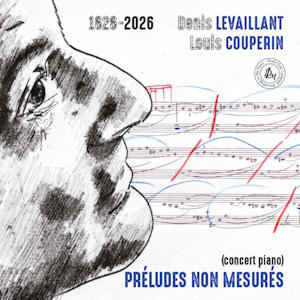
Louis Couperin (1626-1661)
Les préludes non-mesurés
Denis Levaillant (piano)
rec. 2026, studio Paris-Forêt
DLM Éditions 3726 [50]
“To mark the 400th anniversary of Louis Couperin’s birth, Denis Levaillant presents a world premiere: the complete set of Unmeasured Preludes, recorded for the first time on a modern concert grand piano, in Davitt Moroney’s edition.” (The Facebook page of the pianist and composer).
That same announcement includes an extract from a recent review of the above CD from classiquenews.com in which Levaillant’s endeavour is described as “a landmark recording and premier recording, and his playing as the true “interpreter and inventor” of Couperin’s music, praising the freedom and coherence of his approach and the way the modern concert grand reveals the harmonic richness and expressive depth of the Unmeasured Preludes.”
That’s just for openers, but in fact, this is exactly what this CD from French pianist Denis Levaillant consists of, this set of Couperin’s Préludes (non-mesurés) being originally for the lute and being intended to precede the group of musical pieces which follows. In truth, these pieces, while seemingly free-style improvisation, were actually very correctly written down, and as the booklet notes suggest, in many ways anticipate the coming of melodrama. Having said that, and as I hope I can explain, they hardly come across that way. Denis Levaillant, the pianist here, expresses the following in the notes he has written for this edition. ‘Contrary to what one might think at first glance, Couperin’s notation is extremely precise. All the notes are whole notes, but they are all connected to one another.’
In another section of the piece, Levaillant talks about the ‘delight’ that Couperin seems to take in employing a form whereby the startling dissonance of the base notes rings out, something which becomes clear in the first few bars, where we are not quite entering the world we thought we were – “particularly in a few major sevenths which would not seem out of place in a Ravel Prélude or a jazz grid by Bill Evans.”
Unmeasured preludes for harpsichord started appearing around 1650, and Louis Couperin was at the forefront of this new genre. These so-called unmeasured preludes were essentially a long group of notes connected by what were called curves. Later, this idea of unmeasured preludes came to be used by a number of French pianists and composers, among whom was eventually included Rameau.
The first time I listened to these preludes (a little short-changed for listeners, maybe, with only fifty minutes or so of music), my reaction was that they were more like a set of study pieces of the sort that, having to repeat them endlessly, might drive a youthful pianist mad to escape practice for the outside world. However, once I had rid myself of that youthful prejudice, my second listen brought an entirely different reaction. The secret, I think, as in so many pieces of solo piano music, is in playing them at a fairly quiet volume – the whole point being that they are really improvised introductions meant for a lute, which, while purporting to be improvised, are actually fully proscribed and notated. The remarkable thing is that, especially with regard to some of the more avant-garde and atonal, they do at times sound both improvised and, with enough of a flight of fancy, verging on jazz.
They also clearly echo Bach’s Partitas, which is hardly surprising as they could very easily replace or even precede the opening to any of these. Yes, I now find myself enjoying and warming to them. It turns out that in their own way they are just as therapeutic as Bach’s Partitas, and seem to have far more in common with them, than say, Rameau. This is certainly what Denis Levaillant believes: “Today, all pianists play Rameau. Well, it seems to me that the time has come to play Louis Couperin on the piano, for today’s piano lends itself admirably to its interpretation. It even seems that certain sustained notes and legato affects anticipate the tone pedal. The piano’s very rich harmonic structure easily does justice to the writing.”
Producing a CD such as this seems to be a labour of love. Unless I am much mistaken, I cannot see evidence of this material having been presented before in this way, other than as occasional inclusion of one of these preludes in other collections. Therefore, it seems, there is no real way of making a comparison. Nor, as a mere enthusiast of the instrument and long-lapsed pianist, do I feel able to judge any particular piece from another. What I can say is that to me it seems that Denis Levaillant and his record label do as good a job as any of making this music convincing.
The accompanying booklet has a very interesting design, but the fact that it seeks to appear as avant-garde as possible while employing Louis Couperin’s original manuscript graphically throughout can make finding important information such as the name of the record company producing it more difficult than it should be. The pianist manages to explain the music and his intentions well and it is reasonably easy to grasp. The countless curves that cover these manuscripts, he explains, are there not only to emphasise the duration of a note, (most often base notes) but to clearly emphasise the phrasing. Again, there’s that odd contradiction between what sounds as if it should be free playing and the exact way in which Couperin writes it down.
Being unable really to give you more of a guide to each individual music, my main role here must be to guide readers into whether they should buy this CD. Despite any misgivings about its short length – and after all it would probably ruin the impact of the eighteen scattered preludes included here to add something more, as he has recorded all of them here – my answer has to be resoundingly positive. First, it will for most people be as new a repertoire as it is for me and that’s always welcome. Secondly, I have no qualms about Denis Levaillant’s approach to a project which is part worthy and part adventurous, or for that matter his playing, which suits the music perfectly well. Above all, however, it has to be about the music itself. Do we need a recording of Louis Couperin’s harpsichord music played on a modern piano rather than a harpsichord? On this evidence, we certainly do and Le Vaillant’s adventurously languid style which sounds at times as improvised as Couperin intended, gives us something both old and new in the repertoire.
Stephen John Wray Gladwin
Click here for more information about the availability of this recording both as a download and a CD
Contents:
Prélude 9
Prélude 3
Prélude 2
Prélude 6A
Prélude 12B
Prélude 7
Prélude 1A
Prélude 13
Prélude 11
Prélude 5
Prélude 14
Prélude 8
Prélude 10
Prélude 4
Prélude 6B
Prélude 12
Prélude 1B
Prélude 129
Denis Levaillant’s ballet La Petite danseuse de Degas received a Recording of the Year award in 2011 (review)














How were you able to get a copy of this CD?
According to the artist, a CD will be available in the near future from his website.
Thanks for this review, and for giving this fascinating disc some attention, Stephen. I’d heard of ‘unmeasured preludes’ before, but I don’t think I gave it more thought beyond, ‘okay, sometimes baroque composers would write a prelude and leave the note durations up to the former.’ But actually, as you point out, and as Levaillant plays them, that resonates nicely with various currents in 20th-century music: impressionism, jazz, and even aleatoric compositions. I think the playing here is ideal for sounding both faithful to Couperin and edgy enough to make it all sound modern to my ears. So, a great idea, well executed!