
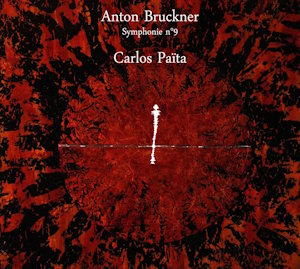
Anton Bruckner (1824-1896)
Symphony No. 9 (1896)
Philharmonic Symphony Orchestra/Carlos Païta
rec. in concert 1992, venue not listed
Le Palais des Dégustateurs PDD043 [51]
On my copy of this, the shrink-wrapping was quite plastered with stickers: “Recommended by Fanfare”; “2026 Nomination, ICMA” (for International Classical Music Awards) and then “Winner ICMA’; a Supersonic award from Pizzicato magazine, and, similarly, a Joker from Crescendo magazine.
Clearly, Le Palais des Dégustateurs, handling the Païta series, is looking to drum up interest, as well it might. Perhaps the powers-that-be realize that a fifty-one-minute timing might put off Brucknerians accustomed to conventional renditions approaching an hour’s duration. At the extreme, Celibidache’s concert performance (EMI) runs a protracted seventy-six minutes, making Païta’s nearly twenty-five minutes shorter: can the score really take such a divergence of tempi and approach?
Well, somewhat. The movement that works best, unexpectedly, is the closing Adagio, even if some of it veers treacherously close to an andante – a yardstick I got from an opera conductor. But there’s enough breadth that the pace rarely feels “fast.” The opening gesture and theme, with the swooping augmented octave, is voiced fervently, though the horns are permitted briefly to obscure the violins. The second theme is very flowing, but it still maintains sufficient weight and tonal intensity. And, at 12:07, Païta actually brings out the third theme’s dance lift: Bruckner does this sort of thing elsewhere, especially in the Seventh Symphony, but I’ve never heard this in the Ninth before.
The short, blazing fanfares and their setups mark off musical paragraphs effectively. There’s the usual problem of the passage at 17:02 prematurely signalling an approaching valedictory – it’s still a way off – but that’s more my problem than the conductor’s or composer’s.
Earlier, there are some good things. The opening attack is nice and clean, although the lower brass are much too loud – or too closely miked – for a pianissimo; full-throated horns make a strong effect at the peak. But the following paragraph keeps moving, and Païta moves it still faster as it proceeds; with the resulting insecurity, the landing on the unison peak is clearly not together. The still-faster tempo for the pizzicato transition, conversely, actually works, and the second theme sings clearly, but becomes thick and sloppy as it proceeds. Similarly, the third group’s expansions become increasingly untidy and approximate.
The Scherzo gets a nice, bracing tempo, not bad in itself, though the woodwind chords sometimes cover the pizzicato themes. Unfortunately, the tuttis are a slapdash mess. Similarly, the Trio goes at a nice, buoyant gallop, but the last paragraph suffers a scrambled onset. In general, neither the conductor’s impulsiveness nor his laissez-faire coordination is helpful in Bruckner; with both in play at the same time, the combination proves fatal.
The brass choir registers with strength and depth in the sonic frame. I’d still like to know the provenance of this pseudonymous-sounding orchestra: Le Palais des Dégustateurs doesn’t even identify the concert venue.
Stephen Francis Vasta
stevedisque.wordpress.com/blog
Availability: Le Palais des Dégustateurs












