
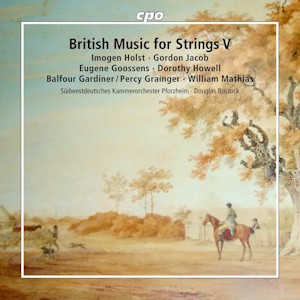
British Music for Strings V
Südwestdeutsches Kammerorchester Pforzheim/Douglas Bostock
rec. 2026, Johanneshaus Niefern-Öschelbronn, Germany
cpo 555 808-2 [70]
The fifth volume in this series strikes me as the most interesting yet. The works concerned vary in date from 1901 to 1964, from Balfour Gardiner to William Mathias, and offer variety in both form and texture. Some, like Imogen Holst’s The Unfortunate Traveller, are in thrall to stylistic models, in her case, very much her father, but others show mature independence of mind. It all adds up to a refreshing and varied programme of pieces that are as good as unknown, at least by me.
Imogen Holst’s brief, four-movement work was a graduation piece and quite clearly predicated on the lines of her father’s A Moorland Suite. It brims with folkloric influence and of the four movements the third, an Interlude, is the most piquant and personal with some rich sonorous writing which would certainly work well for brass band – the original form of the work, which she had to alter to strings to meet the stipulations of her college examinations. If you enjoy a thoroughly unpretentious work that incorporates some genial and well-known folk melodies (Shepherd’s Hey, The Wind Blaws Cold etc), this might well be the work for you. It was edited for performance by Paul Hindmarsh in 2025.
Shortly after Imogen Holst wrote her graduation work, Gordon Jacob composed his Variations on an Air of Henry Purcell, the theme coming from the music to The Double Dealer, followed by eleven variations. They’re not separately tracked here but they can be followed easily enough, so varied are the contrasts between them. It’s a work of genuine fluidity that doesn’t indulge any pastiche baroque procedure but functions by abrupt contrasts of speed and texture. The fourth variation, for example, is a brilliant Presto followed by an expressive Lento, and then an Adagio (Variation 8) follows a jagged, taut fast variation. This work is an unexpected pleasure to encounter.
The Miniature Fantasy of Eugene Goossens was composed when he was still a teenager, in 1911. An online source suggests it should last eight minutes but, in this performance, it lasts twelve. At any rate this was shortly before Goossens became second violin in the Philharmonic Quartet. It’s a fluidly constructed work, rather in the W W Cobbett ‘phantasy’ mould that, like the Jacob variations, has strong internal contrasts and also a little folklike vitality. It’s all very likeable but not yet quite characteristic of the more modernist composer to come. Dorothy Howell is no longer just a name, unlike like her near-contemporary Marie Dare (though Dare is, thankfully being accorded more recordings), but is seen as a valuable figure in British compositional life. Her Two Pieces for Muted Strings date from 1926, by which time she had already been appointed professor of harmony and counterpoint at the Royal Academy of Music. They show her refined, expressive gifts in communicative writing as well as her gifts for dapper wit in the second piece, a Moto Perpetuo.
Balfour Gardiner wrote his Movement for Strings in 1901, originally as a finale for a now lost string quintet, and finished it many years later, in 1936, dedicated to his ‘Frankfurt Gang’ friend, Percy Grainger. It was Grainger who reworked it for string orchestra in 1949. It’s a gracious work, inevitably sounding a little old fashioned in the context of the programme as a whole, but has a certain zest and encodes quietly rousing Wagnerian references. The disc ends with William Mathias’ Prelude, Aria and Finale of 1964, expertly written, excitingly vivid and full of gracious turns of musical phrase – a most successful work deserving of more recordings.
The Southwest German Chamber Orchestra put over this music with a rather greater spirit than they have sometimes mustered in the past, at least in my experience. Partly that may be to do with the level of the compositions. Douglas Bostock is a practised hand in the reclamation of obscure scores such as these and he draws some good playing in the attractive acoustic of the Johanneshaus Niefern-Öschelbronn. Need I add, finally, that Lewis Foreman’s notes are exemplary?
Jonathan Woolf
Contents
Imogen Holst (1907-1984)
The Unfortunate Traveller (1929-30) ed Paul Hindmarsh (2025)
Gordon Jacob (1895-1984)
Variations on an Air of Henry Purcell (1930)
Eugene Goossens (1893-1962)
Miniature Fantasy, Op.2 (1911-12)
Dorothy Howell (1898-1982)
Two Pieces for Muted Strings (1926)
Balfour Gardiner (1877-1950) – Percy Grainger (1882-1964)
Movement for Strings in C minor (1901 rev 1936 rev 1949)
William Mathias (1934-1992)
Prelude, Aria and Finale, Op.25 (1964)
Buying this recording via the link below generates revenue for MWI, which helps the site remain free













