
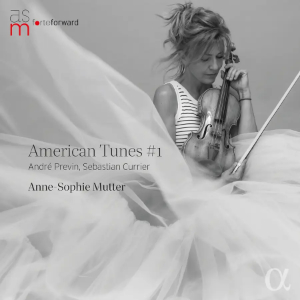
American Tunes #1
André Previn (1929-2019)
Violin Concerto No. 2 (2010)
Sebastian Currier (born 1959)
Ring tone Variations (2010)
André Previn (1929-2019)
Piano Trio (2009)
Anne-Sophie Mutter (violin)
Knut Johannessen (harpsichord)
Roman Patkoló (double bass)
Daniel Müller-Schott (cello), Lambert Orkis (piano)
Mutter’s Virtuosi
rec. 2014, Carnegie Hall, New York City; 2025, Munich, Germany
Alpha Classics 1254 [49]
Violin superstar Anne-Sophie Mutter has done much to encourage and promote contemporary music and the three works on this disc were all written for her. Here, she also proves herself a conductor leading Mutter’s Virtuosi in the Previn concerto.
AndréPrevin was one of the most gifted musicians of the last hundred years: a brilliant conductor, communicator, classical pianist, jazz pianist, and composer. His early years in Hollywood saw him composing and arranging many works for film and jazz, but this lessened from the mid-sixties when his conducting career took off.
One line which goes through his output were concertos. There was a cello concerto written in the early sixties which although unpublished can be found in two versions on YouTube. There was also a violin concerto from 1969 which has never seen the light of day. I do wonder what Previn thought was wrong with the works to hide them, as the cello concerto is rather fine. From the 1970s onwards, he gradually composed more with some notable works such as his Guitar Concerto written in 1971 for John Williams and his Piano Concerto written in 1985 for Vladimir Ashkenazy. The latter is a gem, and I have never understood why it is seldom played; I think André Watts, in the early 2000s, was the only other pianist to take it up.
It was from the beginning of this century, when Previn took on fewer music director posts and had fewer family commitments – he had ten children – that he really began composing in earnest with one or two works appearing each year, ranging from grand opera to chamber works and more concertos, which by the end of his life numbered about a dozen. These included double concertos for, violin and double bass, violin and cello, violin and viola, a second one for cello, one for harp and a triple concerto for trumpet, horn and tuba. He liked concertos – he wrote two for Anne Sophie Mutter; the first was a forty-minute, Straussian love song subtitled “Anne-Sophie” written the year before they married – she was his fifth wife from 2002-2006 (review), and this very different chamber sized work in 2010.
Mutter says in the booklet notes, “André brought together the legacy of European composers – Richard Strauss, the French, everything he grew up with – and the sharpness of American rhythms.” This can certainly be heard in this concerto where crunchy jazz harmonies are placed alongside jagged, sometimes quite savage rhythms and abrupt changes of mood. But this is all ameliorated with an overarching romantic lyricism. This grows out of the key motif a rising B, E, C which holds the work together and which Previn rigorously interrogates throughout the concerto. There is something Korngold-like about; indeed, it is not too dissimilar to the A, D, A motif which opens that composer’s Violin Concerto.
This work was written for a concert with the Trondheim Soloists which also included Vivaldi’s Four Seasons. Being Baroque, that work includes a harpsichord continuo player who plays throughout, supporting and filling in the harmonies, so there was already a harpsichordist available, but rather than incorporate it into the work in a Baroque fashion, Previn gives the player two solos in between the three movements. Maybe Previn did not like harpsichord continuo? Whatever the reason, it is very odd and the two interludes, even though they are based on material from the whole work, have the effect of stopping the flow of what is otherwise a tightly structured piece. The interludes could easily be dispensed with, and it would not affect the concerto.
The three remaining movements are, as I said, tightly constructed from material heard at the outset. An opening flourish gives way to the aforementioned romantic material. Previn does a remarkable job of developing the material in ways which are ingenious yet entertaining and comprehensible. Previn gives the soloist many challenges both technical and musical, to all of which Ms Mutter rises with understated brilliance. There is some beautiful writing for the soloist with solo cello in which Maximilian Hornung is the perfect partner.
By the time of this work, Previn had been composing for orchestra for almost seventy years and the writing for ensemble is flawless. Looking at the score, it is fascinating to see how he achieves so much with so little; there is, for instance, almost no subdivision of the string parts. It is a surprising and entertaining work which I would say was beautifully put together were it not for the two weirdly jarring harpsichord solos. Ms Mutter fluently directs Mutter’s Virtuosi, her handpicked ensemble of scholars from her Foundation. This can have been no easy task, as the work has many quixotic changes of mood and tempo, all of which are delivered seamlessly.
Sebastian Currier is a multi-award -winning American composer, who has had a long association with Ms Mutter; his 2007 violin concerto Time Machines was written for her. Ringtone Variations was written for her and her protégé Roman Patkoló, the same duo who premiered Previn’s Concerto for Violin, and Double Bass in 2007.
Ringtones are the bane of modern concert performance but here the composer muses that “Ringtone Variations might be one of the only pieces where the occasional ringer left on would fit right in with the music unfolding on stage!” It is a very clever work in which the composer makes the most of the unlikely bedfellows. The double bass often plays in its upper register either in natural tones high on the strings or in harmonics and Roman Patkoló is fearless in approaching the demands of the work. Ms Mutter is also called upon to Paganiniesque heights of virtuosity – but even with two such amazing musicians, I found the twelve minutes or so of the work’s fragmented utterings too much. The more lyrical writing in the third movement was appreciated but for me it was too little too late.
The disc ends with Previn’s Piano Trio No.1which Mutter, Previn, and Lynn Harrell, premiered at Carnegie Hall. Here Mutter is joined by her frequent collaborator Lambert Orkis and cellist Daniel Müller-Schott, who in 2012 had joined Mutter and Previn for the London premiere of the work.
It is diverting and concise with the two outer fast movements being full of infectious dance rhythms and sly hints of Tin Pan Alley. The central slow movement allows the two string instruments to sing in long lyrical lines and just stays on the right side of sentimentality. For some reason, while listening, images of Charlie Chaplin’s little tramp character popped into my head. In design it reminded me somewhat of the composer’s Tango, Song, and Dance which he and Mutter premiered in 2001. The three musicians are completely in tune with each other and the performance is surely definitive.
This is a disc of music making by wonderful musicians but is only 49 minutes long, so I cannot but help feel short-changed. There are any number of other works by Previn and Currier, some associated with Ms Mutter, that could have filled the disc.
The packaging is most flamboyant. A sturdy triptych fold-out case with a base colour of brilliant red is adorned with glamorous photos of Ms Mutter. The liner notes by Bernard Neuhoff are informative and a little playful; they come in a paper booklet with many apposite photographs and fit ingeniously into the case.
Paul RW Jackson
Buying this recording via the link below generates revenue for MWI, which helps the site remain free













