
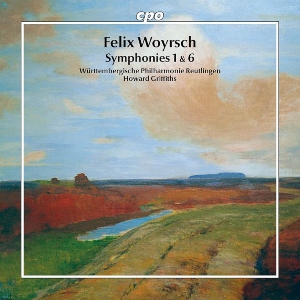
Felix Woyrsch (1860-1944)
Symphony No.1 in C minor op.52 (1907)
Symphony No.6 in C major op.77 “Sinfonia Sacra” (1939)
Württembergische Philharmonie Reutlingen/Howard Griffiths
rec. 2023, Reutlingen, Germany
cpo 555 628-2 [56]
I last encountered the orchestral music of Felix Woyrsch when I wrote about his Fourth Symphony and Fifth Symphony (review). I was not at all impressed by his lack of a melodic gift, and by what I heard as his reluctance to allow such themes as he invented any chance to have an effect before they were transmogrified.
Woyrsch, a self-taught composer, commented that his teachers were the very best: counterpoint with Palestrina, composition with Beethoven, Mozart and Haydn, instrumentation with Berlioz, and “dear old German folksong”. He had a varied and influential musical life. He was the director of various vocal societies in the city of Altona, now part of Hamburg, and organist at the Fredenskirche. He also guest-conducted the Hamburg City Orchestra. It was only with the advent of the Nazis that his influence waned as the musical structure of the towns in the region was reorganised. He retired in 1933.
A prominent critic and proponent of Nazi musical ideals named Heinz Fuhrmann wrote of Woyrsch’s “blood related traits of mystical devout internalisation”. Make of that what you will, especially since Woyrsch’s father was a former Prussian army officer from the Silesian nobility and his mother came from a Dresden family of actors. There is no hint of Jewish ancestry. Typical of the fluid nature of international borders in Central Europe, he was born in Austrian Silesia in a town that is now in the Czech Republic.
By far the more interesting work here is the Sixth Symphony “Sinfonia Sacra”. The first movement, the Sanctus, begins with the strings only; according to the booklet, they “float harmonically in a manner reminiscent of late Wagner or Bruckner”. Unfortunately, this strikingly beautiful opening lasts eight bars, and is superseded by block-sounding brass chords. The chords become repeatedly changed from bar to bar, arising from the sort of compositional technique that irritated me in the Symphonies No.4-5. I will confess, though, that the opening theme does reappear occasionally.
Via Crucis, the eight-minute second movement, is a series of fourteen brief variations representing the Way of the Cross. No doubt the compositional technique on display is a tribute to Woyrsch’s self-taught skills, but the strength of the thematic content is sadly lacking. By strength, I mean anything even remotely memorable for the listener to latch their memory onto.
The third and last movement is the Gloria. To quote the booklet: “Here again the main theme is highly contrasting, characterised by the alternation of tutti chords, surging string figures and fugato sections.” Again, I would have liked less compositional agility and more concentration on giving the listener something to remember.
Woyrsch was an experienced composer when he wrote the four-movement First Symphony, with over forty pieces in his catalogue. We encounter his compositional traits immediately – block-like themes composed of short, strongly rhythmic motifs. So, he can hardly be classified as following in the footsteps of Brahms or Wagner. The last movement is the longest at thirteen minutes. Woyrsch assigns four tempo markings to apply in succession: very slow – very agitated – moderately animated, not dragging.
The voluminous booklet notes describe the entire work as a ”finale symphony”. This raised some hope in me: that I would be hearing a last movement that went out with all guns blazing. To an extent, Woyrsch obliges. We are allowed to experience the opening trumpet fanfare motif reappear in the coda, making an effective apotheosis when the full orchestra joins in. Frankly, this last movement is the only part of the work that I have felt inclined to subject to repeated hearings. Even the slow movement is melodically undistinguished, and the presence of Volkslied elsewhere does not really lift the work, for me at least.
The performances seem to me to be entirely praiseworthy. The Württembergische Philharmonie Reutlingen responds ably to Howard Griffiths’s committed direction. cpo have recorded the orchestra in what sounds to be a really good concert-hall acoustic, and so have produced a technically excellent-sounding disc. The exhaustive booklet notes in German and English include a history of the orchestra and brief biographical details for Howard Griffiths.
Jim Westhead













