
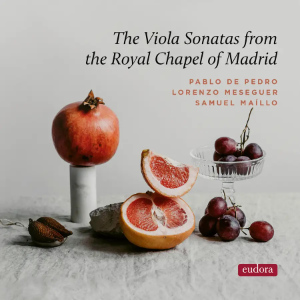
The Viola Sonatas from the Royal Chapel of Madrid
Pablo de Pedro Cano (viola),
Lorenzo Meseguer (cello), Samuel Maíllo (harpsichord)
rec. 2022, Auditorio de San Francisco, Ávila, Spain
Reviewed as a download
Eudora EUDSACD2601 SACD [85]
Over many years of reviewing, only a few discs with music for viola have landed on my desk. If such discs are released, they mostly include repertoire from the period that followed the era we use to call ‘Baroque’. During the Baroque period the viola played its part in the instrumental ensemble, but could also be omitted; quite a number of concertos were scored for a solo instrument, two violins and basso continuo. In the post-Baroque period, the viola was gradually emancipated from its relatively subordinate role. During the second half of the 18th century, it became part of quartets, scored for strings or for a wind or keyboard instrument with string trio. At the same time separate string trios were written as well as duos for violin and viola. Among the latter are those by Mozart. However, sonatas for viola from this period are rare. From that perspective the album that is the subject of this review is of great importance.
That is also due to the fact that it focuses on music written in Spain. Spanish music from the classical period is little-known anyway (apart from the oeuvre of Luigi Boccherini), and this explains why most of the composers in the programme are largely unknown quantities. The main exception is Gaetano Brunetti; in recent years recordings of symphonies and chamber music of his pen have been released. He was of Italian descent: his presence in Spain testifies to the growing influence of the Italian style in Spain in the course of the 18th century. Among the native composers José Lidon is relatively well-known, but Felipe de Los Ríos and Juan Balado don’t have an entry in New Grove.
The sonatas in the programme have one thing in common: they were intended as audition pieces. During the reign of Charles III and Charles IV vacant positions in the Royal Chapel were filled after a procedure during which applicants were tested in three stages. First, a candidate had to play a piece of his own choice. The second stage consisted of a sight-reading performance of a piece selected by the examiners and written for the occasion by one of them. A candidate had just four to five minutes to have a look at the score. “Intonation, strength of sound, sense of rhythm, accuracy in sight-reading, and playing ‘with taste’ or ‘with style’ were all closely observed by the examination board. Above all, it was important to blend within the ensemble, showing the ability to accompany voices or an instrumental group in the third exercise.”
The origin of these sonatas explains why they are technically challenging. Almost every movement includes passages with double stopping. The Sonata in C by Felipe de Los Ríos even opens with such an episode. This is the earliest work in the programme, which is ordered chronologically. This sonata dates from 1778, the Sonatas in D and G both from 1781. Los Ríos was from Seville and settled in Madrid in 1766. He was educated at the violin and a child prodigy; at the age of 14 he auditioned for a place as violinist at the Royal Chapel. He did not succeed, but was appointed as such in 1771. The three sonatas included here are in three movements; the last is, as was so often the case in the second half of the 18th century, a rondo. In the Sonata in D, this movement has the character of a Kehraus. The Sonata in G unusually opens with a set of variations. One of them is dominated by double stopping from start to finish. Another variation explores the viola’s highest register. The sonata ends with a rondo which is powerful, with many forte passages.
Brunetti was born in 1744 in Fano, a city on the Adriatic coast, which was then under the sovereignty of the Papal States. In 1760 at the latest he moved to Spain with his parents, and in 1767 he entered the service of the Royal Chapel as violinist. In 1770 he was appointed violin teacher of the Prince of Asturias, the future King Charles IV. In this position he was responsible for the composition of music which was to be played at the gatherings of his employer’s academies, but also the selection of the repertoire and the musicians to play it. In 1789 Charles was crowned King, and Brunetti was given the post of musician of the Royal Chamber. In 1796 he was made music master of the Royal Chamber. His Sonata in D dates from 1789 and has three movements, the latter of which is a rondeau. In the opening movement the viola quickly moves upwards and downwards. There is double stopping everywhere.
All the remaining pieces in the programme are in two movements: a relatively short slow movement, followed by a longer one in fast tempo. No fewer than five sonatas are by Juan Oliver y Astorga. He was from Yecla in the province of Murcia, and was educated as a violinist. In this capacity he performed in several places across Europe. He may be the same composer who under the name of Jean Oliver Astorga published six violin sonatas Op. 1 in London in 1767, followed by two other collections of music. In 1776 he was appointed violinist at the Royal Chapel in Madrid. In the programme the first group of four sonatas open and close with sonatas in C. The first, dating from 1803, opens with a powerful adagio, which has an improvisatory character. Notable is the harmonic tension, especially in the first half of the movement. The second movement lives up to its character indication: allegro brillante. The slow movements of the next three sonatas are rather short; the adagio from the Sonata in G is little more than the slow introduction to the ensuing presto. This sonata and the next, in F minor, date from 1804, whereas the second Sonata in C is from 1805. The Sonata in E flat from 1807 explores both the higher and the lower register in its second movement, which also includes a number of chords. Its end is especially brilliant.
Chords, played forte, are also part of the second movement, called allegro brillante, of the Sonata in D from 1806 by José Lidon. The first movement, larguetto cantabile, closes with a cadenza. Lidón was educated as an organist, and in this capacity, he was appointed at the Royal Chapel in 1768. In 1788 he was promoted to vice-master and in 1805 to master of the chapel. His oeuvre consists of keyboard music, works for the stage and a few chamber music works, among them the sonata included here.
The programme closes with the Sonata in C by Juan Balado, who was a violinist in the chapel of the Des calzas Reales monastery. In 1804 he entered the Royal Chapel; after a while he was promoted to first violinist. Only a few pieces of his pen have been preserved. The Sonata in C, dating from around 1818, opens with an expressive adagio, which is followed by a sparkling rondo with the indication allegretto. It is a fitting end to an interesting and musically compelling programme.
As I already mentioned, this is an important album because of the scoring for viola and the fact that all the pieces are from the Spanish classical period. To that I would add that these works are technically demanding, reflecting the emancipation of the viola and showing what it is capable of and what was required from violists. Fortunately, these are not mere demonstrations of technical prowess; all these pieces are very well-written and musically interesting. I have really enjoyed this recording, thanks to the music, but also the animated and stylistically convincing way the sonatas are interpreted by Pablo de Predo, who plays in several orchestras, such as the Concentus musicus Wien and Europa Galante. The choice of tempi is always spot-on, bringing out the contrasts between the various movements. His performances are also dynamically differentiated. He has excellent support from Lorenzo Meseguer and Samuel Maíllo.
One does not need to be a viola aficionado to enjoy this disc.
Johan van Veen
http://www.musica-dei-donum.org
https://twitter.com/johanvanveen
https://bsky.app/profile/musicadeidonum.bsky.social
Buying this recording via the link below generates revenue for MWI, which helps the site remain free
Contents
Felipe de Los Ríos (1754-1801)
Sonata in C (1778)
Sonata in D (1781)
Sonata in G (1781)
Gaetano Brunetti (1744-1798)
Sonata in D (1789)
Juan Oliver y Astorga (1733-1830)
Sonata in C (1803)
Sonata in G (1804)
Sonata in F minor (1804)
Sonata in C (1805)
José Lidón (1748-1827)
Sonata in D (1806)
Juan Oliver y Astorga
Sonata in E flat (1807)
Juan Balado (?-1832)
Sonata in C (c1818)













