
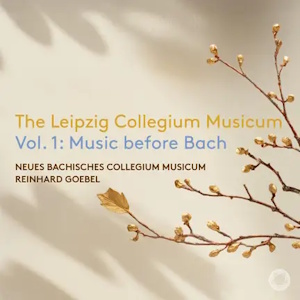
The Leipzig Collegium Musicum Volume 1: Music Before Bach
Neues Bachisches Collegium Musicum Leipzig/Reinhard Goebel
rec. 2024, Paul-Gerhardt-Kirche, Leipzig, Germany
Reviewed as lossless download
Pentatone PTC5187592 [65]
The Leipzig Collegium Musicum is famous for its association with Telemann and then Bach, and for its venue in the coffeehouse Café Zimmermann. In this first release in a projected series, the vastly experienced early music specialist Reinhard Goebel has produced what he describes in the booklet as “a something like this program”. The uncertainty derives from the almost complete lack of documentary evidence about much of the music played at the Leipzig Collegium Musicum, especially before Bach’s time. Hence, the programme consists of composers with an association to Leipzig in the decades before JSB’s arrival … and Johann Beer, who seems to have no connection to Leipzig, and nor is there any explanation in the notes as to the reason for his inclusion.
Goebel’s comment on Johann Beer – “of whom one would gladly possess far fewer novels and far more musical works” – had me scurrying for Google. It turns out that Beer, who I’d never heard of, was better known as a writer of satirical novels than composer. Goebel also says, rather less flatteringly, that “a certain foursquare rigidity cannot be concealed” in Beer’s music, and while the Ouverture presented here is pleasant, it is indeed rather stolid.
Goebel also applies the foursquare description to Heinichen’s Ouverture, and here I must disagree. Yes, it is not quite at the level of the Heinichen’s Dresden concerti presented by the very same Reinhard Goebel back in the 1990s (Archiv – review), but that album didn’t win a Gramophone award for nothing. It’s my opinion that Heinichen is the most under-appreciated composer of the Baroque era. The booklet claims that the Ouverture is gaining its first recording here, but in fact, it was recorded for the Passacaille label back in 2003 (PAS921). Goebel’s slower tempos work better than the Passacaille version, which does seem very rushed in places.
The recorder is not an instrument for which I have any great affection, no matter how well played or written for, so I didn’t expect the Fasch and Graupner concertos to be among the highlights of the album. However, I must admit to quite enjoying them, the Fasch in particular, and the slow movement of the Graupner with plucked strings accompaniment was delightful. Nevertheless, it was good that each was shorter than ten minutes.
Georg Hoffmann is not a well-known name, and while there are a few vocal works listed by Presto, this would appear to be the first instrumental work of his that has been recorded. While it is described as a concerto for horn and two oboes, it is unusually constructed, with the oboes not having any solo role in the first two movements, the horn resting in the third, and it is only in the finale that all three instruments play together. It also sounds the oldest of the six works on the programme. While it is interesting, one could really only describe it as pleasant listening.
It’s unlikely to surprise anyone that the best work on the programme is the Telemann, bursting with life and invention. Had this been a real concert at the Collegium, the audience would have gone home with a smile on its face.
If you are a reader of the BBC Music magazine, then you may have noticed that this recording was one of the July issue’s Records of the Month. What is rather curious is that it is the Choral section in which it has been nominated, but you will have noticed that I have not mentioned any singing, for the good reason that there are no choral works on this release.
The Neues Bachisches Collegium Musicum Leipzig was founded in 1979 from members of the Leipzig Gewandhaus Orchester. That practice continues to this day, and since 2013, the ensemble has had no permanent artistic director. The playing is, as you would expect, very fine, as is the sound quality. I think the best word to describe the booklet notes is idiosyncratic, as you may have detected from the couple of quotes I have used.
This is an interesting start to the series, and I would hope that once we get to the Bach years, the selections are equally diverse, rather than concentrating on JSB’s masterpieces.
David Barker
Buying this recording via the link below generates revenue for MWI, which helps the site remain free
Contents
Johann Beer (1655-1700)
Ouverture for Strings and Basso Continuo in D Major
Johann David Heinichen (1683-1729)
Ouverture for 2 Oboes, Strings and Basso Continuo in G Major, S.205
Johann Friedrich Fasch (1688-1758)
Concerto for Recorder, Strings and Basso Continuo in F Major
Georg Melchior Hoffmann (1679-1715)
Concerto for Horn, 2 Oboes, Strings and Basso Continuo in E Flat Major
Christoph Graupner (1683-1760)
Concerto for Recorder, Strings and Basso Continuo in F Major, GWV 323
Georg Philipp Telemann (1681-1767)
Concerto for 3 Oboes, 3 Violins and Basso Continuo in B Flat Major, TWV 44:43
Soloists
Susanne Wettemann, Amanda Tauriņa, Inmaculada Veses (oboe)
Max Volbers (recorder)
Clemens Röger (horn)
Elisabeth Dingstad, Karl Heinrich Niebuhr, Tobias Haupt (violin)
First recordings: Beer, Hoffmann













