
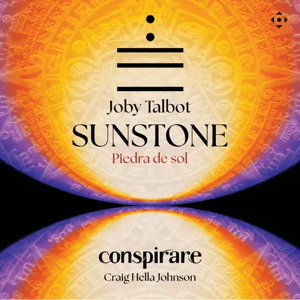
Joby Talbot (b. 1971)
Sunstone (Piedra de sol) (2026)
Thomas Burritt (marimba), Conspirare / Craig Hella Johnson
rec. 2026, Evans Auditorium and Harlan Studios, USA
Spanish text and English translation included
Divine Art DDX21150 [71]
I was keen to review this recording of Joby Talbot’s new choral work because in 2017 I encountered for the first time his Path of Miracles (2005) when I reviewed the reissue of the 2005 recording by Nigel Short and Tenebrae, who commissioned the work. At the time, I said this of Path of Miracles: “[it is] a truly astonishing composition. I would go so far as to say it’s inspired”. As it happens, Conspirare and Craig Hella Johnson also recorded the score, in 2014, but I’ve not heard their version (review). If I read the booklet correctly, Sunstone (Piedra de sol) was co-commissioned for Conspirare and the BBC Singers. I read on the composer’s website that the premiere was given on 23 January 2016 and a few days later Conspirare made this recording (26-29 January) in the Evans Auditorium, which I believe is part of Texas State University; there appears to have been a follow-up session two months later in Harlan Studios
The text that Joby Talbot has set is the long poem Piedra de sol written in 1957 by the Mexican poet, Octavio Paz (1914-1998). In fact, Talbot tells us in the booklet that he selected the verses which would be most suitable for massed voices; as a result, he’s set about two-thirds of Paz’s poem. He set it in the original Spanish; this, I believe, is his first choral work in a language other than English. Though I’m not a Spanish speaker myself, I thought the results sounded very convincing.
Paz’s poem may be unfamiliar to some readers; it was to me. Let me, therefore, give a bit of background for which I draw on the very informative booklet essay on the poem by Adela Pineda Franco of the University of Texas at Austin. Ms Franco writes thus: ‘Drawing on the symbolism of the Aztec calendar stone housed at the National Museum of Anthropology, Piedra de sol employs the techniques of modern poetry, particularly surrealist imagery, to meditate on cyclical time and the possibility of breaking its grip through poetry and love’. I have to say that I found it very difficult to comprehend Paz’s poem, so rich and complex is the imagery; other readers, more attuned to modern poetry, may fare better. Divine Art give us the full text that Talbot has set and they have presented it in a way which I found very helpful; the English translation of each line of poetry is printed immediately below the corresponding line in Spanish. Ideally, I would have liked a larger font but, to be fair, there’s an awful lot of text to fit in; as it is, the text and translations occupy a full nine pages. I ought to warn listeners that if you follow the text it’s dangerous to look away, even briefly; though the singers’ diction is very clear, this is a text-rich piece, often moving at pace, and if you lose your place it’s not always easy to get back on board.
Piedra de sol plays continuously, though, as we shall see, there are short gaps every so often. The work is divided into three sections: ‘Creation’ (tracks 1-8); ‘Despair’ (tracks 9 to 13); and ‘Salvation’ (tracks 14 to 19). There are very short pauses between most of the tracks – usually only a couple of seconds in duration – and these are helpful in letting the listener get his/her bearings.
I’m not sure whether or not to call Piedra de sol an a cappella work because an instrument is also involved. This is a marimba, but I wouldn’t say that this “accompanies” the singers in the way that, say, a piano might do. Rather, the instrument is used to add colour. Very often its contributions are so discreet that the listener can’t be sure it’s involved and, indeed, there are whole sections, especially in ‘Despair’, where I don’t think the marimba plays at all. For all the discretion of much of the writing for the marimba it definitely adds interesting colours and sonorities; Thomas Burritt’s subtle, nuanced playing contributes significantly to the overall effect and impact made by the work. The marimba part is a vital cog in the wheel but I’m going to stick my neck out and say that, to all intents and purposes, in conventional terms the singers are unaccompanied. This, I think, makes the achievement of the members of Conspirare all the more impressive.
In this performance we hear twenty-five singers (7 /5/5/8). They are all professional singers and, my goodness, this is a work which needs professional voices. The demands made on the performers must be prodigious but this gifted team give a terrific performance. One must acknowledge that the recording was made in studio conditions with opportunities for retakes but, remember, Conspirare had performed the work live just a few days before taking it into the studio. I’ve experienced their work on disc before, so I wasn’t surprised by this level of virtuosity. I should say one important thing about the music with which Joby Talbot has challenged them. The score is a searching example of individual and collective vocal technique but every single note in Piedra de sol – and there are an awful lot of them – is sung. To the best of my recollection, there are no instances of the use of extended techniques, requiring the singers to speak, shout, make strange noises etc. Though the score goes through a wide range of emotions – and some of the music in ‘Despair’ is dark and dramatic – this is, fundamentally, a work of musical beauty. Intonation seems flawless throughout and rhythms are precisely articulated.
I’m not going to describe the work in detail; that would be a long and self-defeating task – and I might miss out something important. However, what I will say is that in the first section, ‘Creation’, Talbot’s music is often rich in texture and warm in its harmonies. The textures range from very full and deep to places where a single voice emerges against (usually) a subdued background provided by colleagues. In the central section, ‘Despair’, the music is, as I’ve already said, darker and more dramatic in tone. In this section, track 14 especially caught my attention. For the most part the solo passages in the work are fairly brief but in this particular part of the score we hear an extended and very passionate solo delivered by one of the female singers (from 4:20). The soloist’s voice has a rich, mezzo-ish tinge to it; were we experiencing Portuguese music, I might suggest that the solo is reminiscent of Fado. Like every other solo contribution in this performance, this solo is marvellously delivered. The final part of the work, ‘Salvation’ sees a return to the warm harmonies and textures of ‘Creation’. Here again, I should singe out an ear-catching episode; in track 17 there’s a soprano solo which sounds as if the singer has been placed at a distance from her colleagues who support her with discreet foreground singing. The effect is very lovely. As Piedra de sol moves to its conclusion a wonderful key change takes us into the final episode (tr 19); the new major key enhances the warmth and ecstasy of the music. The work appears to be heading for a strong, affirmative conclusion but then, in a score peppered with surprises, Talbot has one more unexpected gesture up his sleeve: there’s an abrupt cut-off, after which Piedra de sol achieves a soft, luminous ending.
I haven’t begun to do justice to this exciting, inventive score but I can console myself that I’ve largely left the door open for other listeners to discover it for themselves. Talbot displays a high degree of musical imagination throughout and I hope that anyone who listens to it will be as fascinated as I’ve been.
The performance by Conspirare is superb. Clearly, the singers have been thoroughly prepared by Craig Hella Johnson, not just technically but also interpretatively. I’m in awe of the standard of accomplishment that’s on display here. Producer/engineer Randall Squires has captured the performers in excellent sound; there’s a wide dynamic range, which complements the range of Talbot’s music, and excellent definition. Yet, though Squires has recorded the performance very clearly, he’s also done justice to the soft, mysterious passages, such as those which occur towards the end of ‘Despair’ (tracks 12 & 13).
Right now, I don’t think I have yet assimilated Piedra de sol in the same way that I did with Path of Miracles. I’m certain that’s nothing to do with the quality of music and invention in the respective works; it’s entirely because I find the texts of Path of Miracles much easier to grasp. That said, I see that in 2017 when reviewing the Tenebrae recording of Path of Miracles, I said this: “Anyone who cares about contemporary choral music should hasten to hear this wonderful score”. I can say nothing less of Piedra de sol.
Buying this recording via the link below generates revenue for MWI, which helps the site remain free













