
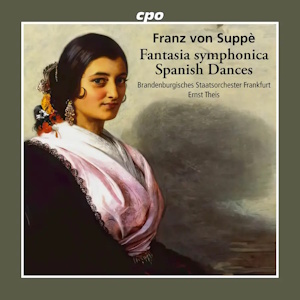
Franz von Suppè (1819-1895)
Fantasia symphonica in A major (1860)
Spanish dances I La Valenciana (?)
Spanish dances II La Granadina (?)
Brandenburgisches Staatsorchester Frankfurt/Ernst Theis
rec. 2023, Konzerthalle “Carl Philipp Emanuel Bach”, Frankfurt (Oder), Germany
cpo555 573-2 [52]
You would need a very long memory indeed to recall my MusicWeb review more than 16 years ago, in which I considered a recording, released on the Alto label, of Rachmaninoff’s first symphony. In the course of it, I pointed out that its producers had erred in referring to the composer as Rachmaninov, for, once he had left Russia for the West and abandoned Cyrillic lettering in his day-to-day life, he himself had adopted the French spelling Rachmaninoff. That was demonstrated in his personal signature, in his application for a US passport and, indeed, on his gravestone. When, a few years later, I had the temerity to point out those facts to The Times, I was grandly chastised in print, de haut en bas, on the grounds that its journalists’ style guide insists on that final letter v. You can, therefore, easily imagine the great glee with which I have, in subsequent years, spotted several instances of the ff variant gracing even the newspaper’s august pages.
I only recall that story because, as our more observant readers will have already noticed, this cpo release renames the hitherto familiar composer Franz von Suppé as Franz von Suppè. While the accompanying booklet essay simply takes the change for granted and offers no further explanation, a little internet research reveals a somewhat confused background story. It appears that the use of acute and grave accents in the Italian language was still in a state of flux in the 19th century. Thus, while the composer’s 1819 birth had been registered in the entirely accent-less form von Suppe, he regularly signed himself as an adult as von Suppè, while his 1895 gravestone memorialises him as von Suppé. As a courtesy to the producers of this new disc, I will use their own preferred spelling in the course of this review. Yet I am afraid that I simply cannot get as wound up about this one as I still do about Rachmaninoff, so I certainly will not be risking another public slap-down from The Times.
As regular MusicWeb readers may already know, there has been something of a revival of interest in von Suppè’s music in recent years. Some of that has been evidenced on disc by several Naxos releases conducted by the enterprising Dario Salvi. Those have included such long-forgotten works as Die Reise um die Erde in 80 Tagen and the incidental music to a play based on the life of Mozart. Naxos continued its von Suppé (as that company chooses to spell it) crusade a few months ago when it released Ola Rudner and the Tonkünstler-Orchester’s world premiere recordings of the overture to the snappily-named Historisch-Additionelle Austellung des Carl-Theaters (1873?) and the much more historically important Fantasia symphonica of 1859 (Naxos 8.574538). The latter, making extensive use of themes taken from compositions by amateur aristocratic composer Duke Ernst II of Saxe-Coburg and Gotha, had actually been rediscovered in Austrian archives by Maestro Rudner himself. Its significance as a major find, adding a whole new dimension to our appreciation of von Suppè’s oeuvre, is indicated by the fact that a second recording has now appeared so quickly in its wake.
Oddly enough, it is not only the spelling of the composer’s name where the two releases differ. While the author of cpo’s notes, Jan Michael Horstmann, quotes from what is said to be a contemporary review of a performance given on 18 March 1860, Naxos’s booklet essay, penned by Robert Ignatius Letellier, states categorically that the Fantasia symphonica had “never [been] heard” before Rudner made his recording in 2022. That contradiction may perhaps be explained by the fact that there are apparently two surviving versions of the score, one somewhat shorter and smaller in scale than the other. Putting that issue to one side, we can certainly acknowledge that Rudner’s and, now, Ernst Theis’s performances of the Fantasia symphonica are, regardless of their origin, the first and second to have ever been recorded.
While the two booklet authors may disagree on the piece’s history, they are virtually as one in their assessments of what it actually is. Mr Letellier nails his colours firmly to the mast: Ola Rudner, he informs us, was aware that that “Suppé had written a lost symphony… [and] after a long search he found the Fantasia symphonica. The manuscript turned out to be the missing symphony”. And while Mr Horstmann is not so categorical – simply preferring to declare, somewhat obliquely, that the work “shows that [von Suppè] is a magnificent symphonist” – he quotes, with no apparent reservations, the aforementioned 1860 review that unambiguously refers to the work as a symphony.
Whether a true symphony or merely a “symphonic” piece of music, the Fantasia symphonica is constructed in four movements. The first opens in grand, declamatory adagio non troppo fashion before von Suppè introduces an energetic, flowing allegro con spirit melody, somewhat reminiscent of Mendelssohn, that, in various guises, propels it dramatically along to its conclusion at 11:41. After a more refined, elegant introduction, the concisely crafted (5:53) second movement, marked andante con moto, incorporates a livelier section – that brings to mind the familiar style of von Suppè’s theatrical overtures – and a few moments of heavier drama. It is followed by a tantalisingly brief (3:40) allegro scherzoso – once again, a delightfully tuneful concoction – before the arrival of a much more substantial (9:37) allegro ma non troppo finale. Occasional hints of Mendelssohn are even more apparent at this point, but, in spite of the odd relaxed moment, in general this is a movement characterised by propulsive drive delivered all the way to its concluding pages. There, bolstered by a battery of extra triangles, side drums, bass drums and even a tam-tam, the piece comes to a hugely enjoyable, over-the-top conclusion.
Entirely delightful though such moments are – and there are plenty of them – we are dealing here, of course, with a work that was, until just a couple of years ago, completely unfamiliar to modern ears. The rest of the composer’s output offers no familiar road map. There is, moreover, no tradition of live performance, and there is only one other recorded account of the piece. Consequently, classical music enthusiasts, musicologists and even conductors have only the rediscovered score itself as a vade mecum. Interestingly enough, even though this new account is only the second performance to have been set down on disc, it adopts an approach to the piece distinctively different from that of its pioneering predecessor. Its most substantial movements, the first and last, are taken more slowly than in Rudner’s performances. For instance, Theis adds almost a full minute to the length of the first. Both central movements are, conversely, taken at a brisker trot. Thus, Theis’s andante con moto shaves almost two full minutes off Rudner’s timing: con moto, indeed! Similarly, he makes up a few more seconds in the third movement. The overall effect of such differences is to add a greater degree of light and shade to the piece.
The remainder of the cpo disc is filled with two sets of Spanish dances. Like many other 19th century composers – Glinka, Rimsky-Korsakov, Lalo, Bizet, Chabrier, Minkus and Moszkowski, to name just a handful – von Suppè utilised such musical clichés as stomping rhythms and colourful orchestration to create pastiche, yet instantly recognisable, “Spanish” pieces. Even so, overshadowed in that crowded field, his two sets fell into such obscurity that the very date of their composition is now unknown. The first, La Valencia, is made up of five individual pieces, while the second, La Granadina, offers a further seven. The longest of the 12 dances comes in at just 2:36, while a full nine of them are less than two minutes long.
Essayist Mr Horstmann argues that the pieces were not really intended for dancing at all. He suggests instead that these were simply two orchestral suites designed for concert performance. Whatever the case, the music is certainly invariably danceable. Indeed, if you listen to the likes of track 5 (La Valenciana;I. allegro), 8 (La Valenciana; IV. allegro non troppo) or 12 (La Granadina; III. boleras), you will hear ear-worm, foot-tapping melodies that might easily have come from such mid-19th century Spanish-themed ballets as Paquita or Don Quixote. Von Suppè, a true man of the theatre, wrote plenty of dance sequences or interludes for insertion into operettas and other works. It would be good to hear more of the unfamiliar ones – a future project for the ever-enterprising musical archaeologist Dario Salvi, perhaps? Von Suppè, however, seems never to have written a full-length score for dancers. Pace Mr Horstmann, these Spanish dances suggest that, had he chosen to do so, he would probably have made an excellent job of it.
All this little-known repertoire is performed with skill and self-evident enthusiasm by the Brandenburgisches Staatsorchester Frankfurt under conductor Ernst Theis. A few years ago, I was mightily impressed by a couple of CDs in which Mr Theis led accounts of overtures by Paul Lincke under the title Das ist die Berliner Luft (Volume 1 and Volume 2). Those discs performed a valuable service in shining light on a composer who would have no doubt been unfamiliar to many listeners. In the same way, this new and well-recorded release gives us the opportunity to familiarise ourselves not only with a newly-minted form of Franz von Suppè’s surname but with music that, if you are only familiar with those bandstand warhorses Poet and peasant and Light cavalry, will surprise you mightily by its undeniable ambition and considerable reach.
Rob Maynard
Buying this recording via the link below generates revenue for MWI, which helps the site remain free













