
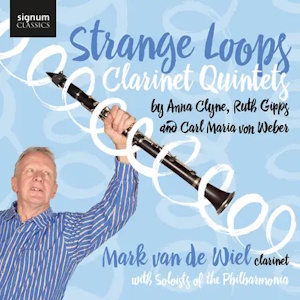
Strange Loops: Clarinet Quintets
Anna Clyne (b.1980)
Strange Loops (2020)
Ruth Gipps (1921-1999)
Rhapsody for Clarinet and String Quartet in E flat Major, op.23 (1942)
Carl Maria von Weber (1786-1826)
Clarinet Quintet in B flat Major, op.34, J.182 (1811-1815)
Mark van de Wiel (clarinet), Zsolt-Tihamér Visontay (violin), Fiona Cornall (violin),
Nicholas Bootiman (viola), Karen Stephenson (cello)
rec. 2024, Lady Stringer Studio, Garsington Studios, Wallace Hill Farm, Stokenchurch, Buckinghamshire, UK
Signum Classics SIGCD1008 [58]
People come to Carl Maria von Weber from different angles. Some are drawn to his operas, Der Freischütz or Euryanthe. I first discovered him through the piano piece Invitation to the Dance and then the piano concertos. Others will be captivated by his concertos for the clarinet and the bassoon. The Clarinet Quintet is one of his relatively few chamber compositions. He wrote it for the brilliant clarinetist Heinrich Baermann, noted for his exceptional technique, command of all the instrument’s registers and an overwhelming lyricism. The key thing to take account of in this work is that it is really a concerto in disguise. Although Weber conceived the Quintet for standard chamber forces, its overall effect has the clarinet acting as a full-blown soloist. The strings provide an elegant accompaniment rather than presenting themselves as equal partners.
The four movements explore an almost theatrical or operatic adventure. After a quiet opening, the Allegro launches into a virtuosic display. The slow movement, an imposing and solemn Fantasia, resembles a funeral march. The capricious scherzo balances quicksilver passages and antique dance gestures; it is like a conversation between two people from different eras. The finale, a Rondo, is full of wit and rhythmical verve that hint at the Tarantella and the Polonaise. It finishes with a dazzling coda.
I had been unfamiliar with this Quintet, which I could easily come to love. Mark van de Wiel and the quartet give it a commanding and enthusiastic performance.
The highlight of this album for me is Ruth Gipps’s beautiful Rhapsody for Clarinet and String Quartet. She wrote it specifically for her husband, clarinetist Robert Baker. The piece reveals a stylistic paradox. On the one side lies an incipient pastoralism that reflects Gipps’s studies with Ralph Vaughan Williams; on the other, there are flashes of drama that present a vigorous, almost rhetorical interplay between clarinet and strings. The latter element is hardly modernistic, yet it steers the music well clear of anything resembling Cow‑and‑Gate sentimentality.
The clarinet leads with a soulful, yearning quality, while the string quartet refuses to remain a passive backdrop. Their dialogue moves effortlessly between serene, rolling landscapes and sudden, brooding intensity. That is perhaps a reflection of the uncertain wartime atmosphere in which the work was conceived. Deceptively complex and quietly compelling, it rewards attentive listening, and here it receives a remarkably sensitive performance.
The latest piece on this rewarding disc is US‑based British composer Anna Clyne’sStrange Loops, written during the Covid lockdowns. This is my first encounter with her work. The liner notes give no biographical facts. Let me quote from the programme notes:
I Am a Strange Loop is a book by Douglas Hofstadter, examining in depth the concept of a strange loop to explain the sense of “I”. [This concept] was originally developed in his book Gödel, Escher, Bach. He writes: In the end, we are self-perceiving, self-inventing, locked-in mirages that are little miracles of self-reference.
Now, I do not understand a word of this. Yet the result is thoroughly approachable and enjoyable. Clyne explains that she has explored “musical loops – motifs and gestures that repeat, morph, modulate and recapitulate in various guises. At the heart of Strange Loops is a sense of playfulness and yearning – inspired by the creative process in isolation.” That is all that you need to know to enjoy this piece.
The whole disc leaves a satisfying impression: helpful if not comprehensive liner notes, a splendid recording, and an overall presentation that reflects real care and understanding.
The three works together make a strikingly complementary programme, charting a clarinet journey from Weber’s operatic sparkle through Gipps’s introspective wartime lyricism to Clyne’s playful, self‑renewing modern ‘loops’. Mark van de Wiel and his colleagues meet each idiom with assurance, warmth and skill, and that results in a disc musically rewarding and unexpectedly unified.
John France
Buying this recording via the link below generates revenue for MWI, which helps the site remain free














What I loved about this disc is exactly what you point out in the final paragraph: there’s a lot of variation here for the clarinet quintet, an ensemble that I don’t think I’d ever considered much outside of the two by Mozart and Brahms. So Clyne was particularly eye-opening– like a lot of the music she writes, Strange Loops is accessible and likable but never cliche or obvious. She writes very ‘colorful’ music.
You’re totally right about the Weber too, I remember thinking that the clarinet was doing all the heavy lifting there. It is essentially a “chamber concerto”, isn’t it?