
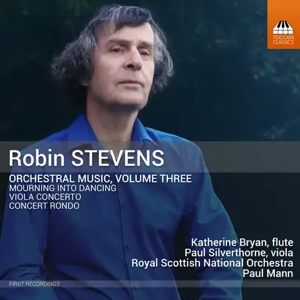
Robin Stevens (1958-2026)
Orchestral Music, Volume Three
Mourning into Dancing (2011 rev. 2013)
Concert Rondo for flute and small orchestra (2016)
Viola Concerto (2022-2023)Katherine Bryan (flute), Paul Silverthorne (viola)
Royal Scottish National Orchestra/Paul Mann
rec. 2025, RSNO Centre, Glasgow
First recordings
Toccata Classics TOCC0788 [66]
This is the last of the three CDs of orchestral music by Robin Stevens that he supervised before his death in January this year. Like the other two discs (review ~ review), this one includes a substantial concerto, an orchestral suite and a shorter light music work.
The composer was in his mid-fifties and nearing the end of his PhD in Composition at Manchester University when he wrote Mourning into Dancing. In four main sections, Lament, Processional, Scherzo, and Jig and Chorale, it was his first large scale orchestral work. It is a very confident work, though in spite of the very detailed and informative notes by the composer, I am not sure of its narrative. Why does it move from mourning to jig? He gives us no clue. It is a colourful thirteen-minute work which calls for some virtuosic displays from the woodwind, which the players happily throw off. One of the composers Stevens said he felt in tune with, was James MacMillan, and one can hear that in this suite – or perhaps Peter Maxwell Davies in user-friendly mode.
The Concert Rondo, for solo flute and chamber orchestra is an arrangement of a 2016 work for treble recorder and piano, presumable for his friend John Turner. It is a brief, four-minute, work, generally good-natured but with the occasional punchy harmonies. Katherine Bryan is an exemplary soloist whom I think I would love to hear in Ibert’s gutsy concerto.
The main work on the disc is Steven’s Viola Concerto which was written between April 2022 and February 2023. Like his Bassoon and Cello Concertos which appear on the previous discs, it is a substantial work lasting about forty minutes.
At nearly seventeen minutes, the first movement is as long as most viola concertos are in total – and I believe I said the same thing about his Bassoon Concerto. It is a dramatic movement, based around a myriad of contrasting figures, some lyrical some aggressive. To me, it sounded as though the viola was going on an extended journey to distant realms. One section near the end has a decided Middle Eastern sound. The composer clearly had a clear plan in his head and the journey we go through, although varied, never sounds haphazard.
In spite of its title, the ensuing scherzo has nothing jokey about it. Rather, like the first, it is a disturbing dramatic utterance that calls for the utmost virtuosity from the soloist. Throughout, Paul Silverthorne seems to relish the challenges thrown at him. It begins with what I have come to hear as Steven’s thumbprint: a passage in microtones which return to give added piquancy. Virtuoso writing for the woodwind and some ethereal effects in the strings make for an enigmatic, though brief, movement.
The slow movement marked poco adagio does not give us much respite in its fifteen-minute span. The tempo has clearly slowed down, but the musical material is darkly dramatic and there is much to challenge the ear in terms of dissonance – and, as the composer writes in the notes, “numerous micro-tonal inflections.” Material that has been heard in the first two movements is given new, often unsettling, embroidery. The many chords that the soloist is called upon to play make for an uneasy sound world.
The last movement, so the composer tells us, “seeks to dispel all vestiges of gloom and melancholy” but it is no romp. The dissonance from the earlier movements is still there as the microtones, and there are many violent outbursts. The soloist sounds as if the soloist has continued his journey into a ravaged landscape. The cadenza which starts at about eight minutes in revisits earlier material in a most disturbing way and the quiet ending to the work, which the composer called an “unexpected peace”, sounds rather forced than natural.
This is by far the most challenging of Steven’s three concertos, not only for the performers but for the listener. There is much to admire in the work, which explores the darker side of the human experience. The many lyrical melodic lines from the brilliant soloist are constantly assailed by the orchestra’s interjections, and only just makes it to the end. Christopher Nolan’s film The Odyssey is currently on release and I wonder whether in this concerto the viola is a musical Odysseus, constantly assailed from all sides on its journey.
It is gratifying that Dr. Stevens was able to finance the three discs of his orchestral music with an inheritance from his mother, and that he was able to supervise the recordings before his untimely death. The venture is far more than a vanity project and serves as a lasting memorial to a gifted composer who died far too soon.
Paul RW Jackson
Buying this recording via the link below generates revenue for MWI, which helps the site remain free













