
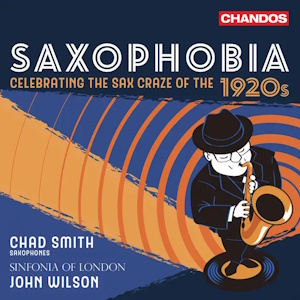
Saxophobia: Celebrating the Sax craze of the 1920s
Chad Smith (saxophone), Mikaela Bennett (soprano), Lynette Wardle (harp), Dalton Ridenhour (piano), Sinfonia of London / John Wilson
rec. 2025, Susie Sainsbury Theatre, Royal Academy of Music, London, UK (instrumentals), Power Station, New York City, USA (vocals)
Chandos SACD CHSA 5390 [56]
Even those of us whose idea of music is late Beethoven string quartets, Wagner operas and Bruckner symphonies occasionally like to relax, and this is a fun disc for just this purpose. It celebrates the saxophone and, in particular, the contribution of Rudy Wiedoeft (1893-1940) to popularizing the instrument.
The Belgian instrument maker Adolphe Sax invented the saxophone in 1846. It has a single reed mouthpiece like a clarinet, a conical bore like an oboe, and is made of brass. Acoustically, it counts as a woodwind instrument. Sax made the instruments in various sizes from soprano to bass; higher and lower ones have also been made. He pitched them alternately in the keys of B flat and E flat, to make them suitable for military bands, where they were quickly adopted. However, in orchestras they are occasional visitors rather than regular members. An alternative set in the keys of C and F never caught on, apart from the tenor in C, known as the C melody saxophone. This is the instrument that Wiedoeft mainly played.
He played the saxophone in dance bands and in ensembles large and small, with the peak of his career being in the early 1920s. Curiously, he never took to jazz, and after jazz became widely popular his career declined. Most of the works here were composed by him, though various people, notably Lanny Meyers, made the orchestral arrangements.
This disc is built round the talents of Chad Smith, a versatile performer on many woodwind instruments but principally on the saxophone. His technique, which must be similar to that of Wiedoeft, emphasizes flexibility and skill. The risk with the saxophone is of it sounding treacly; Smith avoids this with musical phrasing and a rapid staccato technique. He also has a smooth and liquid tone which is most attractive.
The programme here includes fast numbers such as Saxophobia, Saxarella and Sax-O-Trix, which Smith describes as ‘musical postcards from another era’. There are also waltzes such as Valse Mazanetta, named after a pet name for Wiedoeft’s wife Mae Mahoney, and Valse Sonia, which Wiedoeft himself never recorded. Another side of him is shown by Danse Hongroise and Dans L’Orient. This last and Valse Sonia have the saxophone accompanied only by a harp, a strange combination which nevertheless works. Most of the others have an orchestra.
John Wilson was just the man to put this programme together, with his well-known love for the period and expertise in recreating it. His skills extend to finding suitable performers who understand the idiom. These include the soprano Mikaela Bennett, the harpist Lynette Wardle and the pianist Dalton Ridenhour and occasional others as well as Wilson’s own Sinfonia of London.
Although this is light music, it is essential for it to be performed precisely, rhythmically and with good phrasing and articulation. Any sloppiness would be fatal. These performances are all as expert as you would expect. This is an SACD; I was listening in ordinary two channel stereo and the sound in that is good. It is, indeed, a fun disc. Incidentally, surely the title should have been Saxophilia?
Stephen Barber
Previous review: Nick Barnard
Buying this recording via the link below generates revenue for MWI, which helps the site remain free
Contents
Rudy Wiedoeft (1893-1940)
Sax-O-Trix (with Domenico Savino, 1882-1973)(1926)
Valse Mazanetta (1925)
Saxophobkia (1918)
Dans L’Orent (with Domenico Savino) (1926)
Valse Llewellyn (1917)
Sax-O-Phun (1924)
Rubenola (with Hugo Frey) (1927)
Cloudy Days (1919)
Saxema (1920)
Valse Sonia (with Hugo Frey) (1932)
Saxarella (1923)
Valse Vanité (1923)
Saxophobia (bonus track) (1918)
Victor Herbert (1859-1924)
Kiss me again (1924)
Justin Ring (1876-1963)
Gloria (with Frederick Hager, 1874-1958) (1923)
Danse Hongroise (with Frederick Hager) (1924)
Earl Carroll (1893-1948)
Canary Cottage-One Step (1893-1948)
Irving Berlin (1888-1989)
You Forgot to Remember (1925)













