
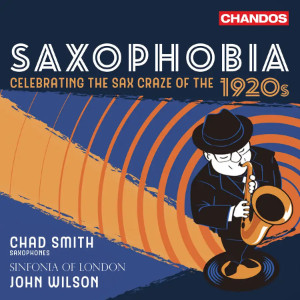
Saxophobia: Celebrating the Sax Craze of the 1920s
Chad Smith (saxophones)
Mikaela Bennett (soprano), Lynette Wardle (harp), Dalton Ridenhour (piano), John Mills (violin)
Sinfonia of London / John Wilson
rec. 2025/26, Susie Sainsbury Theatre, Royal Academy of Music, London; Power Station, New York City, USA (vocals)
Chandos CHSA5390 SACD [56]
Think Charlie ‘Bird’ Parker, think late-night smoke-filled, one-for-the-road speakeasies. Is any instrument as synonymous with jazz as the saxophone? Yet when Adolf Sax invented in 1840 the instrument that bears his name, clearly he had nothing of the kind in mind. Instead, here was an instrument to combine the best of woodwind and brass features in a flexible and relatively simple new form. Sax tried to persuade Wagner it would be just the thing for his Ring cycle (Wagner decided to invent his own new instrument instead). César Franck did fall prey to the salesman’s pitch and include four saxophones in his opera Hulda.
France seemed particularly susceptible to the saxophone’s charms. By 1856, the Garde républicaine band was the largest ensemble of its time to feature the instrument prominently: they used eight saxophones. In Europe, interest in the use of the saxophone in classical music waned in the late decades of the 19th century. But by that time it had arrived in America and was beginning to have an impact in more popular forms of musical culture. By the early years of the 20th century, this translated into its presence in military, vaudeville and ragtime bands. The 1920s saw its progression into a pre-eminent position, alongside the trumpet, in dance bands and popular music ensembles.
At which point enter Rudy Wiedoeft. To say “enter” is slightly misleading: the teenaged Wiedoeft had been playing clarinet in various bands since 1909 when he met his closest and lifelong friend Ferde Grofé (of Grand Canyon Suite and Rhapsody in Blue orchestration fame). By 1914, Wiedoeft had switched to the saxophone, an instrument perfectly suited to his skill set. This serendipitous timing aligned with the burgeoning dance craze; numbers such as Canary Cottage – One Step (track 11) embodied the high-energy chromium-plated brilliance of the style.
Doug Caldwell provides the superbly informative and fascinating liner notes. To quote from him at length: “Behind the scenes – in the seclusion of home, office, and rehearsal rooms – Wiedoeft obsessed over the mysteries of the saxophone, experimenting endlessly not only with technique (tongue speed and dexterity), tone (reed setup and embouchure), and articulation ( staccato , slap tongue, rasps), but with texture and blend: how the horn worked in combination with other instruments. During this period of emerging ‘jazz’ and the expanding possibilities of the dance band, there was no blueprint for the way in which the saxophone should contribute – and he tried everything. Utilizing C melody, E flat alto, and (with surprising frequency) soprano sax, he experimented with the solo saxophone’s carrying the melody, and sax lines woven through the arrangement (using up to four horns); he isolated the sax in full-chorus breaks (anticipating the jazz ‘break chorus’) and featured it in stop-time breaks. He tested the horn in duos, trios, quartets, sextets, and mixed woodwind ensembles – all the while raising the bar for the complexity of saxophone playing. With his Californians, he initiated the extended use of three- and four-sax sections, a device that would soon become standard, though rarely in so ambitious a manner”.
It is this ground-breaking revolutionising of the instrument, its use and its musical potential that raises this disc up from a niche-market curio into something of real musicological and historical worth – and it is just darn good fun. But the music that Wiedoeft played, wrote and promoted is not the style or sound that I alluded to in the very first paragraph. And, in brief, that is why Wiedoeft – who for a decade or so was in effect “Mr Saxophone” – fell from the public consciousness. He died at just 47 of alcohol-induced liver cirrhosis, “heartbroken” (to quote Grofé’s wife).
Wiedoeft was not alone to view the bluesy gutsy ‘new’ jazz with suspicion. Composer Eric Coates – who wrote his own Saxo-Rhapsody in 1936 – sniffily considered jazz a lesser musical form, preferring syncopation. Syncopation, of course, looks back towards the raggedy time rhythms of ragtime and vaudeville. In fact, then, the seventeen works recorded here are in many ways a celebration of earlier musical styles, albeit clothed in the technical ground-breaking brilliance of the modern 1920s.
The sheer brio and verve is the standout feature of the music and the performances here. John Wilson and the Sinfonia of London are superbly at home in this kind of repertoire, and their contribution to the disc cannot be played down. But the star, front and centre, is saxophonist Chad Smith. This is clearly a passion project for him in the very best sense of the word. Interestingly, his own career trajectory has followed something of a modern-day equivalent to Wiedoeft’s with work in shows, sessions and film. Wiedoeft sought to monetise his considerable skill by recordings, sheet music publishing, broadcasting and the creation of a saxophone “method” for amateur players inspired by what they heard. In many ways, this parallels pianist Billy Mayerl, who performed and recorded his own material and a piano school for those who wanted to play like Billy.
It is clear from the opening Sax-O-Trix that very few players in any generation will reach the level of technical brilliance required for this type of music. On display are the whole bag of technical and musical tricks Caldwell alluded to in the earlier quote. This is absurdly buoyant and entertaining music, about as musically consequential as a stick of candyfloss perhaps. But it is important to appreciate that the level of care, research and meticulous study that goes into the preparation of a disc like this matches any restoration of a baroque masterpiece. The musical structure of most pieces are simplicity itself: a bright upbeat A section, a contrasting B with A reprised, and a brief tag/coda. Of the music here, twelve are original Wiedoeft compositions (some co-composed), three are Wiedoeft transcriptions, and two are saxophone features by other composers.
The Sinfonia of London accompanies eleven numbers, a couple are with harp, three more with piano and one of those also with a violin. The Canary Cottage – One Step features a six-piece line-up emulating the small band who had the original hit. It is interesting to note that none of the orchestrations are by Wiedoeft: seven are by Lanny Meyers, three by Andrew Cottee and one by Dan Higgins. All three arrangers have the essence of that 1920s sound off to a tee. Wilson and his virtuoso band capture the spirit of the music just perfectly – although, as the liner notes say, these pieces had never been played with an orchestral accompaniment. Chad Smith’s remarkable playing is in the spotlight but there are many subtle delights in the accompaniments too. While they might not show off the sheer technical brilliance of the players as they have on other Sinfonia recordings, just listen to the little details of perfectly judged trumpet muting and vibrato, witty alert kit playing and a sinewy vibrant small string section.
For this recording, Chandos have used the same venue and engineer/producer that they have for the successful series of complete show recordings with these performers. It is a wise choice. The Susie Salisbury Theatre at London’s Royal Academy of Music has a slightly dry acoustic but is of exactly the right scale and ambience for this type of music and sound. Engineer/producer Jonathan Allen has achieved a good balance between the various sections. Smith’s sax is prominent but that is probably quite an authentic balance in any case. Possibly I would like the upper strings to be a fraction further forward in the mix but again in mixing terms they are positioned here very like they are on a lot of those older original recordings.
This is an SACD stereo and multi-channel recording. It is very good and clear but in many ways this kind of music does not really require that degree of resolution of spatial clarity. For all of Wilson’s recordings across a broad selection of repertoire, I do feel that he is especially successful in this type of music. His preference for bright peppy tempi and super-tight rhythms and articulations is exactly right in this repertoire.
All of the original works are what would be termed “novelty”. Some are the firework/display numbers like Sax-O-Trix (track 1), Saxophobia (track 3, bizzarely similar to the (in)famous Benny Hill ‘chase’ music Yakety sax composed and played by Boots Randolf in 1958), Sax-O-Phun (track 7 – check out the brilliant drum-kit tricks and toys and sweet solo violin counter-melody), Saxarella (track 16) and the already mentioned uplifting Canary Cottage – One Step (track 11 – no surprise this was a hit!). More of a surprise – to me at least – was the “Palm Court” feel of the character pieces: Valse Manzanetta (track 2), Dans L’Orient (track 4), Valse Llewellyn (track 5), Valse Vanité (track 17) and Danse Hongroise (track 12). There is a Ketèlbey-esque sentimental sweep and swoon to the melodic lines here. The advantage is that these show a very different quality to Wiedoeft’s (and Smith’s!) technique. To be brutally honest, though, the melodies are not as memorable as those by the likes of a Ketèlbey or Coates. This is somewhere where the orchestrations are fun and interesting but lack the individuality of those masters of the genre.
American vocalist Mikaela Bennett joins the performers for two numbers: Victor Herbert’s Kiss Me Again (track 6) and Irving Berlin’s You forgot to remember (track 13). “Join” is somewhat misleading since the vocal tracks were dubbed on in New York nine months after the London sessions. Bennett’s vocal style and delivery are absolutely spot-on. Both arrangements are genuine delights, presented with a sense of authentic ‘rightness’ that is completely convincing. The engineering seamlessly integrates the two disparate sessions.
Back in the Palm Court, there are two arrangements for sax and harp. Smith is joined by Lynette Wardle – the aforementioned Dans L’Orient,the prevalent “mystic land of the East”, all sinuous snake-charmer melodies and oriental dancing. Smith’s tone is meltingly beautiful here. He deploys the slightly tremulous vibrato that again is characteristic of the period. It is important to reiterate how effortless this all sounds but how that is the product of years of personal practice and research. Wardle is responsible for the adaptation of Valse Sonia (track 15 – dreadful name!). It is once more played with supreme skill but it strikes me as one of the weaker pieces melodically.
The Sinfonia leader John Mills joins Smith and pianist Dalton Ridenhour in Rubenola (track 8) which by dating from 1927 is one of Wiedoeft’s later original compositions. This is a fun/silly piece – a kind of Ragtime in the Chicken Coop. It is hard to hear (or play) this kind of piece without grinning. But Wiedoeft’s refusal to adapt his playing and compositional styles to the changing tastes of the following decade led to a rapid falling away of demand for his type of music and a consequent loss of income. By time of his death, he had given up music completely and was working as a prospector…
As a bonus, rather curious, Chandos have ‘faked’ a period recording (background scratches and rumble) of Smith playing Saxophobia accompanied by piano replete with applause and an announcer voiced by Bennett using her best ‘period’ voice. I suppose it brings this disc of good-natured music to a good-natured close but I am not sure I see the point. In the “thanks”, Smith references sax makers “Selmer, D’Addario and Vandoren”. The booklet includes a publicity shot of Wiedoeft with a Selmer sax but I have no idea if the instruments used on this disc are “period” ones and if the age and mechanics of the instruments in any way dictate the sound produced. A little explanation about that in the notes might have been helpful. In a performer’s note, Chad Smith mentions that the C melody saxophone played in the majority of these arrangements belonged to his teacher Ted Hegvik, but although the date and the make are not given. Online, the suggestion is that Selmer introduced major changes to the mechanics of the instrument in the 1930s. Does that imply that all pieces were written for an earlier generation of saxes?
This disc can be approached in a variety of ways. As a historical reference to a very particular but influential figure in the history of popular music, it has great value. But then it is equally important as a celebration of marvellous contemporary playing. Lastly, this is an easy listening collection of the highest possible calibre. It might not be a disc to listen to complete or on repeat but there is much to love along the way.
Other review: Stephen Barber
Nick Barnard
Buying this recording via the link below generates revenue for MWI, which helps the site remain free
Contents
Rudy Wiedoeft (1893-1940), Domenico Savino (1882-1973)
Sax-O-Trix (1926) (arr. for Saxophone & Orchestra by Lanny Meyers b.1937)
Rudy Wiedoeft
Valse mazanette (1925) (arr. for Alto Saxophone & Orchestra by Lanny Meyers)
Rudy Wiedoeft
Saxophobia (1918) (arr. for C Melody Saxophone & Orchestra by Lanny Meyers)
Rudy Wiedoeft, Domenico Savino
Dans l’orient (1926) (arr. for Alto Saxophone & Harp by Lynette Wardle b.1970)
Rudy Wiedoeft
Valse Llewellyn (1917) (arr. for C Melody Saxophone & Orchestra by Dan Higgins b.1957)
Victor Herbert (1859-1924)
Kiss Me Again (1924) (arr. for Voice, C Melody Saxophone & Orchestra by Andrew Cottee b.1978)
Rudy Wiedoeft
Sax-O-Phun (1924) (arr. for C Melody Saxophone & Orchestra by Lanny Meyers)
Rudy Wiedoeft, Hugo Frey (1873-1952)
Rubenola (1927) (arr. for Alto Saxophone, Violin & Piano by Chad Smith b.1974)
Rudy Wiedoeft
Cloudy Days (1919) (arr. for Alto Saxophone & Orchestra by Lanny Meyers)
Frederick Hager (1874-1958), Justin Ring (1876-1963)
Gloria (1923) (arr. for C Melody Saxophone, Banjo & Piano by Rudy Wiedoeft)
Earl Carroll (1893-1948)
Canary Cottage-One Step (1916) (trans. for C Melody Saxophone, Trombone, Violin, Banjo, Piano & Drums by Dan Levinson b.1965)
Frederick Hager
Danse Hongroise (1924) (arr. for C Melody Saxophone & Orchestra by Rudy Wiedoeft & Andrew Cottee)
Irving Berlin (1888-1989)
You Forgot to Remember (1925) (arr. for Voice, C Melody Saxophone & Orchestra by Andrew Cottee)
Rudy Wiedoeft
Saxema (1923) (arr. for C Melody Saxophone & Orchestra by Lanny Meyers)
Rudy Wiedoeft & Hugo Frey
Valse Sonia (1932) (arr. for Alto Saxophone & Harp by Lynette Wardle)
Rudy Wiedoeft
Saxarella (1923) (arr. for C Melody Saxophone & Orchestra by Lanny Meyers)
Rudy Wiedoeft
Valse vanité (1923) (arr. for C Melody Saxophone & Orchestra by Lanny Meyers)
Rudy Wiedoeft
Saxophobia (Bonus Track)













