
Gioachino Rossini (1793-1868)
Il turco in Italia (1817)
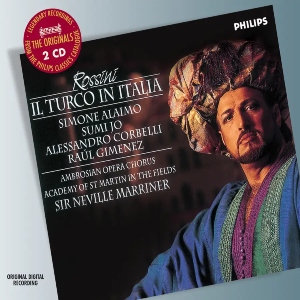
Selim – Simone Alaimo (bass)
Fiorilla – Sumi Jo (soprano)
Narciso – Raúl Giménez (tenor)
Don Geronio – Enrico Fissore (bass-baritone)
Poeta (Prosdocimo) – Alessandro Corbelli (baritone)
Zaida – Susan Mentzer (mezzo-soprano)
Albazar – Peter Bronder (tenor)
Ambrosian Opera Chorus
Academy of St Martin in the Fields/Sir Neville Marriner
rec. 1991, St John’s, London
Libretto in Italian and English
Philips 475 8249 [2 CDs: 154]
Il Turco in Italia received a relatively cold reception at its premiere at La Scala on 14 August 1814. To some, it seemed like a knock-off in reverse of the very popular L’Italiana in Algeri that had met with great acclaim the previous year. The situation wasn’t helped by a recycled libretto and what some considered the work’s low moral tone.
The plot revolves around a flirtatious young woman named Fiorilla, who is married to an older man. She has already attracted the attention of one young man, Don Narciso, when Selim, the Turk of the work’s title arrives. On meeting, Fiorilla and Selim decide to entertain themselves with each other. Ultimately, Fiorilla’s husband, Don Geronio, threatens to send her back to her parents, prompting her repentance and their, presumably, happy reunion. Selim sails back to Turkey with his formerly estranged fiancée, Zaida, who serendipitously had joined a local band of gypsies. The poet Prosdocimo comments on all the activities whilst documenting them for the plot of his new opera buffa.
Rossini revised the work for its 1815 premiere in Rome. Over the following years, further revivals were staged elsewhere, notably in Naples and Paris, sometimes without any participation from the composer. Performances of the work continued through the first half of the nineteenth century, in increasingly corrupt versions of the score. After that, it fell into neglect until it was revived in a production starring Maria Callas at the Teatro Eliseo in Rome in 1950.
Most people who are familiar with this opera probably know it from the Callas recording made in 1954. An indication of how corrupt the score had become can be found in what John Ardoin says of this recording in The Callas Legacy. He mentions pieces that were cut, including a bolero for Zaida and ballet music. He says the Callas recording was made before a Rennert-Ricordi edition of the score was published, which he seemed to have considered set a new standard at that time. The Fondazione Rossini of Pesaro published a preliminary version of the critical edition of the score in 1978. The definitive version was published in 1988, with a piano vocal score published in 2000. The editor of the critical edition refers to the Rennert score as a “travesty of Rossini’s work.” The critical edition contains neither a solo piece for Zaida nor a ballet.
Little is known about the compositional history of the opera, other than that that, as the Preface to the critical edition states: “Il Turco in Italia is among the operas by Rossini most indebted to another composer’s hand.” An unknown composer provided all the secco recitatives and an aria di sorbetto for the comprimario character Albazar, as well as two important and integral pieces, without which the opera cannot be performed: the aria di sortita for Don Geronio and the entire finale to the second act. Rossini did not incorporate any music from his earlier operas into Turco, though he did recycle parts of this opera’s overture for Sigismondo (Venice, 1814) and Otello (Naples, 1816).
The booklet that accompanies this recording states that “The numbering of the scenes follows that of the critical edition of the full score by Margaret Bent, Rossini Foundation, Pesaro, 1988, on which this recording, with a few minor cuts, is based.” I followed the recording with the piano vocal score based on the critical edition. All the original musical numbers are included, with the exception of Albazar’s aria di sorbetto in the second act. There are a few trimmings to the recitative in the in both acts. This performance includes an aria for Don Narciso in the first act that Rossini wrote for the opera’s premiere in Rome in 1815 that’s not found in any of the other studio recordings of the work.
This is a fine performance, even given some slight reservations about Sumi Jo’s Fiorilla. The clear, pristine tone of her voice has only one color, silvery and pure as it is. Consequently, she hasn’t got the vocal resources to differentiate the moods that Fiorilla must display. She tries at being the shrew but she’s better in the remorse of Fiorilla’s second act aria Squalida vesta e bruna.
The rest of the cast sing very well indeed and are involved in their roles. The title role is sung by Simone Alaimo. I’ve always liked the bright tone and quick vibrato of his voice. He’s excellent at the florid music. Raúl Giménez has made a specialty of bel canto roles. His light, flexible voice is just right for Fiorilla’s home-grown admirer, Don Naciso. I’m pleased that he sings the role’s additional first act aria. Alessandro Corbelli is his reliable self in Rossini buffo roles. This is the only time I’ve heard Enrico Fissore who is very good at portraying Fiorilla’s put-upon husband.
The discography of Il Turco in Italia is fairly limited. There are only four studio recordings of the work as well as a few recordings made during staged performances. I listened to the other three studio recordings in preparation for this review.
The Callas recording mentioned above is the earliest of the studio sets. It’s enjoyable for Callas’s vividly portrayed Fiorilla; not surprisingly, the leading ladies on the other recordings are pale by comparison. Nicola Rossi-Lemeni is both funny and vocally accomplished as the title character. I was surprised by the precision with which he handles the roles more florid passages. The rest of the cast vary from acceptable to superannuated. Mariano Stabile was 66 when sang the role of the Poet in this recording; his performance is full of character, but he sounds every year of his age. Due to the corrupt performing edition, this isn’t a very good representation of the opera, even if it is a lot of fun.
Riccardo Chailly recorded the work twice. His 1981 recording on CBS/Sony starred a seriously miscast Montserrat Caballé as Fiorilla, who at this point in her career was frequently singing Turandot. Her notes above the staff are occasionally floated, but most often shrieked. This is too bad, as the rest of the cast is very good. His second recording made in 1998 for Decca stars Cecilia Bartoli, with a fine cast in the rest of the roles.
I think this set is the best among the studio recordings, though Riccardo Chailly’s recording with Cecila Bartoli runs it a close second. Bartoli is a better vocal actor than Jo, but she’s also more taxed by the high tessitura of the role and her heavily aspirated coloratura can become tiresome.
Stephen Wells
Buying this recording via the link below generates revenue for MWI, which helps the site remain free














The Callas recording is the one which most converys what this opera is about. It has numerous cuts and not every singer is in Callas’s class but despite being in mono, and with no critical edition, it leaves a much deeper impression thany of the stereo versions from the 80’s and 90’s. One really should have Callas’ version and a complete modern set in any collection. The recent edition on Pristine Audio is worth the cost to purchase.