
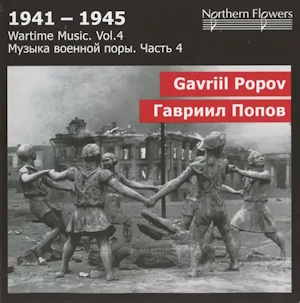
Gavriil Popov (1904-1972)
Symphony No. 3 “Heroic” for large string orchestra Op. 45 (1939-1946)
Symphonic aria for cello and strings Op.43 (1945)
Dmitri Khrychov (cello)
St. Petersburg State Academic Symphony Orchestra/Alexander Titov
rec. 2008, St. Catherine Lutheran Church, St. Petersburg, Russia
Wartime Music Volume 4
Northern Flowers NF/PMA9972 [70]
Gavriil Nikolaevich Popov has the ignominious honour of being the first composer of a symphony that the Soviet regime banned. His Symphony No.1,premiered in Leningrad on March 22nd 1935, was promptly banned the next day. Astonishingly, it had to wait until 2008 to be heard again. In the meantime, it gained almost mythic status because, according to the edict, “performance of this symphony conveying the ideology of classes hostile to us is intolerable”.
As so often with opaque authoritarian dictats, no-one really had a clue what any of that meant, least of all those guilty of having created the intolerable Art. But the shadow cast by these edicts was real and literally dangerous. Popov wrote of planning a Symphony No.2that would “sideline this power by a colossal roar of challenging, piercing Thought”. Fortunately, a sense of self-preservation prevailed and the symphony that ultimately appeared as No.2 was more sensibly sub-titled “Motherland”. This was quarried from a film score, the medium Popov in which worked extensively as a means to earn money but also to rehabilitate himself within the establishment.
Symphony No.3 offered on this disc sprang from a 1939 documentary film “Spain”, based on footage shot during the Spanish Civil War. As his Op.28, Popov created a suite of seven movements for full orchestra based on the 35-minute film score. In 1944, he decided to rework themes from the film as a Concerto Grosso for Strings; he completed the score on September 21st. He then renamed it as his Op.45, Symphony No.3 “Heroic”, and dedicated it to his friend and near-contemporary Shostakovich. Given the scale of the work, contemporary critics suggested that it should be re-scored for full orchestra. Popov defended his decision: “the choice of a string orchestra […] was prompted by the domination of folk-song, melodic, and dancing […] thematic material”.
This is a very big work for strings – 55 minutes in this performance – in five movements dominated by a twenty-minute Largo espressivo placed fourth. This functions as a memorial to the dead of the Civil War. The movements that surround it draw on Spanish dance idioms. The stipulation “for large string orchestra” is necessary not just to provide the sheer tonal weight the music requires but to allow for the multiple string divisi passages that Popov writes.
I last reviewed Popov’s music in June 2010: on the companion disc to this one, on the same label, the same artists performed Symphony No.2. While tracking down my old review, I spotted a review of this disc posted a month later. (Quite why it has appeared now in the new review listings, I have no idea.) As a work and as a recording performance, this ‘new’ disc is significantly better than the tub–thumping Symphony No.2. The playing of the strings of the St. Petersburg Academic Symphony Orchestra is by no means perfect – there is a lot of demanding passage work here – but it is committed and powerful. Likewise, conductor Alexander Titov holds the fairly sprawling work together convincingly.
To my ear, Popov here is more successful at finding a creative balance between compositional choices and the extra-musical demands made of composers in the Soviet Union. (A year or so later, Popov would be one of many swept up by the infamous First Congress of the Union of Soviet Composers, held in April 1948 under Andrei Zhdanov, the man in charge of post-war Soviet cultural policy.) This feels like a more genuinely heart-felt work. The third movement Prestissimo is a whirling virtuoso passage which the composer described (accurately!) as a kind of “scherzo tarantella”. You do wonder if somehow he had heard, or knew of, Britten’s Bridge Variations, which seem to share a similar musical topography.
The heart of the work is the Requiem 4th movement, which apparently is the only one to quote in full an existing folk-tune “The Beautiful Moon”. This is also the movement which has echoes of Shostakovich’s long grieving slow movements. There is also a passing resemblance in the statement of a melody in the violas that pre-echoes the more famous composer’s Symphony No.11, a decade in the future. Certainly, for listeners who enjoy that kind of musical and expressive landscape there is much to recognise and appreciate here.
The closing Presto impetuoso also has shades of Shostakovich’s famed scherzo, although this one is more outwardly celebratory. Popov achieves a degree of cyclic symphonic form by reintroducing the “heroic” themes from the opening movement to give the work overall unity. Again, the orchestral strings work hard and passionately, while sacrificing quite a bit of ensemble integrity. I have found this to be one of the more impressive Popov scores I have heard, which the composer:’s diary entry reflects: “Vladimir Shcherbachov [his former teacher] believes Symphony No. 3 is my best achievement”.
Given the scale of the symphony, the inclusion of a filler seems generous rather than necessary. Nonetheless, the presence of the Symphonic Aria for Cello and String Orchestrais a logical one. Popov broke from writing the symphony on the news of the death of the writer Alexey Nikolaevich Tolstoy. Posterity has been a harsh judge of Tolstoy’s legacy because of his privileged position in the Soviet hierarchy and his role as a Stalinist apologist. But the sincerity and pathos of Popov’s compact fifteen-minute work cannot be doubted, and it receives an effective and indeed rather touching performance here. Given its requirements for strings and solo cello alone, this strikes me as a work that could be useful to any string orchestra looking for an unusual addition to its repertoire. The scale and technical demands of the work are far less than the symphony.
In the past, the engineering of the Northern Flowers releases has been variable, to say the least. Here, soloist Dmitry Khrychov is given an effective, not inflated, position in front of the accompanying string orchestra. He plays with technical security and expressive authority.
Overall, this is a significantly more worthwhile addition to the Popov discography than my previous encounter. It has only taken me 16 years to find that out.
Nick Barnard
Previous review: William Kreindler
Buying this recording via the link below generates revenue for MWI, which helps the site remain free













