
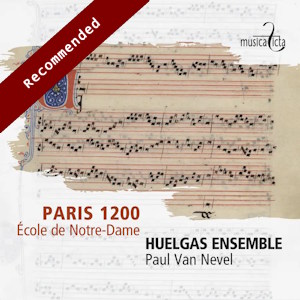
Paris 1200 – École de Notre-Dame
Huelgas Ensemble/Paul Van Nevel
rec. live, August 2025, Handelsbeurs, Antwerp
Texts available from the label’s site
Reviewed as a download
Musica Ficta MF8041 [58]
Music has been a major part of Christian worship since its origin. For about one thousand years, liturgical music was monophonic. The chants which today are known as ‘Gregorian’ are the main specimens of this style of liturgical music, and are still very much in use. It seems very likely that additional voices were sung in the way of improvisation, but the first known piece of written-out polyphony has been discovered in a manuscript preserved at the British Library, dating from the early 10th century. The best-known examples of music from the early stages of polyphony are what has come down to us from what is known as the ‘Notre-Dame school’ in Paris. Only two names of composers are connected to it: Léonin (or Leoninus) and Pérotin (or Perotinus). The largest part of the repertoire has remained anonymous.
In his De mensuris et discantu (c1270), a theorist known as Anonymus IV attributes the composition of the so-called Magnus liber to Leoninus. This has not survived, but it is assumed that it contained polyphonic compositions, such as two-part organa for the responsories of the Mass and the Office. Perotinus revised and updated this collection. While Leoninus limited himself to two-part music, Perotinus expanded the number of voices to four. It is also thanks to this Anonymus IV that some anonymously transmitted compositions can be attributed to either Leoninus or Perotinus.
The disc to be reviewed here is devoted to the music written in Paris between circa 1180 and around 1290. For information about the repertoire and performance practice, Paul Van Nevel mentions four sources from the 13th century, written by Johannes de Garlandia (De mensurabili musica, c1250), Hieronymus of Moravia (Tractatus de Musica, c1275), Franco of Cologne (Ars cantus mensurabilis, c1250) and the above-mentioned treatise by Anonymous IV. They bear witness to the changes in the style of composition which took place around 1200, which Van Nevel characterises as “a seismic revolution”. These not only concern the birth of musical genres, but also vocal scoring, ornamentation techniques and rhythmic notation.
The repertoire of the Notre-Dame school consists mainly of three forms. The first is the organum, a work whose core is a sustained tenor (usually a liturgical melody), over which one or more voices move in free rhythm. The second is the conductus, in which all voices are freely composed, independent of liturgical models. The third is the motet, a general term for a polyphonic sacred or secular work. Motets often had more than one text. A special form is the isorhythmic motet, in which a rhythmic pattern is repeated several times with varying melodies.
Van Nevel, in his liner-notes, describes at length the way singers – both choirboys and adults – were trained in Paris, and especially at the Notre-Dame, linguistically and musically. The education in polyphony started with the simplest way of adding parts to plainchant. In what is known as organum purum, based on the note-against-note principle, the plainchant melody is accompanied by a parallel voice sung at one of the consonant intervals: fourth, fifth or octave. An example is the anonymous Laudes Regiae. It is followed here by Leoninus’ Haec dies, which is an example of what Van Nevel describes thus: “The Gregorian melody – now designated as the vox principalis – was elongated into slow, sustained note values, rendering it almost unrecognisable. A second voice – the vox organalis – was composed above each of these notes. This upper voice began as a kind of notated improvisation but quickly evolved into a virtuosic showcase of both compositional ingenuity and vocal technique.” This piece includes so-called clausulae: both voices move together, which obviously is only possible with a precise rhythmic notation. The latter is one of the innovations of the Notre-Dame school.
Whereas Haec dies is more complex than Laudes Regiae, Perotinus, in his four-part Viderunt omnes, goes a step further. “[Suddenly], four voices resound in synchronised, obsessive rhythm. According to the treatises, performances of this more than ten-minute-long organum provoked states of hysteria and hallucination among the audience.” This was the reason that the new style was strongly criticized. The English scholar and prelate John of Salisbury is quoted, who called the way of singing “wanton and sensual” and accused the singers of using their voice “to overwhelm, confuse, and intoxicate simple souls.”
Crucifigat omnes and Belial vocatur are homophonic conducti; some sections end with a melisma. The motets have different texts sung simultaneously. In O Maria maris stella three different texts are sung by duplum, triplum and quadruplum respectively, whereas the tenor consists of just two words: “In veritate” (in truth). Homo miserabilis has two texts, with the tenor singing “Brumas est mort”. It is an example of a piece with texts in Latin and in the vernacular. Cum apertam sepulturam and Balaam de quo vaticinans are isorhythmic motets for three voices with a single text, which is divided among the upper voices; they are rhythmically complex. The Agnus Dei in the program is a so-called trope: a piece, whose fixed liturgical text is expanded with new texts.
It was probably during a concert of The Hilliard Ensemble in the Early Music Festival Utrecht in the 1980s that I heard this repertoire for the first time. For most of the audience it was also entirely new, and the performances caused great excitement. That was probably not very different from the impression these works made when they were first performed in Paris. I can’t remember how The Hilliard Ensemble performed the organa and conducti, but it must have been very different from how they sound here. That is partly due to the different line-up: The Hilliard Ensemble consisted of four or five male voices; here we have a larger ensemble of female and male voices. However, Van Nevel is a specialist, who always goes to the sources to find the appropriate way to perform music. Here, the singers make use of various embellishments described in the sources. Unfortunately, Van Nevel mentions them, but does not explain them.
It is not easy to describe embellishments, but New Grove is of some help here. One of them is called plica: “a two-note neume, containing the pitch where the plica was placed on the staff plus a higher (‘U’ shape) or lower (inverted ‘U’) note. The second note was semi-vocalized to provide a passing or anticipatory note before the next pitch.” The reverberatio is “an ornamental appoggiatura from below”. The tremulando vox and vinnola vox both have to do with the way the voice is used. The former speaks for itself, the second literally means “vining voice”. I could not find a clear explanation, but a treatise by Isidore of Seville says: “The vinnola vox is soft and flexible”. That does not help very much. Lastly, longa florata comes from the treatise of the above-mentioned Anonymous IV; it literally means “flowered long”, which indicates that it concerns a way to use the voice.
Van Nevel claims that in this recording these embellishments are used for the first time. I can’t check that, but it seems very likely that he is right. At least I have not heard them in other recordings. It is one of the reasons that this recording stands apart from earlier performances of pieces from the Notre-Dame school. One can only admire the way the singers of the ensemble realize Van Nevel’s intentions. Both the music and the embellishments are quite complicated, but they succeed with flying colours. These performances were recorded live at the Laus Polyphoniae festival in Antwerp in 2025, which makes them all the more impressive. The venue was rather prosaic; a larger space, especially a church or cathedral would have added something to these performances, but then some details may have been lost. It doesn’t matter: this album is mesmerizing, and may cause the same effect as the performances in Paris 800 years ago.
Johan van Veen
http://www.musica-dei-donum.org
https://twitter.com/johanvanveen
https://bsky.app/profile/musicadeidonum.bsky.social
Buying this recording via the link below generates revenue for MWI, which helps the site remain free
Contents
anon
Laudes Regiae (organum)
Leoninus (fl 1170-1200)
Haec dies (organum)
anon (c1260)
O Maria maris stella / O Maria dei cella / O Maria virgo / Veritate (motet)
anon (c1250)
Crucifigat omnes (conductus)
Perotinus (fl 1207-1238)
Viderunt omnes (organum)
anon (c1290)
Cum apertam sepulturam (isorhythmic motet)
anon (c1250)
Agnus Dei / Exultet hec concio (trope)
anon (c1250)
Belial vocatur (conductus)
anon (c1280)
Homo miserabilis / Homo luge fuge / Brumans est mors (motet)
anon (c1290)
Balaam de quo vaticinans (isorhythmic motet)
anon (c1230 (Perotinus?)
Benedicamus Domino (canon)













