
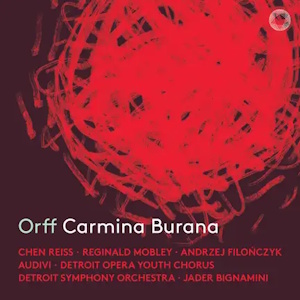
Carl Orff (1895-1982)
Carmina Burana (1937)
Chen Reiss (soprano), Reginald Mobley (countertenor), Andrzej Filończyk (baritone)
Audivi, Detroit Opera Youth Chorus
Detroit Symphony Orchestra/Jader Bignamini
rec. live, 7-9 November 2025, Orchestra Hall, Detroit, USA
Texts not included
Pentatone PTC5187519 [61]
Carl Orff’s Carmina Burana is undoubtedly the Marmite (or Vegemite if you are, like me, Australian) of the classical musical world: you either love it or hate it. Those in the latter camp will point to its lack of polyphony, the simple (or simplistic) musical construction, even the composer’s possible (unproven) Nazi links, but I suspect there is also an unspoken reason: Orff wrote it to entertain his audience, not a musical motive in the 1930s that was all that common. You could add to the charge sheet the ubiquity of O Fortuna in advertising, selling aftershave, instant coffee, beer and many more. Despite this, the record labels clearly think that the “love it” camp is sufficiently well-populated to keep producing new recordings.
Jader Bignamini is an Italian conductor, who has been Music Director in Detroit since 2020, and will be there until at least 2031. His vision for Carmina Burana is quite individual, and a little hard to put into words, but as a reviewer, that is what I need to do. It is not restrained, but it definitely doesn’t have the visceral and primitive feel that some – Jochum and Muti come to mind – have. Perhaps the word I’m after is “civilised”; it certainly has some of Orff’s sharp edges rounded off.
At 61 minutes, it is on the slower end of the scale, but is by no means the slowest: Dorati and Previn/Vienna come in at 63, and there are undoubtedly others even slower. Muti sounds so much faster, but is only two minutes quicker. There are few of the twenty-five movements where Bignamini is significantly slower than the competition. Veris leta facies is one of those, where at 4:54, he is more than a minute slower than Jochum and 40 seconds than Muti, and there is a definite sense of lost momentum. However, the well-regarded account by Seiji Ozawa in Berlin does have similar characteristics.
For Bignamini, it is more often a matter of “borrowing from Peter to pay Paul”, by which I mean he will be quite slow and quite fast in different sections of the one movement. The prime example of this is the Dance that begins the “On the Green” section, where the score indicates a little (un poco) slowdown in tempo for the flute and timpani duet. Bignamini reads this as a large, not a little, slowdown far more so than any other version I’ve heard. It does make the duet quite delicate and lovely, but then there is a huge acceleration as the full orchestra resumes and it is quite jarring, uncomfortable and unattractive.
Very surprisingly, for someone of her reputation, Chen Reiss doesn’t impress. She employs a quite heavy vibrato, not really appropriate for the seductive arias in The Court of Love, though she is at her best in In trutina. She leaves the worst until last: she makes a real mess of the very high notes in Dulcissime, overextending her voice and creating a bit of a screech. Baritone Andrzej Filończyk is very impressive across the range of emotions required of him, but the choice of a countertenor instead of a tenor is bound to raise some eyebrows. The tenor’s single duty is purely to depict the swan being roasted alive, and the conventional wisdom is that the high notes that a “normal” tenor really struggles with, make the dying of the bird sound more real. Reginald Mobley doesn’t have the same problem reaching those notes, and hence the scene sounds far more beautiful (civilised?) than Orff surely intended.
Without doubt, the stars of this recording are the two choruses, numbering around 100 members in total. Audivi is a Detroit-based choir, and together with the Opera’s Youth Chorus, they give a wonderfully enthusiastic performance. Yes, it is not always possible to hear the words clearly, but in this work, it is the rhythm, rather than the diction, that seems the more important for me, and here the choirs are superb.
The work is less about the orchestra than the singing, but the Detroit Symphony plays with drive, but also great delicacy in places, such as the opening instrumental section of Reie and, of course, the Dance.
It might seem that I didn’t really enjoy this, but that’s not the case. Mind you, I think it would have to be a pretty dire performance of Carmina to make it not enjoyable, and this is very far from being dire, though the 38 seconds of Dulcissime possibly came close. Bignamini’s approach did allow for some extra colours and details to be revealed, though whether this compensates for a lowered thrill quotient will depend on your outlook.
It is up against a lot of opposition: this is the second new release for the year, and looking at Presto Classical, not many years have gone by this century without a new one. That said, few have gained the almost universal praise that one of the first recordings – Eugen Jochum’s 1967 Berlin version, recorded in the presence and with the endorsement of the composer – has garnered. It has so much energy and drive, perhaps a little too much in places, and I have quickly developed a real affection for Riccardo Muti’s Philharmonia recording, which seems to strike the perfect balance, and has Arleen Auger who is peerless in this role.
For a live recording, the sound quality is pretty good, and the audience noise close to non-existent (there is no applause at the end). The booklet notes are very well done, both historically and musicologically informative.
This is going to divide opinions, because of the approach taken by Bignamini. There are some very good parts, and some that don’t work so well, but overall, it is definitely worth a listen. It’s probably not one I will return to very often, not because I didn’t like it, but rather there are too many others that are better.
David Barker
Buying this recording via the link below generates revenue for MWI, which helps the site remain free













