
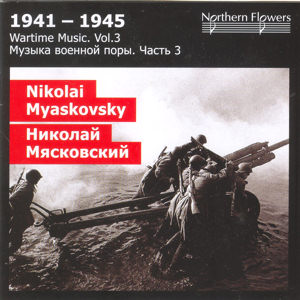
Nikolai Myaskovsky (1881-1950)
1941-1945: Wartime Music. Vol. 3
Symphony No. 24 Op. 63 (1943)
Symphony No. 25 Op. 69 (1945-1946)
St. Petersburg State Academic Symphony Orchestra / Alexander Titov
rec. 2008, St. Catherine’s Lutheran Church, St. Petersburg, Russia
Northern Flowers NF/PMA9971 [76]
Given that the existence of Evgeny Svetlanov’s set of the complete symphonies (review) dominates Myaskovsky recordings – now on Warner, it’s also available on Alto – it’s proved fascinating to revisit the 2008 coupling of Symphonies 24 and 25 on Northern Flowers. Rob Barnett reviewed it in 2009; he is a typically astute guide to Alexander Titov’s architectural concerns in these two wartime works of the composer’s late maturity.
Symphony No. 24 dates from 1943 and like its companion is in three movements. The opening is terse, march-like with characteristically pungent, deep brass and much compensating lyricism in the winds, some of almost Rachmaninovian eloquence. The mournfully noble central movement is enriched by a warm string cantilena whilst the longest movement is the finale. Here the heroic is balanced and braced by a B section that offers more lyricism and ensures that the symphony ends in reconciliation. I prefer the playing of the St Petersburg State Academic Symphony here to Dmitry Yablonsky’s Moscow Philharmonic on Naxos 8.555376 but I prefer the tighter tempo decisions taken by Svetlanov and Yablonsky. Rob Barnett is correct when he writes that, Titov takes the long view and it’s this that can destabilise the contrasts in the finale, in particular.
Titov is particularly attentive to the string cushion in the opening slow movement of Symphony No.25 over which the winds hover, the music constantly irradiated by those moments of warmth and nostalgia that so frequently haunt the composer’s music. Overt passion is characteristically suppressed in favour of a more generalised eloquence, touched by pious-sounding sonorities. The central Intermezzo is cast in three sections, and the brass here ventures a richer sonorous presence in preparation for the sonata-form finale which generates nobly old-school sonority and a gentle, quietly unassuming grandeur. Titov’s finale is notably slower than Yablonsky and Svetlanov’s but in general he is closer to the latter than to Yablonsky’s more mobile approach.
The recording quality is earthily direct and the notes are fine. For all those occasionally expansive tempo decisions, Titov’s approach is one that should be respected.
Jonathan Woolf
Previous review: Rob Barnett
Buying this recording via the link below generates revenue for MWI, which helps the site remain free













