
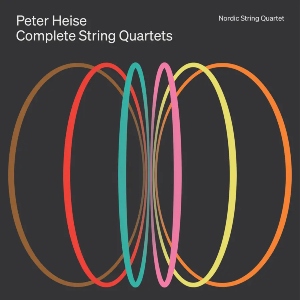
Peter Heise (1830-1879)
Complete String Quartets
Nordic String Quartet
rec. 2022, Garnisonskirken, Copenhagen, Denmark
Reviewed as lossless download
First recordings
Dacapo 8.226283-85 [158]
David Barker’s previous review was a ‘Recording of the Month’ in June 2026, and I was delighted to be able to follow up and agree with all of his points, both positive and with that caveat about Dacapo’s duplication of the first three quartets.
I have to admit that Peter Heise was a new name to me, though looking at the sheer quantity of Danish composers listed online it seems we all have much still to discover from this source. The booklet notes for this recording by Jens Cornelius are titled The Lost Quartets, and there is some interesting context given to the “quite exceptional oblivion” reserved for Heise’s quartets, the manuscripts of which received a glimmer of attention in the mid 20th century but had to wait until 2017 to be published.
Labelled and dismissed as youthful works, the first three quartets do have a certain amount of classical cliché woven into their scores, but as with all of these performances we become involved and invested as a result of the sincerity and conviction radiating from the Nordic String Quartet in these recordings. Set in the gloriously spacious acoustic of Copenhagen’s Garnison or Garrison Church, these quartets sparkle with energy and wonderfully transparent sonics, the superlative technique of the quartet taking all of Heise’s virtuoso writing in its stride. Vibrato is always employed tastefully and in the service of expression, and movements such as the gorgeous Larghetto second movement in the Second String Quartet serve as a fine example of perfect balance between the instruments, their perfect intonation and dynamic weighting, giving the composer’s melodic ideas and harmonic invention complete clarity and musicality.
Recording quality is consistent between the two sets if we’re dividing these quartets into two groups of three, and with the booklet notes giving a nice amount of commentary on each quartet we a guided towards the experimental nature of aspects of the Fourth String Quartet, leading to speculation that Heise might not have expected the work ever to be performed in public. While he seems to have been humble to a fault this is a point I would dispute, but there is indeed plenty of surprise and quite angular contrast in the variations in this quartet’s Andante tranquillo second movement. The Fifth String Quartet is the longest of the collection and “his most ambitious to date. Here, one senses the influence of the great masters – Schubert, Beethoven and Mendelssohn – prompting Heise to engage in longer and more complex structures.” Alongside a certain expansion in terms of form you can hear a heightened sense of drama and poetic sensibility which to my ears connects both to Schubert and Heise’s respective reputations as composers of songs.
The Sixth String Quartet was the first to be rediscovered, and so there are quotes from critics who heard it through a performance and broadcast in 1945 by the Erling Bloch Quartet, declaring it to be “a glorious piece of music, fresh and sweeping, with great musical authority and an immediately engaging musicality.” Keeping the fresh and open nature of the set as a whole, this last quartet is in general more demanding of the listener as its symphonic character and scale lends a greater degree of minor-key heft and transformation within its musical ideas. While still very approachable, this is indeed a work that with a bit of imagination could become a striking piece for string or even symphony orchestra as it nudges its way towards the mid-life turbulence of Brahms or the legacy of Schumann.
This recording ticks all of the boxes as one of those gorgeous demo discs you want to take when trying out speakers in your local HiFi shop, and with it a collection of premiere recordings that opens up a world of string quartet music that will bring you back time and again.
Dominy Clements
Previous review: David Barker (Recording of the Month)
Contents
String Quartet No. 1 in B minor (1852)
String Quartet No. 2 in G major (1852)
String Quartet No. 3 in B flat major (c. 1853)
String Quartet No. 4 in C minor (c. 1853)
String Quartet No. 5 in A major (c. 1853)
String Quartet No. 6 in G minor (1857)
Buying this recording via the link below generates revenue for MWI, which helps the site remain free













