
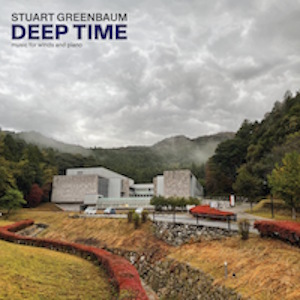
Stuart Greenbaum (b. 1966)
Music for winds and piano
Deep Time, sonata for bassoon and piano (2019)
Life in a Day, for bassoon and piano (2008)
Seeing Earth (2019)
Five of One Half a Dozen of the Other…? (2000)
New Roads, Old Destinations II (1997)Lyndon Watts, Nicholas Fitter (bassoon)
Leigh Harrold, Max Kielly, Anthony Lais (piano)
Lindsay Hicks (oboe)
Ensemble Françaix
Continuum Sax
rec. 2001-23, Melbourne, Australia
Salisbury Records SR 040326 [60]
This disc covers almost twenty-five years of compositions by Stuart Greenbaum, now Professor Emeritus at the Melbourne Conservatorium of Music. All are for wind instruments with or without piano and prove an excellent snapshot of the composer’s varied style. As with his rather splendid Piano Sonata No. 3 which I reviewed in March (review), the composer gives us quite detailed notes as to the background to the various works but I once again found it more beneficial to just listen and respond to the very appealing and accessible music.
The first work on the disc, from which it takes its title, is the three-movement bassoon sonata Deep Time. This is the seventeenth in a series of sonatas for various instruments that the composer has written since 2000. Astonishingly for a twenty-one-minute work, it was written in only three days in September 2019. The three movements entitled The Abyss of Time, Deep Time, Ghosts of the Anthropocene, are his response to various philosophical ideas from 1788 to the present day concerning “Deep Time” that spans billions of years, far beyond the scale of human experience.
It is a largely meditative work that makes excellent use of the wide-ranging timbres of the two instruments. The bassoon plays from the top of its register to the bottom and Lyndon Watts, for whom the work was written, proves fearless in facing its considerable challenges. Much use is made of grace notes which help to distort the sense of pulse in the work. The final movement takes some ideas from Henry Cowell’s The Aeolian Harp, when the pianist is asked to silently depress chords on the keys while gently strumming the strings to sound the chord. It works very effectively in conjuring the “ghosts” of the movements title.
The other works on the disc reminded me of the sound world of the iconoclastic British composer David Bedford (1937-2011) who over his career upset purists, in both camps, by using popular music in a classical context and vice versa. So, too, does Greenbaum allow popular styles to unexpectedly bleed into these art music works. I wonder if critics get as annoyed with him as they did with Bedford, or have times changed?
Life in a Day was originally for shakuhachi and harp but is here given on flute and piano. The original combination must have been something special, allowing the special effects of which both instruments are capable. Here, it is an enjoyable, slightly poppy work coloured with some Japanese sounding moments. There is on YouTube another even jazzier version for marimba and saxophone.
Seeing Earth, is a fifteen-minute work for oboe, bassoon and piano inspired by Peter Chelsom’s rather maudlin and poorly received 2017 film, The Space Between Us. In the film there is a scene where a human boy (Asa Butterfield), born on Mars, sees Earth for the first time, initially from a distance and then experiences it on land. The film had music by Andrew Lockington, but this score makes no reference to it. This trio has a timeless, magical quality about it with occasional playful episodes which may reference the young protagonists of the film. There is some extremely high writing for the oboe which is brilliantly delivered. The piano once again is called on to occasionally mute the piano strings with his fingers. The tone colours of the instruments in solo, duet, or trio are inventively explored, and it is a very attractive addition to this combination of instruments.
There is a complete change of texture in Five of One Half a Dozen of the Other…? which are four short pieces for saxophone quartet. Inspired by M. C. Escher’s optical illusions, the music uses different rhythmic possibilities to create an aural impression of his prints. The four movements called At sixes and sevens, Möbius strip, Five of one, half a dozen of the other…? and Delayed arrival (flight 7456), are delightfully inventive. The third movement builds from little groups of notes to a raunchy middle section, which the players seem to enjoy enormously.
The disc ends with another duet for bassoon and piano, with Nicholas Fritter on bassoon. New Roads, Old Destinations II, is again inspired by Escher, this time his famous 1960 lithograph, Ascending and Descending, which depicts a large building roofed by a never-ending staircase. Two lines of identically dressed men are on the staircase, one line ascending while the other descends. The composer plays with tightly controlled musical conceits to construct the work. I have always thought of the print as rather frustrating, but Professor Greenbaum clearly sees it in a more relaxed way, and the piece is a rather lyrical movement, both parties seemingly happy to continue forever.
The performances were variously recorded over a long time period but all sound fresh and immediate. Most of the performers also gave the premieres of the works and all totally ‘get’ the Greenbaum sound. The CD comes in a beautifully designed glossy cardboard case.
As I said in my previous review Stuart Greenbaum has been a real discovery for me. He is a very fine composer, not afraid to use whatever means he wants to explore his ideas. Given that the music is so communicative, I still find some of his programme notes unnecessary. His music is now published by the giant conglomerate that is Wise Music, so I hope to see it on concert programmes.
Paul RW Jackson
Availability: Stuart Greenbaum













Thanks for this, Paul! Even though you had introduced Stuart Greenbaum to me with that piano sonata disc (what a blast!) I didn’t recognize the name until reading your review. His chamber music for winds is very, very beautiful, and you’re spot on as to why: communicative, expressive, makes full use of his instruments’ timbres… I particularly loved “Seeing Earth”, which is a real watercolor of a slow movement. I’d sort of prefer to ignore the cinematic context entirely, which is exactly your point about the tendency to ‘over-explain’ this music. I’m with you: I wish they wouldn’t, it works perfectly well on its own!