
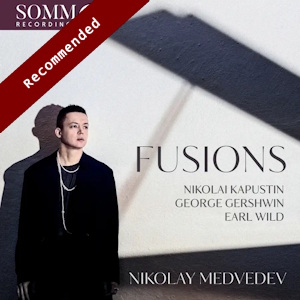
Fusions
Nikolai Kapustin (1937-2020)
Piano Sonata No.2 op.54 (1989)
George Gershwin (1898-1937)
Three Preludes (publ. 1927)
Nikolai Kapustin
Eight Concert Études op.40 Nos. 1, 2, 6-8 (1984)
Earl Wild (1915-2010)
Seven Virtuoso Etudes after George Gershwin (1954, 1973, rev. 1975)
Nikolai Kapustin
Variations for piano op.41 (1984)
Nikolay Medvedev (piano)
rec. 2025, Tonstudio Ölberg-Kirche, Berlin
SOMM Recordings SOMMCD0724 [70]
In 55 years of listening to classical music, this is the first time I have consciously heard anything by the Russian composer Nikolai Kapustin – and I am bowled over.
First things first. Kapustin definitively proves that classical composers do not have to be fusty, incomprehensible, or even well behaved. The biographers point out that by the time he began to attend the Moscow Conservatory, he could play a fugue with textbook precision and a bebop chorus with nightclub swagger, and he never saw any contradiction between the two. Despite his early training in the three Bs – Bach, Beethoven and Brahms – he spent evenings listening to the Voice of America Jazz Hour, absorbing the swing of Oscar Peterson and the colourful imagination of Duke Ellington.
Kapustin produced a masterly fusion of classical forms with the prevailing jazz idioms of his day. Much of this technique came from his years performing with the Oleg Lundstrem Big Band, touring widely and absorbing jazz from within an ensemble setting. Later, believing that composition was his true vocation, he used jazz not as a style to imitate but as a language to compose with. The result is a body of work spanning 161 opus numbers, including twenty piano sonatas, six concertos, a set of twenty‑four Preludes and Fugues that nod to Bach with tongue-in-cheek humour, and countless études, variations and suites that feel like high‑octane games for the fingers.
The recital opens with Kapustin’s Piano Sonata No.2. He wrote it at the time when Mikhail Gorbachev decided to loosen the Soviet hegemony on the countries of Eastern Europe. That created an independent, democratic momentum which led to the collapse of the Berlin Wall in November 1989, and the rapid disintegration of Communist rule throughout the region.
The Sonata is a brilliant fusion of classical forms with syncopated jazz idioms. Cast in four movements, it begins with an Allegro molto that blends bebop inflections and motoric rhythms within a traditional sonata structure. The Scherzo has an equally driving mood. There follows a deeply contemplative meditation that echoes jazz harmonies and a laid-back cocktail bar atmosphere. The finale is a toccata-like Perpetuum mobile, with energetic cross-rhythms that brings the work to a thrilling, virtuosic close. It is important to note that Kapustin is not an improviser. Even if his music often sounds like spontaneous invention, every note is written down with meticulous care.
Kapustin’s Eight Concert Études were not conceived as a set but a collection from which the concert pianist could select. Nikolay Medvedev has chosen to play five of them. The bright opening Prelude evokes Carnival time in Rio de Janeiro. It is suggested that the second Étude may acknowledge Kapustin’s home country rather than the jazz salons, engaging the pianist with dense double-note figurations. Étude No.6 Pastorale has a jaunty, ragtime, Joplinesqe rhythm to it. There is a more reflective mood in the seventh number, with its gentle promenading stride. No.8 is relentlessly toccata-like in its flurry of notes and “unstoppable energy”. Medvedev’s performance is nothing short of dazzling.
The final offering from Nikolai Kapustin is his Variations for piano. It is a difficult piece to categorise. The booklet notes suggest reminiscences of Stravinsky’s Le Sacre du printemps, but the composer made clear to Yana Tyulkova (Conversations with Nikolai Kapustin, 2019), that when he was writing the work, he was not thinking of Stravinsky at all. Other critics suggest that Kapustin had the initial bassoon passage of the Rite in mind, perhaps subconsciously. Regardless of its inspiration, the variations unfold with breathtaking speed, nodding to be-bop, Count Basie and Erroll Garner. One interesting byway here is a Rachmaninovian interlude of pure romanticism. Medvedev’s interpretation makes this an ideal entry point to Kapustin’s music, and it is easily my favourite work on the disc.
George Gershwin was rumoured to have planned a suite of twenty-four piano preludes titled The Melting Pot. As it turned out, he was to produce seven such preludes in manuscript, of which five were performed at a New York recital on 4 December 1926, where Gershwin accompanied the contralto Marguerite d’Alvarez. Three were selected for publication next year as the Three Preludes. These were the only set of solo piano pieces he published in his lifetime. Of the remaining preludes, two were later reworked as Short Story, one was rejected by the publisher for its similarity to the Concerto in F, and at least one has not survived.
Each prelude reveals Gershwin’s gift for fusing classical craft with blues harmony and jazzy rhythmic vitality. The first prelude, in B flat, is driven by a propulsive five‑note motif; the second, in C sharp minor, offers a gently melancholic “blues lullaby”; and the third, in E flat minor, has a taut, quasi‑Spanish flair.
Earl Wild was a larger-than-life American virtuoso. Ostensibly, he was one of the last great links to the golden age of pianism, reflecting Lisztian showmanship. His considerable repertoire included Dieterich Buxtehude, J.S. Bach and Mozart through to Sergei Rachmaninov, Xaver Scharwenka, Aaron Copland and Paul Creston. He recorded many of the ‘big’ standard piano concertos. To everything he played, Wild brought a sparkle, seemingly effortless glamour, and a lifelong delight in sheer pianistic bravura.
Wild transcribed seven extremely popular Gershwin Songs: Liza, Somebody Loves Me, The Man I Love, Embraceable You, Lady Be Good, I Got Rhythm and Fascinatin’ Rhythm. They were issued in two volumes in 1954 and 1973, and revised in 1975. They can be regarded as studies or études in the sense of Chopin or Liszt. Stylistically, there are allusions to these composers and to Maurice Ravel. These are not technical exercises or mere arrangements; they are vivid reworkings of Gershwin’s original songs. Just following one of these Etudes in the score is enough to make the tyro pianist wish they had learnt another instrument.
Russian pianist Nikolay Medvedev is a graduate of the Moscow Conservatory. He has built a reputation through competition successes, recital appearances, and a growing catalogue of recordings. Medvedev’s repertoire ranges widely, from Baroque clarity to the big Romantic canvases, and now the jazz-infused music on this disc.
This is a magnificent release. Nikolay Medvedev delivers the formidable, finger-busting scores with a perfect blend of classical rigor and effortless swing. He proves himself an ideal advocate for the three composers on this disc alike. Coupled with crisp sound quality and informative liner notes, this disc is an absolute triumph. To borrow from Gershwin himself—”Who could ask for anything more?”
John France
Previous review: Nick Barnard
Buying this recording via the link below generates revenue for MWI, which helps the site remain free













