
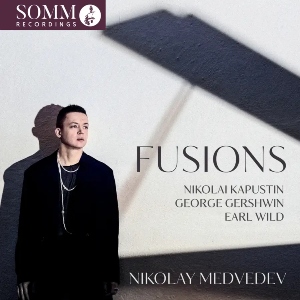
Fusions
Nikolai Kapustin (1937-2020)
Piano Sonata No.2 Op.54 (1989)
George Gershwin (1898-1937)
Three Preludes (1927)
Nikolai Kapustin (1937-2020)
Eight Concert Études Op.40: Nos.1,2,5-8 (1984)
Earl Wild (1915-2010)
Seven Virtuoso Etudes after George Gershwin (1954, 1973, rev. 1975)
Nikolai Kapustin (1937-2020)
Variations for piano Op.41 (1984)
Nikolay Medvedev (piano)
rec. 2025, Tonstudio Ölberg-Kirche, Berlin, Germany
SOMM Recordings SOMMCD0724 [70]
Russian pianist Nikolay Medvedev brings this well-planned, very well-played recital together under the title “Fusions”. The apt title represents not just the fusion of jazz and classical keyboard idioms but the various cultural influences that melded together in early 20th-century America to create what is now termed jazz.
For the listener, the interest may lie in the “compare and contrast”: how do three different composer-pianists respond to writing in what might be termed a jazz idiom? Ukrainian Nikolai Kapustin lived his entire life in the Soviet Union and then Russia. It is only in the last quarter century or so that his music has been extensively played in the West. Here is the ‘quirk’ of Kapustin’s compositions: he writes in an explicitly jazz style but his music is rigorously notated with no allowance for improvisation. Indeed, a famous Kapustin statement rejects the notion that he was a jazz musician; rather, he was a classical composer whose music should be played exactly as it appears on the page. This is strikingly different from, say, Gershwin who frequently improvised performances of his most famous and most published works, or even Earl Wild who would extemporise on his own and other’s music.
The extensive Wikipedia article on Kapustin includes a quote from a 2009 doctoral thesis at the University of Arizona: “Kapustin’s scores serve a unique pedagogical and artistic function: they provide classically trained musicians without any background in jazz improvisation a gateway to master the kinetic energy, harmonic richness, and stylistic nuances of jazz.” This encapsulates for me the success and the possible limitations of Kapustin’s music.
Nikolay Medvedev, an impressive guide, has the bravura technical skill and musical nuance to make the most of the music of all three demanding composers. The recital opens with Kapustin’s Piano Sonata No.2. This is a confident choice since it is one of the best-known, most recorded works. It is often cited as the breakthrough composition for the composer outside of Russia. Marc-André Hamelin premiered the work at a 2000 London recital which Kapustin attended. He wrote in the pianist’s score: “To dear Marc-André Hamelin from the grateful author of the Sonata No.2, that nobody will ever perform better”. Hamelin recorded the work for Hyperion (I have not heard it), as did Steven Osborne for the same label. This is easily the most-often recorded of Kapustin’s sixteen piano sonatas.
There is a considerable difference in approach between Medvedev and Osborne, especially in the opening Allegro molto. The former makes more of the ‘molto’: his driving forceful tempo contrasts with Osborne’s more playful, relaxed approach. Both are superbly technically accomplished, and simply emphasise different facets of the music. Medvedev’s hard-edged approach links this work back to those Prokofiev toccata-like movements in his sonatas. Osborne’s more mercurial style seems to ally the music to a more European jazz perspective. Roles are reversed in the 4th movement, Perpetuum mobile, where Osborne favours the fleeter basic tempo. Here I think that is generally the preferable style but again it is nip and tuck. The sonata is a substantial work, around 23 minutes. The skill of the performance notwishdtanfing, I am not really sure the material is worthy of the time-span.
I am sure that those who have made a deep analytical study of this sonata will be able to point to how well it adheres to traditional sonata-form. My main concern with much of Kapustin’s music is that it can sound like a series of jazz-inflected gestures and riffs. Suddenly there will be a passage of stride piano or bluesy harmony or boogie-woogie. These are always interesting, effective and recognisable but to my ear they somehow steadfastly remain only gestures. A lot of Kapustin’s later professional work was as a pianist recording soundtracks for Soviet and Russian cinema, so he was a past-master at producing and playing music of maximum effect. There is for me too much of a sense that this mimics rather than inhabits the jazz idiom.
I feel that Gershwin’s and Wild’s music points up this mimicry – in different ways. Gershwin lacked a fraction of Kapustin’s formal training. He is well-known for seeking a kind of classical validation by approaching the likes of Ravel for composition lessons. As mentioned before, actual improvisation lay at the heart of much of his own playing. Yet when the definitive version of Three Preludeswas published, the fusion between the spirit of jazz and the formality of the printed page was supremely successful. The preludes get another exhilarating performance from Nikolay Medvedev. Allegro ben ritmato e deciso has a strutting arrogance (helped by the rich bass resonance of the Bechstein D282 Concert Grand on this recording). In the central Andante con moto e poco rubato,Medvedev picks a fairly flowing tempo. More unusually, he chooses to play the quavers and eight notes of the main melody as swung. I do not know another version that does that, including such jazz/classical cross-over luminaries as André Previn and Michael Tilson-Thomas, or Gershwin specialists like Alicia Zizzo or Norman Krieger. Even the Harmonie Ensemble’s recreation of a 1930s orchestral version by Roy Bargy plays straight eighths. The third prelude again has a nervy slightly brittle energy to it, which is consistent with Medvedev’s general approach across the entire disc.
Kapustin’s Eigth Concert Études again appear on several collections of his music, including Hamelin’s first Hyperion disc from 2004. Recently they were the slightly odd choice filler for Nobuyuki Tsujii’s Rachmaninov Piano Concerto No.2on Avex Classics. More logically Catherine Gordeladze’s Naxos disc couples them with the complete 24 Preludes in Jazz Style. As Robert Matthew-Walker points out in his liner notes, this set was not conceived to be always performed complete (although the versions above are of all eight pieces). Medvedev plays five, leaving out Nos.3-5.
The chosen five, well-contrasted, make for an effective “suite” in their own right. I still cannot quite get rid of the nagging feeling that this is very accomplished – and fun – pastiche. If you want to hear just how brilliant and dextrous Medvedev’s technique is, try No.8 Finale. Next to him, the accomplished Gordeladze sounds a fraction effortful and sturdy. Listening to this kind of movement, you can understand why international virtuosi such as Yuja Wang have added Kapustin to their encore repertoire. This type of movement is guaranteed to bring the house down.
Remarkably, Earl Wild heard George Gershwin play both Rhapsody in Blue and the Piano Concerto in F, so he had first-hand experience of how Gershwin would ‘expand’ on the written score in performance. The so-called Gershwin Songbook of 1932 was in effect a commercial decision to produce for the public the composer’s own transcriptions for piano alone of eighteen of his most popular songs. There is little doubt though that these are simplified and abbreviated versions of the kind of versions Gershwin would perform at private parties. Earl Wild’s Seven Virtuoso Etudes after George Gershwin are probably closer to the display pieces the composer would have played, albeit refracted through the lens of one of the last truly great keyboard virtuosi in the spirit of the 19th century keyboard lions. Wild’s particular genius is somehow to balance the true spirit of the original songs and jazz with display virtuosity. Of course it helps that these are all great tunes and standards of the Great American Songbook.
Medvedev is once more nonchalantly virtuosic in exactly the way this music needs. I also find his expressive rubato to be wholly effective. Competition is again fierce – not least from Earl Wild himself. Wild was in his mid-70s by the time he recorded them for Chesky Records in 1989. Perhaps the last drop of phenomenal virtuosity was dulled by then but these are seminal performances. Xiayin Wang’s version (review) gained a record-of-the-month status. Both of those recordings are finer than the Brilliant Classics Collection version which includes this as part of a complete survey of Wild transcriptions. The pianist there, Giovanni Doria Miglietta, is good but not at the level of the other three I mentioned. In my review of the Wang disc, I described I got rhythm as having the character of a moto perpetuo music box with a cog loose and “the way it slips through keys and rhythmic side shifts is wonderfully witty and capricious”. Medvedev also captures these qualities. Interestingly, he is very close to Wild in tempo and feel in Oh lady be good but here I prefer, on grounds of personal taste, Wang’s late-night bluesy approach.
One more Kapustin work completes this well-filled disc. The theme in the Variations for Pianois apparently original. Even so, the notes for Hamelin’s recording say: “[it] 0moves between a jazzed-up rendition of the solo bassoon motive that opens Stravinsky’s Le sacre du printemps (‘the rite of swing’, if you will!) and a descending, bluesy gesture.” The variation form allows the composer to exercise his predilection for bouncing different styles off each other in close musical proximity. Certainly it makes for a high-octane storming conclusion to the disc. Nikolay Medvedev carries it off with complete confidence.
All of the music here can be found on many other recordings, but by definition the programme as presented here is unique. The brilliance of Nikolay Medvedev’s playing is backed up by very fine engineering: the piano sound is a delight from first to last. So, if the music itself appeals, this recital of the highest quality will bring pleasure to many.
Nick Barnard
Other review: John France
Buying this recording via the link below generates revenue for MWI, which helps the site remain free













