
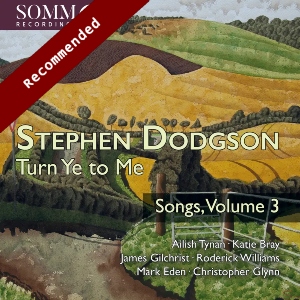
Stephen Dodgson (1924–2013)
Turn Ye to Me — Songs Volume 3
Ailish Tynan (soprano), Katie Bray (mezzo-soprano), James Gilchrist (tenor), Roderick Williams (baritone)
Mark Eden (guitar), Christopher Glynn (piano)
rec. 2021, Potton Hall, Saxmundham, UK
Texts included
Reviewed from a AAC download: 96 kHz/24-bit
SOMM Recordings SOMMCD0720 [62]
This is the third issue of an invaluable series of Stephen Dodgson’s songs on the Somm Recordings label. The first volume was issued in 2022 and I reviewed it in early 2024 (review). Volume 2 was released in 2023 but seems not to have been reviewed on MusicWeb. The contents of all three volumes were probably recorded at the same sessions in February and October 2021, and most of the performers are common to all three.
I can do no better than to direct readers to my colleague Dominic Hartley’s long review of the present volume in which he pays close attention to a singular feature of Stephen Dodgson as a song composer, his tendency to adapt, sometimes extensively, his chosen texts to suit his musical needs. All the poets in the present collection are subjected to Dodgson’s modifications, and these are meticulously detailed in the booklet. Much of the poetry is both obscure and minor, but neither Wilfred Owen nor Cecil Day-Lewis’s words were immune to Dodgson’s tinkering.
The first items in this collection, to words of T.L. Beddoes, date from 1953 and demonstrate that Dodgson’s skill at finding the right music for the texts he chose to set was already well established even at the beginning of his career as a composer. The third song, for instance, introduces us to Adam and Eve, a couple of carrion crows who, having recently ‘supped on the king’s marrow’ give us a song that can be placed somewhere between the jovial and the grotesque. The harsh chords that punctuate most of Winter Heavens might be seen as an appropriately bitter accompaniment to a poem that, ostensibly about nature, goes on to explore wider issues.
Daphne to Apollo, quite a long song at 6 minutes, begins with Apollo’s proposal of betrothal, then passes to Daphne’s answer and closes with ‘the contract’, her formal acceptation and final conditions. Dodgson has chosen to underline her somewhat business-like manner, characterised both in the guitar accompaniment and in the sometimes florid vocal part. The contract, for instance, is briskly dispatched! The original poem is by Matthew Prior (1664-1721), previously unknown to me but celebrated enough to be buried in Westminster Abbey. Celebrated or not, Dodgson subjects the text to lengthy cuts, changes of word order and even minor additions. The singer plays both roles in this song, and the guitar is a real participant rather than a bystander. Robert Matthew-Walker describes this song as ‘utterly compelling’, and I agree with him.
It might seem irreverent to describe music by a distinguished composer as ‘good, clean fun’, but I will do so all the same in the case of his Bush Ballads, 18 settings of ‘Australian Folk Verses’ arranged in three sets to texts taken from The Penguin Book of Australian Ballads. Here we have the third set, which begins with a song in which the narrator recites a lengthy list of animals all of which ‘have a mate but me!’ The second narrator good-naturedly reveals all that is ‘grand’ about life. The light-hearted nature of both these texts is brilliantly brought out by the vocal writing for mezzo-soprano and baritone duet, and perhaps even more so by the deliciously piquant accompaniments. The third song is a gentle portrait of Whalen, whose tranquil rhythm of life is reflected in the name of the place where he lives, ‘Waitin’-a-While’. These are lovely songs, but so quirky that one wonders how many performers will know of them, still less take them up. Prospective performers might be able to purchase the scores, in Dodgson’s immaculate and unmistakeable hand, at the website devoted to the composer’s music, a site well worth a visit for many other reasons.
The Stone, a masterly setting of an enigmatic poem, is characterised by advanced harmonic language in the piano part. Turn Ye to Me, that follows, is a lovely arrangement of a Hebridean folk song in which the melody is beautifully supported by the apparently simple accompaniment. A closing vocalise followed by a repeat of the final words brings the song to a touching close.
Stephen Dodgson was not a guitarist himself, yet he made a major contribution to the instrument’s repertoire. He was already a highly experienced composer for the guitar by the time he wrote the tenor and guitar song-cycle, London Lyrics, with two concertos, for example, and the superb Duo Concertante for guitar and harpsichord behind him. Like many, perhaps most, of his music, this work was written at the request of specific performers, the guitarist Anthea Gifford and the tenor Neil Jenkins. The five texts are drawn from widely diverse sources, and all deal with some aspect of the city where he was born and where he lived all his life. With the opening song, a humorous love/hate tribute to London that ends with a delicious sign-off, to the closing, serious meditation that follows the path of the Thames, this is a major work.
As in Volume 1, there are two extracts from the solo piano set of 1956 entitled Eight Fanciful Pieces. ‘Il Zoppo’ is terse and dry, whereas ‘Mirage’, inviting significant use of the sustaining pedal, is more pensive and poetic. Christopher Glynn shows both here and in the song accompaniments how deeply he is immersed in Dodgson’s very particular style, and indeed, this was clearly a labour of love for all the performers. The composer would have been delighted.
Anyone who has read my review of an excellent book celebrating the centenary of Dodgson’s birth will know that in the early 1970s I spent four years as one his composition pupils. The fact that I learnt far more about music in general than I did about being a composer was my fault rather than his. He was an easy communicator – witness his years as a broadcaster on BBC Radio – and was able with a very few words to offer great insight into a particular composer or work. His own compositions, tonal but with more than a touch of piquancy of melody and harmony, communicate too, but it is not easy music to characterise, and a listener will often need to hear a piece two or even three times before its beauties and subtleties begin to become clear.
William Hedley
Previous review: Dominic Hartley (Recording of the Month)
Contents
Three Songs (to words of T.L. Beddoes) (1953)
Tandaradei
Dirge
The Old Crow of Cairo
The Mower to the Glow-Worms (1956, Andrew Marvell)
Winter Heavens (1950, George Meredith)
Daphne to Apollo (1977, adapted from Matthew Prior)
From Eight Fanciful Pieces (1956)
Il Zoppo
Mirage
Bush Ballads (Third Series) (1974–2003)
All Got a Mate (Anon.)
Song of the Squatters (A.B. ‘Banjo’ Paterson)
Waitin’-a-While (Jim Grahame)
The Stone (1950, Hal Summers)
Turn Ye to Me (1950, Christopher North)
London Lyrics (1977)
London is a Milder Curse (Pierre Antoine Motteux)
Shadwell Stair (Wilfred Owen)
From a Ship, Tossing (Arthur Hugh Clough)
Margaret, Maud and Mary Blake (George Rostrevor Hamilton)
River Music (Cecil Day-Lewis)
Buying this recording via the link below generates revenue for MWI, which helps the site remain free













