
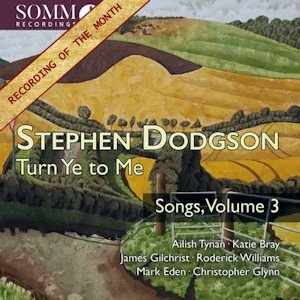
Stephen Dodgson (1924–2013)
Turn Ye to Me — Songs Volume 3
Ailish Tynan (soprano), Katie Bray (mezzo-soprano), James Gilchrist (tenor), Roderick Williams (baritone)
Mark Eden (guitar), Christopher Glynn (piano)
rec. 2021, Potton Hall, Saxmundham, UK
Texts included
Reviewed from a AAC download: 96 kHz/24-bit
SOMM Recordings SOMMCD0720 [62]
The handwritten score for Stephen Dodgson’s 1977 song Daphne to Apollo tells us a number of things about the care Dodgson took in shaping the vision the text inspired (a poem by Matthew Prior). It’s meticulously presented, typical of Dodgson’s skilful penmanship. Performance directions, too, abound, starting with the instruction to the guitarist, ‘declamando: misurato’ (declamatory and measured). And the whole thing is obviously less a song than a miniature scena: there’s an ‘Address’ from Apollo, Daphne’s ‘Reply’, and then ‘The Contract’, all clearly labelled and sectioned. What won’t immediately strike you, unless you’re familiar with Augustan poetry, is Dodgson’s editorial genius. Prior’s original is a witty reworking of the Daphne myth, in which the pursued nymph stops running and starts negotiating. The comedy lies in the bathetic descent from mythological register to domestic contract: the longer Daphne talks, the further we get from Ovid and the closer to Restoration comedy. Dodgson’s response to the text was to cut it heavily. By removing the most extended passages of domestic negotiation, he concentrates the text into a more compact dramatic scenario. What’s lost is the leisurely, discursive wit that makes Prior enjoyable to read at length. What’s gained is dramatic focus suitable for a song. It works brilliantly, as we’re able to hear in the performance by Katie Bray and Mark Eden on this welcome third (and final) volume of Dodgson songs from SOMM. Bray encapsulates the voicing and the drama perfectly, and Eden’s guitar provides a subliminal commentary, giving us an insight into the unspoken abashment and surprise of the god confronted with the highly purposeful ‘beauteous maid’ he’s besotted with.
How Daphne works is important, because the editorial instinct behind it turns out to be central to the whole recital. By the time of its composition Dodgson had been writing songs for over thirty years. There’s nothing quite as early on this disc as Volume 1’s Slow, Slow, Fresh Fount, Dodgson’s baroque setting of Ben Jonson from 1946, but there’s a more representative selection of his earlier work here, and taken together the songs offer a chronological tutorial in how his relationship with his texts evolved. Three settings date from 1950. Meredith’s Winter Heavens is called a ‘fine poem’ by Robert Matthew-Walker in his excellent booklet notes. I think that’s only partly true. The octave is genuinely impressive, possessing a visionary intensity. The sestet far less so: archaic, portentous, and, in places, obscure. Dodgson, I think, saw this. The two cuts he makes from the poem remove precisely the phrases where Meredith’s reach most visibly exceeds his grasp. His setting deliberately compounds the octave/sestet fracture, reaching its climax at the end of the octave on ‘The living throb within me…’, the singer’s voice immediately falling for the line’s conclusion, ‘…the dead revive.’ Thereafter the remaining lines have a quality of increasing eeriness and uncertainty, concluding on a held, disconcertingly low C sung pianissimo on the word ‘felt’. It’s very clever writing: you do very much ‘feel’ something rather more ambiguous than Meredith’s attempt at comfort in invoking the ‘Soul’s haven’. James Gilchrist has an intuitive understanding of the effect Dodgson was after, and his almost unemotional rendition works perfectly.
Hal Summers is a sadly largely forgotten poet in 2026, but had made a mark on the contemporary literary world with two collections published in the 1940s when Dodgson came to set The Stone. Its central metaphor — a stone dropped into a lake by the arrival of a letter, the disturbance gradually subsiding to apparent calm while the stone remains permanently on the bottom — is handled with considerable skill. Even so, Dodgson’s cuts here are substantial. What remains feels lean and deliberate, and his approach to the central metaphor is founded on some of his most imaginative piano writing: an exquisite, unsettling motif of rising quavers, like an extended split chord, immediately evoking the widening ripples of the poem, sensitively sustained here by Christopher Glynn under Gilchrist’s impeccable narration.
The third of the 1950 settings is Turn Ye to Me, a literary imitation of Hebridean folk poetry by Christopher North. There is nothing here to criticise because nothing here aspires to literary originality. Dodgson treats it accordingly. The music has a deliberate simplicity, the piano part playfully toying with the 3/4 rhythm in different patterns in each hand and over bar lines supporting the unpretentious melody. Roderick Williams knows how to sing this — without affectation or unearned profundity — and the result is very touching.
Dodgson’s settings of three poems by Thomas Lovell Beddoes, composed in 1953, are fascinating. Beddoes was a poet whose sensibility runs against the grain of Victorian respectability — macabre, comic, sometimes grotesque, always formally assured — and whose voice is recognisably his own. Ailish Tynan makes the most of the dramatic opportunity offered by the first poem, Tandaradei (a translation of Walther der Vogelweide’s Under der linden) relishing the lilting compound rhythm in the song’s first stanzas, sounding positively blissful, then hushed and awed for those depicting consummation and appropriately reflective for its conclusion. It’s a lovely cameo.
Dirge is Beddoes at his best. The formal control is remarkable: the short lines carry emotional weight because they are so compressed, the longer lines unfurling around them like the sea-wave the poem invokes. Dodgson’s setting is correspondingly restrained. The dynamic arc of the song follows the poem’s own two-part shape rather than imposing anything on it, and the harmonic language stays within a defined tonal territory throughout. Gilchrist’s delivery is gravely beautiful, and Glynn’s piano part hovers beneath him with the tact of someone who understands that the words are doing the work.
The Old Crow of Cairo is dramatic and chilling, depicting a carrion crow married to his ‘grey carrion wife’, nesting in Cleopatra’s cracked skull. Glynn’s superb rendition of Dodgson’s piano part does a lot of the work atmospherically, allowing Gilchrist to float the unsettled recitation with acuity. As with the first two poems Dodgson changes almost nothing textually: the poem’s rhythmic propulsion and tonal assurance need no help.
Marvell’s The Mower to the Glow-Worms, set by Dodgson in 1956, is, I think, the finest poem in the recital. The conceit is developed with perfect logical control through four stanzas, each of which redefines the glow-worms’ light in a new way before the final stanza turns the whole structure inward to reveal that the speaker is the one who is truly lost, displaced by love, beyond the reach of any guiding light. Apart from a trifling detail Dodgson leaves Marvell’s text alone. What is remarkable — and what strikes me as the clearest signal of his compositional temperament — is how differently his music behaves in the presence of a poem that needs no help. The harmonic language is more settled than in any of the works we’ve considered so far, and the dynamic profile restrained throughout, the music reaching a modest climax before subsiding immediately. Tynan’s soprano sits naturally in the vocal line, and the piano writing is quietly supportive rather than textually independent. Dodgson is offering a reading that complements Marvell. The music’s self-effacement is itself a kind of critical judgement.
By the time we reach 1977, Dodgson had been making these calibrations for a considerable time. The signs of his editorial discrimination are already present in the 1950s — the quiet cuts to the Meredith, the substantial reshaping of the Summers, the near-total restraint with the Beddoes and the Marvell — but nothing quite prepares us for the radical treatment seen in Daphne to Apollo, composed in the same year as the London Lyrics. The London Lyrics show more editorial intervention at the textual level, with Dodgson cutting lines, substituting words, and adjusting syntax across the cycle. But more interesting still is his selection of the poems. All five are flawed to one extent or another.
Motteux’s London is a Milder Curse is a satirical catalogue whose rhymes do the feeble structural work and whose concluding twist (the nagging wife is worse than the city) was a Restoration cliché by the 1690s. Owen’s Shadwell Stair benefits enormously from his reputation as a war poet and suffers badly under scrutiny without it: the ABBA quatrains trap him into lines like ‘Dolorously the shipping clanks’, where ecclesiastical Latin smothers any chance of sensory contact with its subject. Clough’s From a Ship, Tossing adopts the posture of homesickness without earning it, and lurches between metres without the control to make the variation feel purposeful. Hamilton’s Margaret, Maud and Mary Blake stretches a single visual observation — Thames tugs as English dowagers by day and exotic queens by night — across eight unyielding lines. Day-Lewis’s River Music reaches for Eliot without Eliot’s rigour and grounds the whole thing in a Thames-as-muse conceit that was threadbare before he touched it.
So: five imperfect poems, porous texts that left room for Dodgson to work. Crucially he chose the guitar rather than the piano for the accompaniment. A piano setting would inevitably have brought with it the weight of the English art-song tradition — the pianistic idioms of Finzi, Gurney, Butterworth, Warlock — and might have placed these poems in a company they could not possibly sustain. The guitar changes everything. It offers a lighter, more transparent texture in which Dodgson’s harmonic and rhythmic invention can carry more of the load, and in which the unevenness of the verse becomes less exposed.
Every one of the five London Lyrics carries a performance direction that tells you something about where that interest lies. London is a Milder Curse is marked ‘brisk and rhythmic’ in 3/2, an unusual metre that keeps Motteux’s catalogue moving. Shadwell Stair is ‘with suppressed tension; steady pace’ in 5/4, the asymmetry pushing against the trundling ABBA rhymes. From a Ship, Tossing is ‘turbulent’ in 6/8, the compound rhythm doing the work of seasickness that Clough’s verse never quite achieves. Margaret, Maud and Mary Blake is ‘gentle: melodious’ in 7/8. River Music is ‘fluent: sustained’ in common time. In each case Dodgson’s metrical decisions do what the verse ought to have done and doesn’t.
Gilchrist is the linchpin of the recital, and he rises to everything the cycle demands of him: the mock-grievances of the Motteux, the spectral evenness of the Owen, the compound-time lurch of the Clough, the transformation from daylight to midnight in the Hamilton, the grand cumulative sweep of the Day-Lewis. Mark Eden’s guitar is his equal partner — alert, colouristically varied, and responsive to the smallest shift in vocal weight.
Matthew-Walker’s booklet notes rightly compare the cycle to Walton’s 1962 A Song for the Lord Mayor’s Table. The comparison is worth pressing further. Walton set poets of considerably higher calibre — Blake, Wordsworth, Herrick — and his music has less room to manoeuvre because the poetry has already done so much of the work. Dodgson’s more modest texts give him more freedom, and his guitar writing flourishes precisely where the poems are thinnest. It is the same genre in name only: one is music in the service of poetry, the other is music that has identified the poetry as raw material and worked it accordingly.
Which brings me back to the point I’ve been circling since the opening paragraph. Dodgson strikes me as a composer whose primary creative act is neither the invention of melody nor the construction of striking harmony — though he is plainly capable of both — but the critical reading and reshaping of his source texts. He reads, he selects, he cuts and substitutes and restructures, and then he calibrates his musical response to whatever the text still needs. When the text is strong (Marvell, Beddoes at his best) he stands back. When the text is partly strong (Meredith, Summers) he excises the weaknesses and writes music that enhances what remains. When the text is weak but useful (the Prior, the London Lyrics poets) he treats the text as a libretto to be reshaped in the service of his own musical conception. This is a distinctive and unusual compositional identity, and the current album, with its extraordinary range is uniquely well placed to demonstrate it.
That leaves the Bush Ballads (Third Series) and the two piano pieces. I feel the same about the Ballads as I did about the Second Series on Volume 1: they are enjoyable and unpretentious, and Dodgson’s handling of the folk-idiom is deft, but they do not quite compel the attention the way the art-songs do. Katie Bray and Roderick Williams perform them with real affection. The two piano pieces from the Eight Fanciful Pieces are an enjoyable and technically demanding interlude, dispatched by Glynn with real flair.
The recording, made at Potton Hall, Saxmundham, almost five years ago, is SOMM at its best: warm, present, and perfectly balanced. Documentation is as usual first class — not only Matthew-Walker’s fine notes but full texts with footnotes that explain every one of Dodgson’s textual interventions. A label prepared to go to this kind of trouble in 2026 deserves more than a routine nod of appreciation.
What this disc sends me back to, in the end, is not just the music but the nature of the song-composer’s craft itself. This album reveals a composer whose relationship with his texts is more active and more critically alert than the art-song composers I’ve mentioned. Having the opportunity to hear the music he went on to make from those texts in performances of this quality is a real gift.
Dominic Hartley
Other review: William Hedley
Contents
Three Songs (to words of T.L. Beddoes) (1953)
Tandaradei
Dirge
The Old Crow of Cairo
The Mower to the Glow-Worms (1956, Andrew Marvell)
Winter Heavens (1950, George Meredith)
Daphne to Apollo (1977, adapted from Matthew Prior)
From Eight Fanciful Pieces (1956)
Il Zoppo
Mirage
Bush Ballads (Third Series) (1974–2003)
All Got a Mate (Anon.)
Song of the Squatters (A.B. ‘Banjo’ Paterson)
Waitin’-a-While (Jim Grahame)
The Stone (1950, Hal Summers)
Turn Ye to Me (1950, Christopher North)
London Lyrics (1977)
London is a Milder Curse (Pierre Antoine Motteux)
Shadwell Stair (Wilfred Owen)
From a Ship, Tossing (Arthur Hugh Clough)
Margaret, Maud and Mary Blake (George Rostrevor Hamilton)
River Music (Cecil Day-Lewis)
Buying this recording via the link below generates revenue for MWI, which helps the site remain free













