
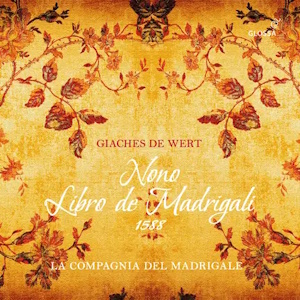
Giaches de Wert (1535-1596)
Nono Libro de Madrigali, 1588
La Compagnia del Madrigale
rec. 2025, Confraternita dei Santi Rocco e Sebastiano, Cumiana, Italy
Texts and translations included
Reviewed as a download
Glossa GCD 922813 [58]
When Giulio Caccini, with his Nuove Musiche of 1601, propagated a close connection between text and music, he only expressed a goal composers of previous generations had pursued with different means. In the second half of the 16th century, several composers aimed at illustrating words and phrases in their musical settings; it was especially the genre of the madrigal which was the vehicle for their experiments in this field. That is why the musical figures they made use of, were labelled madrigalisms. One of these composers was Giaches de Wert.
De Wert was a representative of the Franco-Flemish school. He may have been born in Ghent, but next to nothing is known about his formative years. It seems likely that he was taken to Italy, when he was still a boy. That was not uncommon; the Flemish chapel in Madrid, for instance, included boys who were taken from Flanders. Wert seems to have spent his boyhood in Avellino, near Naples, in the household of Maria di Cardona, Marchesa of Padulla. Four places played the main role in his career: Novellara, Milan, Mantua and Ferrara. When he was in Ferrara, he became acquainted with Cipriano de Rore, at the time the main composer of madrigals. The county of Novellara was ruled by a branch of the Gonzaga family. It is probably thanks to these ties that he was able to work as maestro di capella at the court of the governor of Milan. In 1565 he became maestro di capella at the court of Mantua.
De Wert composed a considerable amount of sacred music, but most of it has been preserved in manuscript, including a number of masses. Only three books with motets were printed during his lifetime. In comparison his contributions to the genre of the madrigal are far better-known, due to the many printed editions: sixteen in total. The disc under review includes the complete ninth book, which was published in 1588. It is notable that it includes three madrigals for six voices, whereas nearly all other books are entirely for five voices.
The ninth book came from the press only a few months after the death of Wert’s employer, Duke Guglielmo Gonzaga of Mantua. Marco Bizzarini, in his liner-notes, states that “[with] this new collection, the experienced composer sought to win the favor of his successor, Vincenzo Gonzaga (…).” The first madrigal, Or si rallegri il Cielo, specifically refers to the latter’s coronation, and opens thus: “Now let Heaven rejoice, and Mantua take pride, for you hold her scepter and her mantle.” Another madrigal is also connected to the new Duke: Mesola, il Po da lato, e ‘l mar a fronte is in praise of his hunting estate on the delta of the river Po. The text was written by Torquato Tasso. He is also the author of the text of Ha Ninfe adorne e belle, which is dedicated to Margherita Gonzaga, Vincenzo’s sister, wife of Alfonso II d’Este. She was a patron of the Concerto delle Dame at the Ferrara court.
Five texts are taken from Francesco Petrarca’s Canzoniere. One of them is the ingenious Mia benigna fortuna e ‘l viver lieto, which consists of two stanzas. The last word of each line of the first returns as the last word of a line of the second. The opening of the first stanza is bright and joyful, but the atmosphere turns in the last section of the first stanza: “All, suddenly turned to grief and tears, make me hate life and long for death.” It goes on in the second stanza, opening with the words “Cruel, bitter, pitiless Death, you are the cause that I can never be glad”. This emotional turnaround is illustrated in Wert’s setting, going from consonances to dissonances.
It is just one of the madrigals where Wert shows his mastery in setting a text in such a way that the emotions are graphically expressed. Harmony is one of the means he uses. He also depicts specific words with musical figures. An example is Valle che de’ lamenti miei se’ piena, another text by Petrarca, which includes images from nature. The second line opens with the word “fiume” (river), and this is set on a long-held figure which almost makes one see the waves moving. In the next line the “gentle birds and fishes” are also vividly depicted. Quel rosignol, che sí soave piagne uses the image of the nightingale, which is said to “weep so sweetly”. It is an example of “the ‘sweet’ kind of weeping, since poetry and music – of which the nightingale’s song is a metaphor – can express sorrow with sweetness,” as Bizzarini puts it. In this madrigal, Wert also indicates a trill figure in the soprano parts. Quite a number if madrigals include images from nature, such as Sovra un bel cristallino e puro rivo (Beside a clear and sparkling stream) and Vago augelletto che cantando vai (Pretty little bird, as you go singing).
References to death in connection to love were common at the time, comparable with the melancholic fashion in England in Dowland’s time. L’anima mia ferita ends with the line: “The weeping is the blood of the soul, flowing from the wound through which, with pain, the soul and life depart.” Another example is Di morte già sentìa il fero ultimo dardo: “I already felt Death’s cruel, final dart”. There is also the opposite, in a text by Battista Guarini: “Indeed, I was dead; but when I left you, I was reborn so that I shall never die again” (O come vaneggiate, Donna).
Something one probably won’t expect in a book of madrigals is a spiritual piece on a text by Petrarca: Padre del ciel, dopo i perduti giorni – “Father of Heaven, after the lost days, after the nights spent wandering with that fierce desire that inflamed my heart.” It comes to an expressive close on the line “Remember how, on this day, you hung upon the Cross.”
The madrigals by De Wert have received quite some interest, but the number of complete recordings of single madrigal books is rather limited. That is hard to understand. This recording of the ninth book seems to be the very first. It was about time that it was recorded, given the quality of these madrigals. There is hardly a better ensemble to take care of that than the Compagnia del Madrigale. These singers work together on a regular basis, and that allows them to adapt their singing to each other. That is essential in this repertoire, as is a perfect intonation, which is needed to make sure that both consonances and dissonances come off and don’t miss their effect. It is certainly helpful that Italian is their native language, which – in combination with their wide experience of singing madrigals – guarantees that they not only pronounce the texts correctly, but also understand and are able to communicate their meaning.
As a result, this is an impressive display of the art of Giaches de Wert.
Johan van Veen
http://www.musica-dei-donum.org
https://twitter.com/johanvanveen
https://bsky.app/profile/musicadeidonum.bsky.social
Buying this recording via the link below generates revenue for MWI, which helps the site remain free
Contents:
Or si rallegri il Cielo (I)
L’anima mia ferita (IX)
Vago augelletto che cantando vai (IV)
Valle che de’ lamenti miei se’ piena (III)
Quel rossignol, che sí soave piagne (XI)
Ecco che un’altra volta, o piagge apriche (II)
Mia benigna fortuna e’l viver lieto (VII)
Sovra un bel cristallino e puro rivo (V)
Un bacio solo à tante pene, hai, cruda? (XII)
Di morte già sentìa il fero ultimo dardo (VIII)
Mesola, il Po da lato, e’l mar a fronte (XIII)
O come vaneggiate, Donna (X)
Ha Ninfe adorne, e belle (XIV)
Padre del ciel, dopo i perduti giorni (VI)













