
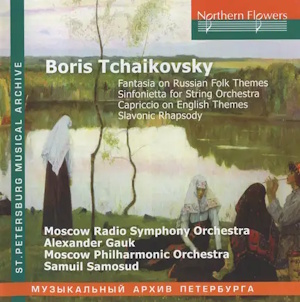
Boris Tchaikovsky (1925-1996)
Fantasia on Russian Folk Themes (1950)
Sinfonietta for String Orchestra (1953)
Capriccio on English Themes (1954)
Slavonic Rhapsody (1951)
Moscow Radio SO/Alexander Gauk (Fantasia; Sinfonietta); Moscow PO/Samuil Samosud (Capriccio; Rhapsody)
rec. 1952 (Fantasia); 1954 (Capriccio); 1955 (Sinfonietta); 1957 (Rhapsody), Moscow; ADD
Northern Flowers NF/PMA 9957 [62]
Gauk and Samosud were the young Boris Tchaikovsky’s first celebrity good angels. They recorded and performed his music in concert and on the radio. Their work and the voice of the young Boris can at last be heard in these contemporaneous vintage mono recordings of works written in the 1950s and transcribed from LPs in the composer’s personal archive; I applaud their revival.
Using themes of his own devising as well as those taken from the folk collections of Balakirev and Rimsky-Korsakov, the composer here spins a feel-good confection. It’s in the long tradition of Russian nationalism but with an early 20th century toughening. For example, there are several moments where Shostakovich puts in an appearance and once, at 8:50, the groan of the brass recalls Khachaturian. Speaking of the brass, they are thoroughly Soviet with the beloved rasp and warble that has been so much diluted by international homogenisation of orchestral sound. You can sample this again with the French horns at 3:04 in the Rhapsody (tr. 7). The piece ends with a weighty epic pace.
The Capriccio on English Themes – Shostakovich also took an interest in English song – opens in emulation of the bagpipes. There are two intentionally wheezy clarinets and a musing pastoral reflection. We are not spared the Rowlandson eccentric-absurd aspects of the English character either (4:12). We are treated to a romping bustle with fragments of Bladon Races flying left, right and centre. The Slavonic Rhapsody is in three pause-less sections making sport with themes from Bulgaria, Poland and what was the then Czechoslovakia. The pulse is steady and steadfast in the first movement which is a sort of soliloquy. The Polish movement is livelier with some pepper in the harmonic corpuscles, as in the brass writing at 2:51. The exuberance of this movement is punctuated with tambourine impacts.
We put the predominant folk accent to one side for the Sinfonietta for Strings. It’s a melodic four-movement piece which comes across as a sort of modern counterpart to Tchaikovsky’s Serenade for Strings. Both works are prone to sentimentality – take the start of the Variations movement (tr. 4) as an example. This work is consistently inspired with touching, ideas and highly skilled springheel writing. If you are wondering about parallels beyond the Serenade for Strings then the Wirén Serenade is not a bad comparator.
The notes in Cyrillic and English translation are by those latest good angels to Boris Tchaikovsky’s music: Pyotr Klimov and Igor Prokhorov.
Rob Barnett
Previous review: Jonathan Woolf
Buying this recording via the link below generates revenue for MWI, which helps the site remain free













