
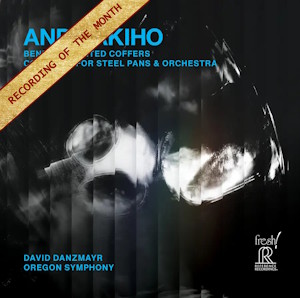
Andy Akiho (b. 1979)
Beneath Lighted Coffers (2015)
Concerto for Steel Pans & Orchestra (2011)
Andy Akiho (steel pans)
Oregon Symphony/David Danzmayr
rec. live, 2023-24, Arelene Schnitzer Hall, Portland, USA
Reference Recordings FR-764SACD [45]
Born in Columbia, South Carolina, in 1979 and currently based in Portland, Oregon, percussionist Andy Akiho discovered steel pans while he was a student at the University of South Carolina. He travelled to Trinidad, where he became involved with steel pan ensembles and becoming quite the virtuoso. Then, at the Manhattan School of Music, he earned a Master’s in contemporary performance in percussion and followed that with a Master’s in composition from Yale University. It was that institution that commissioned the final work on this disc.
The first work Beneath Lighted Coffers was commissioned by the National Symphony, in Washington DC, and was inspired by a stay at the American Academy in Rome after Akiho won the Luciano Berio Rome Prize. There he became enamoured of the Pantheon, built by the Romans in 126 A.D. The architectural marvel with its enormous, coffered dome has fascinated the world for nearly 2,000 years.
The work was written for steel pan virtuoso Liam Teague, though the composer is the soloist here. It is extraordinary how he conjures the incredible array of sounds from just one steel pan. Its five movements: “Portico,” “Twenty-Eight,” “Oculus,” “Corelli,” and “Permanence”, take about thirty minutes to perform.
I have only heard steel pans in one art music work, Brian Elias’ expressionistic ballet score The Judas Tree written in 1992 for Sir Kenneth MacMillan. There it represents “the stranger” and is very much the outsider in the orchestra. Nothing there had prepared me for the sheer brilliance and virtuosity on display here.
The first movement is a kaleidoscopic play of orchestral colour inspired by the Pantheon’s main entrance. As the portico welcomes one into the Pantheon, so this movement welcomes us into the work. Not all the tricks are shown at once and the listener is gradually drawn in by astonishing timbres on the pan and in subtly developing orchestral sounds.
“Twenty-Eight”, the second movement, inspired by the 140 sunken panels in the Pantheon’s dome is of a darker hue. The hypnotic rhythmic patterns draw the listener into the music just as the 140 panels draw the observer into the building depending on the light of the time of day.
The third movement imagines not the building, but the sky and clouds seen through the roof of the famous Oculus. The Oculus is famously still open to the sky and when it rains it falls through into the drains in the marble floor. Shimmering patterns on the drums and serene melodies in the orchestra evoke this magical sight. A beautiful extended duet between drum and harp is a magical feature of the movement.
Arcangelo Corelli is buried in the Pantheon and the very short fourth movement entitled “Corelli “is based on the slow movement of the Baroque master’s Concerto Grosso No. 3. Applying architectural/mathematical principles to Corelli’s original the composer has created an ever-changing sound world of dark fanfares and intricate filigree patterns.
The work ends with “Permanence”, a homage to the resilience of the great building from the days of Rome. Longer than the other movements, it brings the work to a scintillating and inspiring close.
The disc ends with what I guess is the Steel Pans Concerto No 1 as it predates Coffersby four years. The composer premiered it with the Yale Philharmonia under Adrian Slywotzky, a video of which is available on YouTube. That video shows a work for multiple steel drums not just one. Lasting twelve minutes the piece covers a wide range of moods and textures, from the skittish to the introspective. In listening I was reminded of Colin McPhee’s Tabu Tabuhan which was inspired by his stay in Bali. The overlapping melodic and rhythmic patterns conjure up a gamelan sound but there is so much more besides. I doubt it could be bettered as a showcase for the virtuosity possible on the steel pans. The final cadenza had my ear trying, unsuccessfully, to understand how there was only one player with two hands playing.
In both works, the orchestra under their music director David Danzmayr sound brilliant, fully attuned with Akiho’s style. Though assembled from different performances the editing has created a seamless whole.
The two concertos are an ear-opener as to what is possible on steel pans combined with orchestra. Akiho’s skill has been to take the instruments out of the vernacular and demonstrated through extraordinarily sophisticated orchestration how they could have a place on the concert platform.
My only quibble with the disc is that at 45 minutes it is too short. Having excitedly explored Akiho’s catalogue and his collaborations with the orchestra, there are any number of works that could have been included.
Paul RW Jackson
Buying this recording via the link below generates revenue for MWI, which helps the site remain free














Hi Paul– thanks so much for this review, I had never heard of Akiho before, nor had I encountered the steel pans in a classical setting to the best of my knowledge. This review really excited me to go give him a listen, and, you’re spot on in all that you say about it: virtuosic playing, colorful orchestration…in short, a breath of fresh air.
One thing I will add is how not-very-Caribbean this music is. My association with the steel pans is fully with all that wonderful Caribbean music, and Ahiko did study the instrument in Trinidad. And yet if there is a substantial influence from actual Trinidadian music here, I definitely didn’t pick up on it.
I think that’s really interesting. Neither approach would have necessarily been better than the other, but I have to admire Ahiko for imagining something totally new for his instrument and bringing it into a fresh context. That can’t be easy to do!
Thanks for your comments Andy. I had never heard of him before but he is certainly on my radar now. YouTube has videos of his fascinating Ping Pong Concerto, which is for solo violin, percussion, who do indeed play ping pong as well as other instruments, and orchestra. There is also his Timpani Concerto which was premiered in Houston in July. Definetly a composer for the BBC Proms.