
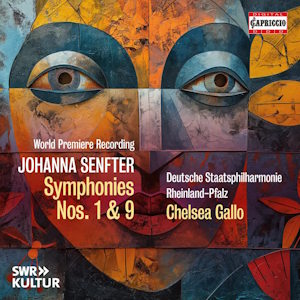
Johanna Senfter (1879-1961)
Symphony No.1 in F major Op.22 (1914)
Symphony No.9 in E flat major Op.117 (1949)
Deutsche Staatsphilharmonie Rheinland-Pfalz/Chelsea Gallo
rec. 2025, Ludwigshafen Philharmonie, Ludwigshafen am Rhein, Germany
Capriccio C5555 [71]
Another composer emerges from a century-long shadow of obscurity. Johanna Senfter’s discography is hardly extensive. According to the liner notes, there are some 134 works in her catalogue. Until now, the few recordings have focussed on her chamber and piano works. Here Capriccio present world premiere recordings of her first and last symphonies, written some thirty five years apart. One can find on YouTube an oddly cautious-sounding performance of her Symphony No.4 but that seems to be the sum total of orchestral recordings. Her work featured on BBC Radio 3’s “Composer of the Week” in March 2024. (In the UK, a 75-minute survey from that week of programmes can be found via the BBC Sounds app online.)
When is obscurity imposed, and when is it chosen? There is curiously little biographical information about Senfter, and she seems to have been responsible for this lack of detail. Her family background was one of upper middle-class affluence. She seems to have lived her whole life in Oppenheim, where she was musically active, but there is no mention of any marriage, let alone children. The liner notes describe her as an “extraordinarily shy composer [who] placed little importance on the dissemination of her own works”. Then there is the question of political alignment; the Nazi Horst-Wessel-Lied is apparently quoted – by accident or not – in her Symphony No.6. After the War, she nailed her musical colours to the mast, describing the emerging avant-garde as “atonal garbage”. There is a distinct sense that the Symphony No.9, based on a Lutheran hymn, is a defiant musical creed that clothes this melody in the musical techniques and styles of an earlier age.
Max Reger was Senfter’s mentor, teacher and friend until his untimely death at 43 in 1916. He was only six years older but it feels as though he belonged to an earlier age. Indeed, an earlier age is where you feel Senfter would have preferred to be too. The number of composers – often those disinterred from the musty vaults of history – who write in a manner ‘conservative’ for the age in which they lived is legion. With Senfter, this goes beyond a musical preference and seems to border on ideological obsession.
Both symphonies are carefully crafted and certainly make use of ‘modern’ trends – especially with regard to a very fluid approach to harmony which continuously shifts restlessly. But at the same time Senfter’s orchestration is oddly heavy and quite thick. Neither does it feel very imaginative. Many great composers utilised exactly the same orchestra as Senfter to far greater effect. It is another feature of this music that in each movement there is a certain sameness to the expressive landscape – not in the sense that it lacks dynamic contrast but rather that the general mood is not as varied. (This characteristic is not unique to Senfter’s work.)
Symphony No.1, in three movements, runs in this performance to just shy of 30 minutes. The liner notes state that “little to nothing is known about the genesis of her major works and that’s no different for her First Symphony”. She sent the score to Reger, who returned it in early 1915 with very encouraging words. There seems to be some debate whether the score is an artistic response to the outbreak of war. Contemporary reviews refer to the work as the “1914 Symphony” although nothing on the manuscript suggests that as a title. My sense is that Senfter was immersed in the Austro-Germanic tradition and heritage, and the score simply reflects that fact in a broadly noble and weighty manner.
The twelve-minute first movement Gemäßigt (moderate)is the longest. The notes aptly describe it as “sonorous and richly polyphonic in texture”, which chimes with that sense of recreating the musical tradition. No score is available online to follow but certainly the Deutsche Staatsphilharmonie Rheinland-Pfalz under Chelsea Gallo play – and are recorded – with exactly the right rich full sound. I wondered if a little faster basic tempo would just help galvanise the music to greater effect, because even in the capable hands of these performers there is a faint sense of “stodge”.
The impression of backward-looking continues into the central Langsam which opens with more than a hint of Brucknerian brass chorales and Wagnerian funeral musics. Indeed the whole movement is a rather somberly effective eulogy to a lost musical world. The closing Marsch-Zeitmaß sets off purposefully, although here Senfter does allow the music to relax into a more lyrical second subject. The closing pages of the movement and the work build to an expansive heroic peroration.
Jump forward three and a half decades to Senfter’s final symphonic utterance written in the years of post-war hardship. She called it the Symphony on the Choral “Aus tiefer Not schrei ich zu dir” (Out of deep distress I cry to you). Bachset this Lutheran hymn in the third part of the Clavier-Übung, BWV 686. To quote from the allofbach.com website: “[this] is the ultimate example of stile antico: the strict sixteenth-century ‘motet style’, grafted onto vocal music. There is no room here for frivolities. Within the space of ten bars, Bach envelops us in a sonorous six-part hair shirt – interwoven with successive parts of a chorale melody, and embroidered with plaintive motifs and moments of harmonic despair. Not only is this the only work where Bach wrote a six-part chorale arrangement for organ, but he also explicitly requests the ‘organo pleno’ (full organ) and even an exceptional ‘pedale doppio’ (double pedal), where each foot plays its own part. It is hard to imagine a fuller atonement.”
I quote from the site at such length because the description reveals the motivation behind Senfter’s use of the melody as the root of the entire 40-minute four-movement work. She founded the Oppenheim Bach Association, and regularly performed Bach Cantatas with them. It is hard not to think that Bach was for her not just a musical inspiration but a spiritual and artistic touchstone representing all that was best in German culture. So, is it too much of a conceptual leap to think that the use of this chorale – which embodies not just Bach’s extraordinary skills but also the choice of text – is a visceral cry of despair for all that has been lost?
Technically – and not surprisingly – the work is hewn from very same musical ‘rock’ as the earlier symphony, though the actual handling of the material has become even more complex and the harmony even more fluid. Senfter presents the Chorale theme in the very opening bars. It is then subjected, in the words of the notes, to “an elaborate web of variation and contrapuntal craft, sometimes quoted directly, sometimes transformed in character. The symphony concludes resoundingly will a full-fledged fugue”. The fugue seems to embody not just Senfter’s craft but the spirit of music that she held most dear, whether by Bach or of course by her great inspiration and friend Reger. This is not one of those 20th-century “fugato” passages but a rigorously worked-out proper fugue, so perhaps it is the summation of Senfter’s artistic credo. It is interesting to compare this to Ruth Gipps’s final Symphony from 1982, where she too cocked a snook at the prevailing musical zeitgeist.
Let us return to the beginning of the work. At nearly fifteen minutes, the opening Andante is the longest single movement. From the outset, it is clear this is a sombre and serious work. The chorale is soon fully absorbed into the musical argument, with only occasional flickering hints of its existence. Again, it has to be said that orchestration is not Senfter’s strong suit. What she does is perfectly functional but it often feels more registrational than colourist. As in the earlier work, each movement seems to operate around a single basic mood and tempo. Yes, there are fluctuations around that musical fulcrum, but one suspects that the interest for the composer lay in the working out of the material rather than the desire to cloth it in any particular sonic beauty.
In the Allegretto scherzando, placed second, Senfter again follows a fairly traditional structure: scherzo and trio with a scherzo reprise. There is an oddity in the timings in the booklet; they are all quite different from how long the music plays! For example, the booklet says this scherzo is 5:18 while it actually plays for 7:21. Perhaps by chance, the reprise of the opening scherzo material is around the 5:18 mark. The other differences, in order: 13:12 plays 14:42, third movement 11:20 plays 10:07, and finally 9:20 plays 8:46. None of the movements are played attacca; they are stand-alone sections. So, there does not appear to be a question of where the next movement begins. The total printed timing appears to be about a minute less than the actual track times, although five or six seconds of silence occur at movement ends.
The Allegretto scherzando is quite attractive and dainty, and the bookending outer sections build to a rather grand climax. The Deutsche Staatsphilharmonie Rheinland-Pfalz brass sound suitably weighty and sonorous here. The third movement is an Andante with an angular searching string melody leading off. Senfter builds the music to a couple of impassioned and powerful climaxes before it settles back into a perhaps slightly surprisingly major-key quiet ending.
The closing Finale – Andante sostenuto – Molto allegro immediately breaks away from that repose. More angular string writing tests the unity of the Rheinland-Pfalz players. This is one of the more modern-sounding passages in either symphony, although at 3:22 the strings lead off the previously mentioned fugue which sounds somewhat at odds with what precedes it. Again, the string playing is good but not completely secure. After a fairly strict two-minutes-worth of fugal writing, this evolves into a final two minutes of a return to the spirit of the work’s opening. That is combined with the Bach chorale and elements of the fugue before the work reaches a final assertive major chord. As I mentioned earlier, surely this is some kind of summation of an artistic creed.
Clearly Johanna Senfter followed that personal creed without fear or seeking favour. By the happenstance of her family wealth, she was able to do this throughout her life without the financial imperatives that might have caused her to compromise on those musical beliefs. She was not the first or last composer to forge an individual path, and it will be for listeners to decide how her values chime with theirs. Personally, I was able to appreciate the craft and respect the intellect behind the music without particularly finding the works compelling or emotionally engaging. Chelsea Gallo and her fine Rheinland-Pfalz orchestra, aided by decent engineering, make a good case for these interesting but not revelatory scores.
Nick Barnard
Buying this recording via the link below generates revenue for MWI, which helps the site remain free













