
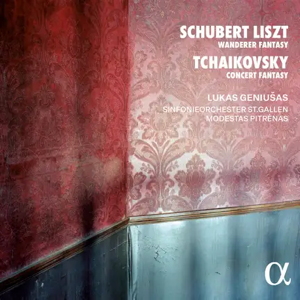
Franz Schubert (1797-1828)
Wanderer Fantasy, arr. Franz Liszt (1851)
Pyotr Tchaikovsky (1840-1893)
Concert Fantasy (1884)
Lukas Geniušas (piano), Sinfonieorchester St. Gallen / Modestas Pitrėnas
rec. 2024, Tonhalle Theater, St. Gallen, Switzerland
reviewed from digital download
Alpha Classics Alpha1225 [51]
Lukas Geniušas is a prize-winning pianist of Lithuanian and Russian descent who has an extensive list of recordings, but this is the first time I have heard him, and I am very glad I have. He has a phenomenal technique and here, where he is in complete sympathy with the orchestra and conductor, he shapes these two seldom played tricky works with tremendous musicality.
Liszt was clearly fascinated by Schubert ‘s music and the Lieder in particular, producing virtuoso transcriptions of more than fifty of them. One of the songs, Der Wanderer, had inspired Schubert’s own technically demanding, nay, pianistically awkward Wanderer Fantasy of 1822. In the work, Liszt saw something symphonic and in 1851 created his own fantasy on a fantasy.
Liszt’s version, which is very much an act of homage, stays remarkably close to Schubert’s original, the Eulenberg score actually prints the piano original underneath the arrangement so closely are they aligned. There is a little added cadenza but mostly Liszt is happy to distribute the piano part between orchestra and soloist and in so doing does a great service to pianists. Schubert’s original is rather indecorous in its piano writing and Liszt, in replacing sequences in arpeggios with repeated chords or alternating octaves, makes it much more pianistic. In adding extra contrapuntal voices, he effectively adds ingenious richness to the textures.
The work, which was once upon a time quite popular, is here in this excellent performance seen as a lost gem. The performers play as one, the interactions between soloist and orchestra are as natural as a conversation between good friends. The tempi are absolutely spot on. In Schubert’s original, too quick a tempo at the opening sees pianists needing to uncomfortably put the brakes on after not too many bars, but in Liszt’s version the finale can be taken at a good Allegro with no fear of catastrophe.
Most changes to the piano part are in the dark brooding ‘slow movement’. Here, Geniušas creates the silent joyless figure of the Wanderer, searching for his lost friends. The added chromatic scales in the bass clef create far better than Schubert the “ocean roars” of the poem.
I have loved the Tchaikovsky Concert Fantasy since I was a teenager, and I live in hope one day of hearing it live. Sadly, it seldom makes its way to the concert stage, at least in the UK, but it has been recorded quite a number of times. It was very popular in the twenty or so years after its premiere but then fell out of favour and did not start resurfacing again until the 1950s.
I partly understand this as it is a curiously constructed beast. There are two movements, the first of which has an oversize piano solo as its central point, ten minutes out of a sixteen-minute movement, so the orchestra sit there with nothing to do. I wonder if Prokofiev was thinking of this movement when he wrote his Piano Concerto No 2. The second movement covers slow movement and finale and is in multiple seamless sections almost like a ballet divertissement. What I cannot agree with is Tchaikovsky authority David Brown who wrote that its” crippling weakness is that it contains not one really strong idea”. It is full of wonderful tunes, brilliant orchestration, and a truly unique structure. For some reason I always think of this as a Christmastime work as in its sparkling sound world reminds me of The Nutcracker ballet which is so much a part of the Christmas season.
The work is full of awkward technical difficulties and in interviews Geniušas has stated that he, and most pianists, make changes where needed. In the long cadenza there are devilishly fast octave passages in both hands which Geniušas overcomes with ease. In contrast, there is one passage (c6’.30” in) where the left hand has a beautiful legato melody on top of which the right hand plays roulades of pianissimo demisemiquavers, all beautifully managed.
The first flute and the first cello get to shine in their idiomatic solos. Likewise, the solo horn gets to play a passage remarkably similar to its part in Romeo and Juliet which Tchaikovsky had revised in 1880. A downside to this recording is the glockenspiel used in the first movement. The writing is often in, unusually for the instrument, four-part chords and on the instrument used here it sounds very clattering and really far too loud. In most recordings it adds colour, here it is too far forward for its own good. On YouTube there are two live performances of the work by Geniušas with different orchestras and in both the glockenspiel is more under control than here.
There have been quite a few recordings of the Concert Fantasy from Noel Mewton Wood’s groundbreaking recording in 1952 through Sir Stephen Hough’s brilliant live recording on Hyperion in 2010 (review). Mikhail Pletnyev gave a convincing account of the work on Virgin in 1991 with the Philharmonia under Fedoseyev, although it is not as good as his 1990 performance with the Moscow Radio Symphony Orchestra under the same conductor which can be found on YouTube and is nothing short of breathtaking. That recording apparently introduced Lukas Geniušas to the work and to which he now adds his own impressive performance.
Tchaikovsky was clearly uncertain about the work and gave the option of performing just the first movement alone for which he wrote a different coda. This was recorded in the 1980s by the sadly underrated Jerome Lowenthal. Initially that recording appeared on Arabesque but has been remastered and is available on Bridge 9301A/B (review) It is fascinating to hear but the work is certainly better in its two movement version.
All in all, this is a very enjoyable release, although at 51 minutes it is short for a contemporary CD. I for one would love to have heard Lukas Geniušas’s thoughts on Schubert’s original Wanderer Fantasy. The liner notes consist of a rather academic essay which, though an interesting read, does very little to introduce the listener to the music.
Paul RW Jackson
Buying this recording via the link below generates revenue for MWI, which helps the site remain free













