
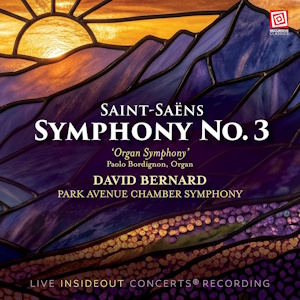
Camille Saint-Saëns (1835-1921)
Symphony No.3 in C minor “Organ Symphony” (1886)
Paolo Bordignon (organ); Maxim Lando & Keyi Wang (piano)
Park Avenue Chamber Symphony/David Bernard
rec. live, November 2025, DiMenna Center for Classical Music, New York City
Recursive Classics RC5230977D [37]
Surely everyone loves Saint-Saëns’ own favourite work, the so-called “Organ Symphony”? I certainly do but am abashed to confess that my favourite recordings are, to say the least, venerable: the latest, by Eugene Ormandy with organist Michael Murray and Karajan with Pierre Cochereau, are from as long ago as the early 1980s and two more from Ormandy are one with Edward Power Biggs from 1962 and the best of Ormandy’s three recordings, with Virgil Fox from 1973 on Dutton (review – and a Record of the Year 2020 for Rob Maynard and me). Evidently Ormandy had a special affinity with the work, but an even earlier favourite is Munch’s recording in Boston in 1959 with Berj Zamkochian – so maybe it is time I lit upon a modern recording.
As opposed to the traditional pipe organ, this recording employs a “spatially calibrated digital organ” which produces sound electronically, whereby the sound is recreated using recorded samples or the physical modelling of real organs and the sound is played through multiple speakers, and calibrated such that different ranks appear to come from different locations, mimicking how a pipe organ sounds and creating a realistic acoustic image. (This might strike some as “gimmicky”, but bear in mind that recording such a work is notoriously challenging and for Karajan’s digital account the organ was separately made in Notre Dame, Paris, and “spliced in”, post-production; the other recordings used famous in situ instruments.)
Furthermore, the recording is of a special nature, and here I quote in full from conductor David Bernard’s press release describing its unique features, as there is no point in my paraphrasing:
“This recording is not a conventional studio product — it is a live artifact of a unique concert experience. Using the InsideOut Concerts® format, the audience was seated within the orchestra itself, placing listeners at the center of the sound. To solve one of live performance’s oldest challenges — balancing the overwhelming power of a pipe organ against an orchestra in the same room — a digital organ was configured with speakers surrounding the entire ensemble, creating a fully immersive acoustic environment for performers and audience alike. The result, presented at New York’s DiMenna Center for Classical Music, was a performance of the Saint-Saëns Organ Symphony in which the balance between orchestra and organ existed naturally in the room.”
Despite its name, the orchestra here can be sizeable and wholly up to performing grand, large-scale Romantic works as per the symphony under review. Timings here are mostly on the broad side compared with the previous recordings mentioned above but very similar to Karajan’s and I cannot fault the pacing. The listener is immediately struck by the clarity and depth of the recorded sound, with a lot of air around the acoustic and a sense of space and grandeur in a manner which might suit those used to the often more intimate ambience of studio recordings. In my generally admiring review of their recording of Mahler’s Ninth Symphony, I express the wish that the orchestra could occasionally manufacture a plusher tone as the timbre was sometimes just a little lean, but there is plenty of weight in climaxes such as the first which occurs five minutes in, and again at seven minutes. We definitely gain the impression of a live performance rather than a studio production, as there is some distance between our ears and the players. Intonation and ensemble are very good, the constant, swirling, downward scoops very well sculpted, dynamics skilfully attenuated and varied, and climaxes carefully contrived by conductor David Bernard.
The opening of the Poco adagio second movement is nicely blended, the strings rich, steady and homogeneous over the warm, harmonic foundation from the organ which sounds remarkably integrated and “authentic” rather than grafted on. There is however, to my ears, occasionally a somewhat harsh, brittle edge to higher passages – although perhaps I am too habituated to the layered lucidity of studio recordings. The third, Allegro moderato – Presto movement is spritely and energetic, with some suitably prominent and acerbic woodwind interjections and fleet, sparkling piano scales.
Obviously the great blast on the organ heralding the finale is crucial and this one is impressive: darker and more sombre than some with spikier overtones but there is plenty of power without drowning out the orchestra and I find it more impressive than either Karajan’s or Munch’s pipe organs, even if it lacks some upper frequencies and for me Virgil Fox on the Rodgers Touring Organ in the Scottish Rite Cathedral still rules. Power Biggs in the Philadelphia Town Hall sounds a little tame by comparison, Likewise, the piano cascades come through very audibly, the vigour of the ensuing ceremonial march is impressive and the whirring strings, whooping horns and growling organ in the peroration are really thrilling. A few seconds of enthusiastic applause are included; the audience is otherwise inaudible.
Although the concert included a performance of Saint-Saëns’ Piano Concerto No. 2 only the symphony is given here and obviously a playing time of only 37 minutes might discourage some punters habituated to CDs filled with 80 minutes and more of music – but this is a special, one-off kind of project from a “high-level non-professional” outfit which relies on donations, grants and sales for its support and is staffed by many volunteers – albeit that many are conservatoire-trained and the orchestra has performed in prestigious venues and received various awards; as such, we cannot reasonably expect the same largesse. Nor does it necessarily displace my favourite accounts; nonetheless, as a souvenir of a daring and innovative performance of one of the most sheerly enjoyable works in the High Romantic repertoire, this is a worthy recording.
Ralph Moore
Buying this recording via the link below generates revenue for MWI, which helps the site remain free














I find Ralph Moore’s reviews to be very helpful and over the years have come to the (rather lazy) conclusion that if he likes a recording, it is highly probable I will like it too. I am a big fan of Karajan’s recordings; even of repertoire in which he is generally not highly regarded – a bit of a “guilty pleasure”, recognising it is not “authentic” but still finding enjoyment in it.
Karajan’s recording of the Saint-Saens Organ Symphony is one that I want to like, but don’t. For me, it is spoiled by the sound of the organ in the famous finale and its lack of presence earlier in the work. For example, I prefer to hear a good rumble from the pedals in the poco adagio (as opposed to having to listen carefully).
Like Ralph, my current favourite version cannot be regarded as recent, being Barenboim/CSO on DG. It is possibly no coincidence it was my introduction to this piece – hearing it for the first time when my father bought it on LP and played it loud enough for most of the street to hear.
I was interested to read about this latest recording. The question of course is whether I need yet another recording of the Symphony!
Thanks, David; I am glad that for the most part our tastes have chimed. For some reason, I am not much bothered by any failings in the sound of Karajan’s organ but should perhaps listen again with new ears. As for the desirability of a new recording, let’s default to King Lear: “O reason not the need”…