
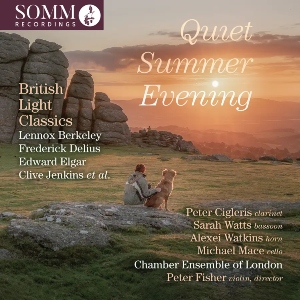
Quiet Summer Evening: British Light Classics
Peter Cigleris (clarinet), Sarah Watts (bassoon), Alexei Watkins (horn), Michael Mace (cello)
Chamber Ensemble of London/Peter Fisher (violin)
rec. 2023, St George’s Church, Pinner View, Harrow, UK
SOMM Recordings SOMMCD0727 [70]
The opening paragraph of the liner notes succinctly defines light music. Nearly six decades ago, Andrew Gold – who led the BBC Light Music Unit in 1965-1969 – summed up his role. He programmed “music where the tune is more important than what the composer does with it”. That crisp description of what we now tend to call light classical still holds. Its defining strength remains what Gold called its “immediacy of appeal”, the quality that continues to secure the loyalty of many listeners. I would add approachability, quality of orchestration and a deft handling of mood and atmosphere.
One niggle to get out of the way: the liner notes could have been more complete, especially on the discussion of each work. Dates of composers, pieces and arrangements should have been listed; I have given them where possible.
The concert opens with Geoffrey Bush’s Rhapsody for Clarinet & Strings. He is noted for music across a wide range of genres, including two symphonies, several concertos and six operas. Yet he remained at heart a miniaturist with a particular flair for chamber and vocal writing. His aesthetic is often, but not always, characterized as “a blend of English pastoral warmth and crisp neoclassical poise”. The Rhapsody is lyrical, with just a little angst here and there which may suggests it was written during the war. Overall, though, it engages the mind in reminiscing about happier times gone by, and looks forward to peaceful days to come.
The notes do not say for what forces Ulster composer Terence Higgins originally wrote his Vers le Sud. It has been arranged here by David Stowe for violin and orchestra. I find the overall effect a little out of kilter. True, there is mood music that reflects languid days in the South of France, but the jazzed-up violin passages seem a little out of place in this supposedly atmospheric evocation. What is it about Messrs Higgins and Stowe that their dates of birth are hidden from view?
Clive Jenkins’s Fantasy for Horn & Strings gently evokes an English landscape at dusk, with just a hint of shadow in the background. It blends melodic poise and fine craftsmanship with a touch of mischievous charm. The soloist gets music that sings as naturally as it speaks.
Nigel Brooks’s Sunday Afternoon for bassoon and orchestra gently potters along. It gives the listener an impression of a peaceful ramble through a suburban landscape, summoning images of playing children or strolling lovers. It is beautifully scored, and Sarah Watts plays the memorable solo part superbly. The piece was written specially for this release.
Sarah Watts is also represented by her enigmatically titled Everything Is Somewhere Else, also for bassoon and orchestra. If I had been the record producer, I would have separated the two numbers wit another work. As I listened, I suddenly discovered that I had changed composer and track, which fooled me into thinking it was the same piece! Yet this ever so short intermezzo is delightful at every twist and turn.
Clive Jenkins’s five Pieces for Clarinet & String Orchestra get picturesque titles, of places in and around his native Plymouth. (That may or may not help the listener.) The set opens with the brisk Richmond Walk, a reference to a promenade by “the tranquil waters of Stonehouse Creek”, though the music presents a bit of a contradiction. Jenkins explains that “Plym Valley has woods and a boulder-strewn river with weirs”; appropriately, this is introverted, and not particularly light. Equally reflective is the tone poem Tamarside, named for the broad estuary between Devon and Cornwall. The bustling fourth movement imagines The Barbican in Plymouth, an area of historic quays, narrow cobbled streets, lively pubs and a gin distiller! The finale is Drake Circus, a modern-ish shopping mall according to Google Earth. The area looks as if it had been knocked about a lot – either by German bombs during WW2 or by over-zealous town planners. Overall, this is a charming suite.
According to the liner notes, Andy Meyers “studied conducting, piano and horn at Trinity College of Music, winning the Ricordi Prize for conducting and, as a collaborative pianist, the Elisabeth Schumann Prize for Lieder and the Dorothy Hawes Prize for French Song”. His scores include Encore une fois, Cantilena, Midsummer Night’s Dream Suite, and a Sinfonietta Concertante, alongside various concertos. The Serenade for Horn and Stringsis another piece that is too short: it just has gotten going when it concludes. It is lyrical, with a definite touch of melancholy.
Gordon Jacob can always be relied on to deliver the goods. The brief and pleasant A Little Waltz is the second number in his Four Sketches. This little movement has a lyrical, dance-like mood with gracefully turned phrasing. As a digression, the third movement (not heard here) is a desideratum: the lumbering L’Après-midi d’un Dinosaur is a humorous play on Debussy’s Prélude à l’après-midi d’un faune.
One of the loveliest tracks on this disc is Luke Whitlock’s Lullaby. Clive Jenkins invited Whitlock in 2022 to contribute a horn‑and‑orchestra piece for this album. The result is an expressive, mood‑shifting miniature. Soloist and orchestra share the focus, conjuring something gently nostalgic and half‑remembered. Quite beautiful.
I love Edward Elgar’s Canto Popolare in its original context as part of the sweeping overture, In the South. It was originally heard at the tranquil turning point in this otherwise imposing work. The melody is anecdotally based on a found tune Elgar had heard a shepherd singing while visiting Alassio, Italy; in fact, it was his own invention. I can just about enjoy it in the composer’s violin and piano version. Clive Jenkins’s arrangement for violin and orchestra takes it entirely out of context. I am sorry, I just don’t dig it!
Lennox Berkeley’s short Andantino has a tangled provenance. Originally part of A Festival Anthem, Op.21 No.2 for SATB choir and organ (to mark the end of the Second World War), the present music was associated with the words ‘The Lord is my Shepherd’. He later recast this section as an independent work, arranging it for cello and piano. Unusually for Berkeley, the mood is entirely pastoral, in contrast with his more prevailing neo-classicism. The liner notes suggest that it is as English as a day in summer. The present arrangement for cello and strings was made by Clive Jenkins.
The penultimate piece is an arrangement of Frederick Delius’s Romance for cello and piano. This delicious work comes from around 1896 when he was resident in Paris. It was “lost” until rediscovered in 1976. Julian Lloyd Webber gave its first modern (possibly even premiere) performance. The only criticism would be the intensity, overblown for such a short piece.
Finally, the listener is treated to Don Shearman’s Quiet Summer Evening of the disc’s title. The notes explain that this British musician, who died at the age of 92, enjoyed a distinguished career as a pianist. He collaborated with leading entertainers such as Norman Wisdom and Russ Conway. This contemplative miniature crosses multiple stylistic boundaries, but it is quite lovely.
Taken as a whole, Quiet Summer Evening offers a generous survey of near-contemporary British light‑classical idioms. It is performed with evident affection and sympathy by Peter Fisher and his Chamber Ensemble of London, and aided by a great recording. Not every arrangement convinces, and a few pieces feel more like sketches than fully realised statements, but the prevailing impression is one of craftsmanship, tuneful ease and lyricism. The soloists play with character and sensitivity. The programme’s mixture of the familiar, the rediscovered and the newly minted gives it a pleasing sense of variety. As the title track gently closes the disc, it leaves behind exactly what light music at its best can still provide: moments of calm, colour and charm.
John France
Contents
Geoffrey Bush (1920-1998)
Rhapsody for Clarinet & Strings (1940)
Terence Higgins
Vers Le Sud (arr. David Stowe)
Clive Jenkins (b.1938)
Fantasy for Horn & Strings (2002/2009)
Nigel Brooks (1926-2024)
Sunday Afternoon
Sarah Watts
Everything Is Somewhere Else
Clive Jenkins
Five Pieces for Clarinet & String Orchestra (2003/2013-2014)
Andy Meyers
Serenade for Horn & Strings
Gordon Jacob (1895-1984)
A Little Waltz (1976)
Luke Whitlock (b.1978)
Lullaby (2022)
Edward Elgar (1857-1934)
Canto Popolare (1904, arr. Clive Jenkins)
Lennox Berkeley (1903-1989)
Andantino (1945, arr. Clive Jenkins)
Frederick Delius (1862-1934)
Romance (1896, arr. Clive Jenkins)
Don Shearman (1932-2024)
Quiet Summer Evening
Buying this recording via the link below generates revenue for MWI, which helps the site remain free














I originally wrote Vers le Sud for violin and piano.