
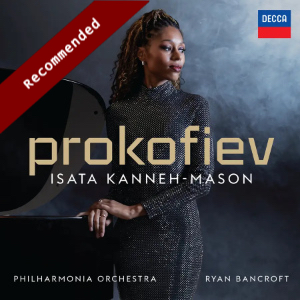
Sergei Prokofiev (1891-1953)
Piano Concerto No.3 in C Op.26 (1917-1921)
Toccata Op.11 (1912)
Prelude Op.12 No.7 (1906-1913)
March and Scherzo from The Love of Three Oranges Op.33 (1922)
Four pieces from Romeo and Juliet Op.75 (1937)
Four pieces from Cinderella Op.97 (1943)
Troika (Sleigh Ride) from Lieutenant Kijé Op.60 No.4 (1934)
Piano Sonata No.3 Op.28 (1907-1917)
Isata Kanneh-Mason (piano)
Philharmonia Orchestra/Ryan Bancroft
rec. 2025, Henry Wood Hall, London (concerto); The Menuhin Hall, Stoke d’Abernon, UK (solo works)
Decca 487 1857 [75]
Everyone has now heard of the amazing Kanneh-Mason family of excellent musicians. Sheku, the cellist, may be the best-known, but Isata, the pianist, is not far behind. She has already made several recordings. I heard her play this Prokofiev concerto in concert last year, and thought she was a real ball of fire. In fact, I thought she was like the young Martha Argerich, who made a celebrated recording of the concerto early in her career.
Prokofiev was himself a virtuoso pianist. The concerto demands a fabulous technique and has some notoriously tricky passages. Kanneh-Mason has the finger dexterity and the strength required. Even more important, she has the right touch for Prokofiev. He favoured crisp non-legato with very light use of the pedal for his toccatas and fierce driving rhythms. He also has a lyrical side, and she is equal to this too; it is not in the least sentimental but poised and cool.
The concerto is in the three traditional movements. It opens with a lyrical theme on the clarinet, which is developed by the strings until the piano comes in with a rush and the tempo picks up. There is a second theme, in chords, and the movement continues in a loose sonata form with many opportunities for pianistic display.
The second movement is a theme, five variations and a coda. Much of this is quite quick but there is a slow variation which gives the soloist an opportunity to show lyrical playing. The composer described the finale as ‘an argument’ between piano and orchestra, though there are gentle passages as well as display ones. The recording is just as exciting as the live performance I attended. It is good to have it.
The programme is filled out with solo piano works. The opening Toccata is Prokofiev at his most relentless, rather like Bartók in a similar mood. The Prelude from the Op.12 set is a complete contrast: light, delicate, with a dancing second section, which nevertheless requires some brisk glissandi. Then there are transcriptions, made by the composer, from The Love of Three Oranges, Romeo and Juliet, Cinderella and Lieutenant Kijé. They are nicely done, and show a knowledge of the orchestral originals in the tempi chosen and the way Kanneh-Mason colours her tone.
More substantial is the third of Prokofiev’s nine piano sonatas. This one-movement work is subtitled From old notebooks. It begins with Allegro tempestuoso, so we know where we are with this kind of Prokofiev’s writing. The mood varies, and the work is at times playful and even gentle. It gets faster and faster towards the end, but Kanneh-Mason seems to revel in this kind of writing and despatches it with aplomb. She seems to have a special affinity with Prokofiev. I would like to think she might tackle a complete Prokofiev sonata cycle.
There is very acceptable support from the orchestra and Ryan Bancroft in the concerto. The recording, though from two different venues and occasions, is good. The booklet has an essay which might be very interesting, but it is printed in white type on a yellow background, so I could not read it.
There are numerous recordings of this concerto. The early one by Martha Argerich I mentioned was with Claudio Abbado, coupled with Ravel’s G major concerto. She also recorded a version with Charles Dutoit. There are many others, usually coupled with another concerto, but if you care for the work, do listen to this. Isata Kanneh-Mason is a pianist to watch.
Stephen Barber
Buying this recording via the link below generates revenue for MWI, which helps the site remain free














I have to second the high praise for this disc–I’d heard and enjoyed Isata Kanneh-Mason before (I think in her ‘Summertime’ album) but this feels like a step above that. I am in agreement with you that something about Prokofiev seems to just click with her style, and I hope we get more as well!