
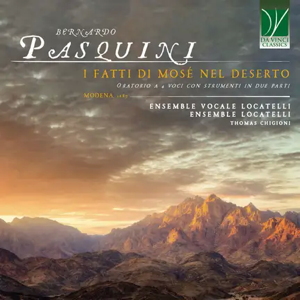
Bernardo Pasquini (1637-1710)
I fatti di Mosè nel deserto
Maddalena De Blasi (Mosè) (soprano), Sofia Sala (Giosuè) (contralto), Matteo Straffi (Testo) (tenor), Santiago Garzon Arredondo (Getro) (bass)
Ensemble Vocale Locatelli, Ensemble Locatelli/Thomas Chigioni
Texts and translations included
Reviewed as a download
Da Vinci Classics C01059 [79]
Bernardo Pasquini was educated as a keyboard player and developed into the most prominent Italian composer of keyboard music between Frescobaldi and Domenico Scarlatti. He settled in Rome around 1650 and remained there for the rest of his life. By that time, Frescobaldi had already died but Pasquini carefully studied and copied his works. After holding various posts as organist of several churches he became keyboard player at the court of Prince Giambattista Borghese. Previously he had also enjoyed close contacts with Queen Christina of Sweden and the cardinals Ottoboni and Pamphili. Pasquini participated in many performances of secular music in Rome, regularly working with Arcangelo Corelli. He was a sought-after keyboard teacher; among his students were Domenico Zipoli and possibly Domenico Scarlatti, but also foreigners such as Johann Philipp Krieger and Georg Muffat.
Keyboard music is the best-known part of his output and is fairly well represented on disc. However, his oeuvre comprises vocal works as well and so far these have been given relatively little attention, partly due in all probability to the fact that most of them were never published. Pasquini is known to have written eighteen operas, twelve of which have survived. Seven of his thirteen oratorios have come down to us.
The second half of the 17th century is an interesting period in the history of the oratorio. It had come into existence around the mid-17th century and then gradually developed into a form which was pretty close to opera. This also resulted in a change of the venues where such pieces were performed. In the time of Giacomo Carissimi, who is often considered the founder of the genre, oratorios were usually performed during the meetings of congregations and religious confraternities. In the next decades these oratorios were performed in churches, but more and more also in the palaces of the nobility. The character of the oratorio changed in various ways. Latin texts were replaced by texts in the vernacular, the Testo which acted as a kind of ‘Evangelist’ gradually disappeared, and the text moved away from the biblical narrative which dominated the oratorios of Carissimi.
I fatti di Mosè nel deserto (The deeds of Moses in the desert) is one of a cycle of eight oratorios devoted to Moses. They were performed at Modena between 1682 and 1691 and written by several composers: Vincenzo De Grandis (1682, 1684), Giovanni Paolo Colonna (1686), Giacomo Perti (1687), Antonio Gianettini (1688, 1691) and Alessandro Melani (1691). Pasquini’s oratorio is the fifth in the cycle and dates from 1687. “It has been suggested that this grand cycle of Oratorios might have been conceived in the effort to affirm the greatness of the Jewish patriarch following the publication of a scandalous and blasphemous pamphlet which libeled him. In the words of Victor Crowther, this series of Oratorios is ‘a sophisticated blend of religion, politics, and dramatic entertainment that would give both instruction and pleasure’.” (booklet)
The librettos were written by Giovanni Battista Giardini, and, as Chiara Bertoglio observes in her liner-notes, show “a noteworthy openness towards the Jews and Judaism”, which is remarkable given the precarious position of Jews in most of 17th-century Europe. The oratorios in this cycle are about the various stages in the life of Moses, and Pasquini’s is about the fate of the Jewish people during its journey through the desert, on its way to the promised land. There are four characters: Moses (soprano), his right-hand man (and later successor) Joshua (alto), a Testo (narrator) (tenor) and Jethro, Moses’ father-in-law (bass). The instrumental scoring is for two violins, viola and basso continuo.
The contents of the oratorio are taken from the Old Testament book of Exodus, but obviously only a few episodes are selected. The oratorio consists of two parts. The first focuses on the hardships of the people: the lack of food and of water. It is described how God provides them with manna and with water from a rock. The first part ends with a chorus: “Sovereign Ruler of Heaven, and King of Kings, for the noble benefits which Thy divine Love with prodigality bestows upon us, our humbled hearts render Thee thanks.”
The second part is entirely devoted to the fight with the people of Amalek, in retribution of their ambush for the Israelites. It is the most dramatic part of the work, and here Pasquini makes use of the stile concitato. The sounds of battle are imitated by both voices and strings; no brass instruments or percussion are involved. The moral of the work – that prayer is more powerful than weapons – may well be expressed by the narrator: “Thus ended that memorable day, and of the noble deed the greatest honour was ascribed to Moses alone, who by his word accomplished more than Joshua by his sword.”
And that brings to the way the various characters act. The narrator (Testo) tells the story, but he does more than that, as he now and then also comments on what is going on. On the other hand, a part of the story – especially in the first part – is told through a dialogue between Joshua and Jethro. In this work there are no minor characters. All of them have recitatives and arias to sing. Jethro even gets one of the longest at the end of the work.
Stylistically this work is somewhere in the middle of the development from the oratorios of Carissimi to the more operatic works of the 18th century. Notable is that it is a specimen of the oratorio volgare – the oratorio in the vernacular. Such works were intended for audiences that did not understand Latin. On the other hand, one of the characters is still the narrator, a figure who with time would be eliminated from oratorios. The recitatives are different from those of later oratorios, and the arias are mostly much shorter. A number of them have a dacapo, which points to the future, and the instruments take a more prominent role in arias than was common in earlier specimens of the genre. Often a recitative ends with an arioso.
There is quite some text illustration in this work. I already mentioned the use of the stile concitato. The arias in the second part are the most dramatic, for instance the one by Joshua (No. 34): “War, war! To arms, to arms! To battle, to strike! Let every soul prove bold, to triumph God invites you; for the glory of His name we must conquer or die.” He also has an expressive aria in the first part, which opens in a slow tempo: “Yet our plaintive voices soared upward to Heaven, and from the stars obtained manna that refreshed our breast”. But then the tempo suddenly speeds up: “thus from a dreadful death our lot was rescued.”
From the few oratorios by Pasquini that I have heard before, I had won the impression that he was a very fine composer of vocal music, and this work confirms it. This is the first recording, based on a transcription by the performance’s director, Thomas Chigioni. It was well worth the effort, and there is every reason to be grateful to him and the performers for bringing this work to our attention. Both the vocal and instrumental parts are very well written and generally performed in a convincing manner. Matteo Straffi is especially impressive as the narrator, and Santiago Garzon Arredondo gives a fine account of the role of Jethro. Maddalena De Biasi can convince in the role of Moses and the expression of his feelings, although here and there she should have reduced her vibrato. That is even more the case with Sofia Scala as Joshua. However, she does full justice to the dramatic nature of her role, which is essential in this work and is part of its attraction.
To sum up: this is an important addition to the oratorio repertoire, and a work that deserves to be performed in concert halls. A printed edition of the score would be welcome. Any lover of this kind of repertoire should investigate this recording, which is a very good case for Pasquini as a composer of vocal music.
Johan van Veen
http://www.musica-dei-donum.org
https://twitter.com/johanvanveen
https://bsky.app/profile/musicadeidonum.bsky.social
(Ed. note: the disc title wrongly accentuates the name “Mosè” in Italian.)
Buying this recording via the link below generates revenue for MWI, which helps the site remain free













