
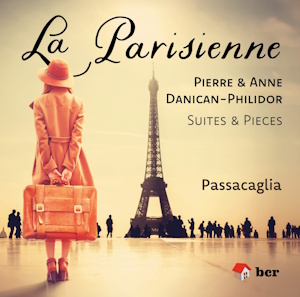
Pierre & Anne Danican Philidor
La Parisienne – Suites & Pieces
Passacaglia
rec. 2025, St Michael and All Angels Church, Great Tew, Oxfordshire
Reviewed as a download
Barn Cottage Records BCR029 [63]
The Philidors were one of the three largest musical dynasties of the French Baroque. The other two were the Hotteterres and the Couperins. The article on the Philidor family in New Grove mentions only five composers but these are just the better-known members of this dynasty. The earliest musician in the family whom we know about was Michel Danican – as the family’s original name was – who played the oboe at the court of Louis XIII. His two sons, Michel and Jean, were members of the Grande Écurie, one of the royal music ensembles. It was Jean who was the first to be referred to with the name ‘Philidor’. One of the best-known members of the family is Jean’s son André Danican Philidor ‘le père’. In his capacity as music librarian of Louis XIV he copied numerous compositions which were part of the repertoire of the court’s ensembles (the so-called Philidor collection).
The disc which is the subject of this review includes pieces by two members of the dynasty: Pierre and Anne. Pierre was a nephew of the aforementioned André; he was a son of André’s younger brother Jacques ‘le cadet’. Pierre started composing at an early age, and took over his father’s position as oboist of the Grands Hautbois. Later on, he became a member of the Chambre du Roy where Marin Marais and François Couperin were among his colleagues. The information about his role in the various sources is a little confusing. He was referred to as joueur de viole (player of the viol). The authors in New Grove take this for granted as they say “he became a member of the chambre du roi as a viol player”, and the liner-notes to the present disc follow them, as it says that he played the viol. However, Antoine Torunczyk, in the liner-notes to his recording of some of Pierre’s suites (ZigZag Territoires, 2008), writes: “Faced with a viol, Pierre would very likely have looked for somewhere to blow into”. He states that the post of oboist of the Chambre du Roy did not exist, and that the title of ‘player of the viol’ doesn’t mean he actually played the instrument – it’s just a formal title. This is in line with all we know about the Philidor family: they were a dynasty of wind players.
In a short essay in the same booklet the American oboist Bruce Haynes presents Pierre Danican Philidor as one of the last representatives of the aesthetics of the era of the Sun King. After the latter’s death in 1715 the taste began to change, but Philidor and others who adhered to the ideals of Louis XIV – in particular Couperin and Marais – were still alive and composing. Philidor was highly appreciated by the King as the high annual pension which Louis XIV awarded him testifies.
Pierre’s oeuvre is relatively small. In 1717 and 1718 he published three collections of suites. Each of them includes a number of suites for a treble instrument (transverse flute, oboe or violin) and basso continuo as well as suites for two transverse flutes without accompaniment. The present disc contains four suites with basso continuo from the first and the third collection respectively. They open with a movement in slow tempo, a prélude (12e Suitte) or (très) lentement (4e, 5e and 6e Suittes). These are followed by other dances. The 12e Suitte includes one character piece, La Parisienne – the piece which has given this disc its title. The 4e Suitte brings us to the countryside. The third movement is called air en musette, which refers to an instrument associated with the countryside, depicted here with a drone. The penultimate movement is a sicilienne, which has a pastoral character. The suite closes with a movement called Paysanne (wife of a farmer), with the addition gayment, which has some unmistakable folkloristic traits.
It is notable that “unusually detailed indications of tempo, breathing, ornamentation, and phrasing demand a new degree of attention and skill from the player”, according to the booklet. This may well indicate that these collections also had a pedagogical purpose. That would not be surprising: we are here in the time of the Enlightenment, which had the education of the people as one of its ideals. This also explains the many treatises that were published at the time.
The other Philidor whose music is performed here, is Anne, called ‘fils aîné’. He was the son of André ‘l’aîné’. In 1704 he joined the Chapelle Royale and in 1712 the Petits Violons. He collaborated with his father in his duties as music librarian of the court. In 1725 he founded the Concert Spirituel which was one of the first series of public concerts for a paying audience in Europe. It existed until the French Revolution. He composed six works for the stage, two of which are lost. Also lost are some motets. As far as instrumental music is concerned, two collections of pieces were published; the reprints have been preserved, which date from 1712 and 1714 respectively.
The Premier Livre is especially interesting as it includes the only work ever published in France that is specifically intended for the recorder. It has the form of a sonata, which indicates the influence of the Italian style. “Ironically, just as the recorder was approaching obsolescence, it inspired one of its first expressly dedicated compositions.” (booklet) This sonata may be modern in its form, but it also includes two fugues, reflecting the contrapuntal skills of Philidor – a quality that in his time was growing out of fashion.
From the second book of 1714, two character pieces are taken: the playful Le Badin (banter) and the swift Les Vents (the winds). Obviously, a chaconne could not be omitted; it was such a popular genre that it appears in nearly every collection of instrumental works, often more than once. Also popular was the Tombeau, a kind of musical epitaph. It is not known for whom Philidor composed the Tombeau included here; he may not have had a specific person in mind. It is dominated by descending figures and includes several pauses; the bass part contains imitations of bells. This shows that the ideal of the time – music as an elegant conversation – did not exclude strong expression.
This repertoire is not intended to cause excitement; it is not theatrical, as Italian instrumental music often is, nor demonstrative in its technical requirements. Elegance and subtlety are what this music is about. It deserves attentive listening. It only reveals its qualities if it is played by performers who have a thorough understanding of this musical language and how it should be interpreted. That is the case here. The performances by Annabel Knight are wonderfully subtle and differentiated, for instance with regard to tempo, dynamics and ornamentation. The character pieces come off perfectly, and the Tombeau’s expression is fully explored. She has the strong support of a basso continuo group consisting of the most revered instruments at the time: the viola da gamba (Reiko Ichise), Eligio Luis Quinteiro (theorbo, guitar) and Robin Bigwood (harpsichord).
This disc is a splendid display of the musical world of early 18th-century France.
Johan van Veen
http://www.musica-dei-donum.org
https://twitter.com/johanvanveen
https://bsky.app/profile/musicadeidonum.bsky.social
Contents:
Pierre Danican Philidor (1681-1731)
12e Suitte in D
6e Suitte in B minor
Anne Danican Philidor ‘fils aîné’ (1681-1728)
Le Tombeau
Le Badin
Pierre Danican Philidor
5e Suitte in E minor
Anne Danican Philidor ‘fils aîné’
Les Vents
Pierre Danican Philidor
4e Suitte in A minor
Anne Danican Philidor ‘fils aîné’
Sonate pour la Flute à bec
Chaconne













