
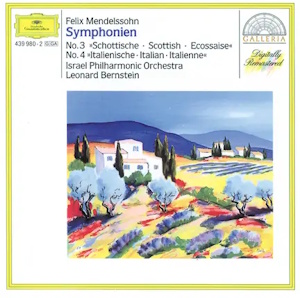
Felix Mendelssohn (1809-1847)
Symphony No.3 in A minor, Op.56 ‘Scottish’ (1842)
Symphony No.4 in A, Op.90 ‘Italian’(1833)*
Israel Philharmonic Orchestra/Leonard Bernstein
rec. 1978* & 1979, Frederic R. Mann Auditorium, Tel Aviv
Deutsche Grammophon 4399802 [70] ADD
It is perhaps now a cliché to declare Mendelssohn a still-under-rated composer, yet whenever I listen to one of his many masterpieces, I find myself too often wondering why I do not listen to him more often and in general give him his due. Here are two such perfect little works; I say “little” only in comparison to the bloated symphonic monsters of late Romanticism whereby whole movements last around the same time as the total of either of these, at forty and thirty minutes respectively.
Nonetheless, Bernstein certainly coached the Israel Philharmonic to produce a lush string tone, indulge in flexible, rubato-laden phrasing, emphasise dynamic contrasts and emotional expressivity – in other words, a more Romantic, “Schumannesque “ affect rather than the leaner Classicism of, say, Claus Peter Flor with the Bamberg Symphony Orchestra. These are both remarkably intense, exuberant readings with especially powerful finales. The Israeli orchestra was never going to attain the refinement of the VPO but that lends excitement and spontaneity to the performances.
The brooding opening to the Scottish symphony immediately reveals the virtues of the partnership: it is dark and dramatic, with slightly sour woodwind tone, more reminiscent of Berlioz than Mozart, for sure. (There is of course nothing “Scottish” about the music beyond the fact that the composer was first inspired to write it while in Scotland in 1829 but it wasn’t completed until thirteen years later.) The bass depth of the sound is striking, too; these are beautifully recorded. The tunes are infectious and the orchestration – naturally, from this composer – endlessly inventive and diverting. Bernstein really tears into the “vivace” second movement – largely ignoring, I would say, the qualification “non troppo” – but then, so does virtually every interpreter apart from Klemperer; it sparkling and buoyant, contrasting neatly with the Adagio, which is first gentle, oozing an almost Viennese charm, but then turns much weightier. There is likewise a certain massiveness to the finale which builds inexorably; again, only Klemperer is slower but it never drags. The coda is a noble construction: grand and leisurely, then thrilling in the last thirty seconds when the tempo doubles.
While the Scottish symphony displays no Hibernian traits, the Italian evinces some overt and implied Italian influence, especially in the saltarello and tarantella of the finale. Bernstein also brings out the sunny element of the introduction and the religiosity of the second slow movement. The contrast between the grandeur of the finale to the Scottish and joyous lift and lilt he gives to the opening of the Italian is telling; that momentum is sustained throughout its eleven minutes and the drive and commitment of the orchestra are impressive. The ostinato-like bass pacing of the slow movement is dignified and sombre, yet the melody sings; the 6/8 con moto slow movement flows engagingly and the Presto finale is predictably breathless electrifying – a headlong rush to the finishing line.
If you respond to Bernstein’s extrovert way with these scores, this is as winning a pair of symphonies as you could wish to encounter.
Ralph Moore
Buying this recording via the link below generates revenue for MWI, which helps the site remain free













