
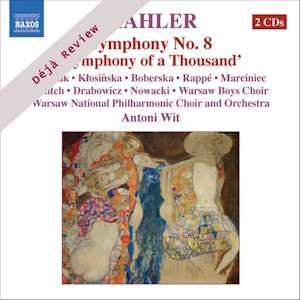
Déjà Review: this review was first published in July 2011 and the recording is still available.
Gustav Mahler (1860-1911)
Symphony No. 8 Symphony of a Thousand (1906)
Cardinal Stefan Wyszynski University Choir, Polish Radio Choir; Warsaw Boys Choir
Warsaw Philharmonic Orchestra & Choir/Antoni Wit
rec. 2005, Warsaw Philharmonic Concert Hall, Warsaw, Poland
Sound: LPCM stereo and 5.1 DTS-HD (24-bit/96kHz)
Sung texts: available on-screen and on-line
Naxos Blu-Ray Audio NBD0009 [80]
As a recent convert to the manifold pleasures of Blu-ray video I was keen to try one of Naxos’s audio-only discs. Unfortunately my first purchase, John Corigliano’s Circus Maximus, refused to work in my player, so I was a little anxious about ordering this Wit Mahler 8, which I already have on CD. I needn’t have worried, as it all worked like a dream.
The Symphony of a Thousand is an ideal candidate for a high-res presentation, and Naxos must be congratulated for their foresight in recording this in 24-bit/96kHz stereo and surround sound as well as the standard 16-bit/44.1kHz used for the CD. I have always admired Wit’s reading of this piece, not least for its coherence and sense of drama. Not only that, he is blessed with a well-matched team of soloists, which is surprisingly rare in this work. His choirs are pretty good as well, and the balances on CD seem entirely natural. There’s no lack of thrill and amplitude either, making this one of the best Mahler 8s in the catalogue.
So how does the Blu-ray version compare? I listened in PCM stereo and from the outset I knew this was going to be a real treat. The transporting cries of ‘Veni creator spiritus’ open out as never before, the ample organ powerfully present but not overwhelming. There’s a convincing left-to-right spread – the soloists are especially well caught – and the sound has a finely etched quality that one simply doesn’t hear on the CD. But it’s the conductor’s firm grip on the music that really impresses; rarely has this first movement passed so purposefully yet still sounded so fresh and spontaneous. The rapt intensity of the singing – solos and ensembles – is a joy to hear, the pieces of this vast Mahlerian jigsaw falling into place at every turn.
The return of that opening chorus and the vast, phosphorescent surge that follows have seldom been captured with such fearless fidelity; indeed, the sense of peering down on to a packed stage from a seat in the balcony is remarkable. Ditto in Part II, where Wit and the Naxos engineers make Mahler’s colour palette glow with new vigour and vibrancy. I was simply astonished by the minute detail unearthed here, the plucked strings especially beautiful. That wouldn’t count for much if Wit’s reading wasn’t so compelling, each tableau knitting seamlessly with the next. This really is a graveyard movement for the unwary, but Wit traverses its valleys and scales its peaks with nary a stumble.
There aren’t any misjudgements among the singers either, and I’m particularly pleased that there are no wobbles and squalls. I honestly can’t remember a better bunch of soloists than that assembled here; diction is fine and there’s an almost holographic quality to their presentation that is very impressive indeed. Even the massed choirs have a discernible shape, a three-dimensionality, that one doesn’t often hear in recordings. As for the orchestra, they’re as adept in Mahler’s chamber-like passages as they are in the big set-pieces. The brass scythes through dense orchestral thickets and the timps lay down a formidable carpet of sound in the huge tuttis. And just listen to the magical harp in track 19; glorious, simply glorious.
As with all true Mahlerians, Wit has the finale of this sprawling symphony firmly in his sights from the first bar. The inexorable undertow, that tremble of anticipation, is keenly felt, especially in the transported singing of the finale. Goodness, I’d forgotten just how unerring Wit is here, the closing peroration arriving in a blaze of triumph, organ, bells and huge tam-tam hurled into one’s listening room as never before. I can only guess at how immersive this must sound in a properly configured multi-channel system.
Wit’s Mahler 8 has always been a hidden gem in the Mahler discography, and now this Blu-ray makes it shine with even more lustre than before. True, one pays a bit more for this than the CD, but the audible – and emotional – gains make this a mandatory purchase for anyone interested in superb Mahler and even better sound.
Dan Morgan
Buying this recording via the link below generates revenue for MWI, which helps the site remain free
Reader comment on the DTS-HD Master 5.1 Surround track
First on a point of information, the surround recording is advertised on the sleeve as 5.1 but my processor reads it as 5.0. This could of course be a typo. The surround tracks are clearly the result of a different mix and a pretty disastrous one at that. The sound is recessed and lacking immediacy, as if the microphones were placed at the back of a large hall. The orchestra is partially placed behind the listener with the choruses in front. The soloists almost disappear into the mix and sometimes lack direction. Orchestral detail is less audible than the stereo. The overall sound is in marked contrast to the very satisfactory
PCM Stereo mix in being overbearing and shrieky on climaxes, it is also at a higher level. It sounds as if the mix was supervised by an engineer who had no idea what the original sounded like. I recently attended a performance of this symphony at the Royal Albert Hall in London and I can confirm that this music can all be heard from a decent stalls seat, from the quietest pianissimo to the loudest fortissimo, without any of these problems. Given the large number of positive reviews of this performance in this and other publications this is surprising. I can only guess but I would suspect the recording was originally intended only for stereo and that a surround effect has been extracted via studio processing. Perhaps Naxos would like to comment. Meanwhile I would direct multichannel listeners to the San Francisco/Tilson Thomas SACD.
Dave Billinge
Soloists
Barbara Kubiak – Soprano I (Magna Peccatrix)
Izabela Klosinska – Soprano II (Una Poenitentium)
Marta Boberska – Soprano III (Mater Gloriosa)
Jadwiga Rappé – Alto I (Mulier Samaritana)
Ewa Marciniec – Alto II (Maria Aegyptica)
Timothy Bentch – Tenor (Doctor Marianus)
Wojtek Drabowicz – Baritone (Pater Ecstaticus)
Piotr Nowacki – Bass (Pater Profundis)














Well-drilled, likable performance, but does not erase memories of Tennstedt’s first EMI recording, back when performing the Mahler 8th was a special occasion, not viewed as working overtime at Walmart on Black Fridays.
Recently I watched and listened to a live Berlin Philharmonic’s performance of the Mahler 8th on January 17, 2026 on their Digital Concert Hall. The conductor was their Music Director KIril Petrenko. The Berlin Philharmonic is often called the best in the world by critics. My experience, in listening to at least 100 of the over 800 performances on their streaming platform over the past two years confirms that point of view. But what really makes the Digital Concert Hall a unique audio and visual experience is the cameras focusing on the players, conductor(s) as the music unfolds. Particularly revealing are the facial expressions of the musicians and conductor as the music is performed. The added visual component deepens the musical and emotional impact on the listener, creating an intimacy with the music that often equals and even exceeds the experience of a live performance. Needless to say, the performance of the Mahler 8th moved me to tears. An amazing experience!