
Johann Sebastian Bach (1685-1750)
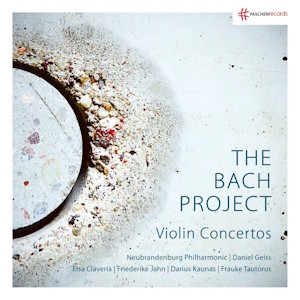
The Bach Project: Violin Concertos
Concerto for three violins in D major BWV1064R
Concerto for two violins in D minor BWV1043
Orchestral Suite no. 3 in D major BWV1068: II. Air
Violin Concerto no.1 in A minor BWV1041
Concerto for oboe and violin in C minor BWV1060R
Elsa Claveria, Friederike Jahn, Darius Kaunas (violins)
Frauke Tautorus (oboe)
Neubrandenburg Philharmonic/Daniel Geiss
rec. 2025, Konzertkirche Neubrandenburg, Germany
Reviewed as lossless download
Paschen Records PR260092 [63]
Neubrandenburg is a small city in the north of Germany, approximately halfway between Berlin and the Baltic Sea. The orchestra celebrates its 75th anniversary in 2026, and this fine recording is a celebration of that milestone. Admittedly, the majority of the players in the full orchestra don’t get to participate in this recording, with the numbers limited to fourteen strings, plus the four soloists, each of whom is a member of the orchestra.
The original form of BWV1064 is in doubt; on the first page of Google search results, there is a “categoric” statement that it was written for three violins and reconstructed for three keyboards, immediately followed by another equally definite one that it was exactly the reverse. The outer movements are deliciously sprightly, but I did feel that the Adagio dragged a little.
Sadly, the masterpiece that is the Concerto for two violins is the only one on the recording where I found myself a little disappointed. The glorious slow movement lacked the poetry that I associate with the best, and the last movement seemed rushed.
Welcome as it is, the inclusion of the famous Air from the third Orchestral Suite is rather puzzling. It is beautifully played, but would not another violin concerto have been more appropriate?
My gold standard for the “authentic” single concertos is the Hyperion recording featuring Alina Ibragimova. Elsa Claveria – I’m sure I’m not the first to think that nominative determinism should have made her a pianist – is not as characterful as Ibragimova, and the Neubrandenburgers sound more vanilla than the twang of the period instrument Arcangelo, but it remains a very enjoyable performance, graceful and light-footed.
The Concerto for oboe and violin is an absolute triumph, clearly the best I’ve ever heard. Everything seems to click into place, with Frauke Tautorus’s joyous and tender playing working sublimely with Elsa Claveria, while the orchestra outdoes itself.
Elsa Claveria is soloist in all four concertos, and plays very well, with a timbre that makes me very happy – no harshness at all. Her two colleagues in the double and triple are well matched, while oboist Frauke Tautorus is a real standout – her contributions to concerts as a member of the orchestra must be a frequent highlight for the Neubrandenburg audiences. The sound quality is very good, detailed, airy and well-integrated.
The booklet notes are more philosophical than musicological, and indicate that this programme has been in development for some time. It would, therefore, suggest to me that it is not going to be the start of a series, despite the use of “Project” in the title. BWV1042 is an obvious absentee from this release, and there are some other concertos, better known in their keyboard forms, that do exist in violin versions as well, e.g. BWV1052, 1055 & 1056.
So a second volume would be most welcome, as this has been a delightful hour spent in the company of JSB’s sublime music.
David Barker
Buying this recording via the link below generates revenue for MWI, which helps the site remain free













