
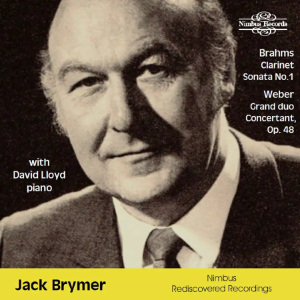
Jack Brymer (clarinet)
David Lloyd (piano)
rec. 1-2 October 1973, Handsworth Wood Studio, Birmingham (Brahms 1, Weber); 29-30 April 1992, Wyastone Leys Concert Hall (remainder)
Nimbus NI7121 [2 CDs: 124]
In the later years of the last century, there were two pre-eminent British clarinettists: Jack Brymer and the younger of the two, Gervase de Peyer. The latter may have been better known but, as an amateur clarinettist, I preferred Brymer. His mellifluous and liquid tone, perfect intonation and elegant phrasing were my ideal of clarinet playing. He played in orchestras and chamber groups, and gave recitals with his duo partner David Lloyd. He made many recordings in the first two of these capacities, but there are few recital discs. Nimbus have put together a disc made in 1973 but not issued until 1979 with recordings made nearly twenty years later but not issued at the time. This is a very satisfactory display of Brymer’s qualities.
On the first disc, we have Brahms’s late clarinet sonatas, inspired by the playing of Richard Mühlfeld, for whom Brahms also wrote the clarinet trio and the clarinet quintet. These sonatas are true duos. The piano part is as important as the clarinet part, and considerably demanding after the manner of Brahms’s piano music. The sonata in F minor begins somewhat sombrely but the mood lightens as we go through the four movements, and the finale is cheerful. The sonata in E flat in three movements is more lyrical, though there are some strenuous passages in the finale.
Between these we have Weber’s Grand duo concertant. We should note that it was Weber’s concertos and quintet which Brahms heard Mühlfeld playing. His sonatas are in the same keys as Weber’s two clarinet concertos. Unlike Brahms’s sonatas, this is unashamedly a showpiece, but for both instruments. Again, the piano part is equally challenging. It is a delightful work, and the playful finale is especially attractive.
The second disc begins with a transcription of Schubert’s Arpeggione Sonata. The arpeggione, a short-lived variant of the cello, was more like a bass viol, with frets and strings tuned like a guitar. Schubert’s sonata is the only important work written for it; it is normally played, without detriment, on the cello. I do not greatly care for it, but Brymer’s clarinet version almost brings me round, so engaging is his playing. The transcription is not credited, but it is a good one, and the work worth hearing in this form.
In contrast, Schumann’s Fantasiestücke are a staple of the instrument. This is one of the sets of pieces Schumann wrote late in his career to provide material for amateurs at home. He allowed them to be played by various instruments but the clarinet version is the original. The pieces are vintage Schumann, in the vein of short character pieces at which he excelled.
William Hurlstone’s four Characteristic Pieces, are precisely that, in a late-Romantic idiom.
Finally, we have Stanford’s clarinet sonata, which has remained popular with clarinettists, as has his concerto. This substantial work in three movements is in an idiom so close to Brahms that actual passages from Brahms’s clarinet works turn up occasionally. The middle movement, Caoine (keen, an Irish lament), shows some influence of Stanford’s Irish background.
Jack Brymer and David Lloyd make a real duo partnership, and all the works are a pleasure to listen to. The recordings, despite the difference in age, match well. The sleeve note is, understandably, more about Brymer than about the works included. I wish there were more, but we should be grateful for what we have, and for the memory of a fine musician.
Stephen Barber
Previous review: Jonathan Woolf
Buying this recording via the link below generates revenue for MWI, which helps the site remain free
Contents
Johannes Brahms (1833-1897)
Clarinet Sonata No.1 in F minor, Op.120 No.1 (1894)
Carl Maria von Weber (1786-1826)
Grand duo concertant, Op.48 (1815-1816)
Johannes Brahms (1833-1897)
Clarinet Sonata No.2 in E flat, Op.120 No.2 (1894)
Franz Schubert (1797-1828)
Sonata in A minor, D.821 ‘Arpeggione’ (1824)
Robert Schumann (1810-1856)
Fantasiestücke, Op.73 (1837, arr. clarinet, 1849)
William Hurlstone (1876-1906)
Characteristic Pieces for clarinet and piano (1899)
Charles Villiers Stanford (1852-1924)
Clarinet Sonata, Op.129 (1911)














I remember Jack telling me about the first disc not knowing what actually happened to it, something to do with the Maxwell’s; he said he did get paid!