
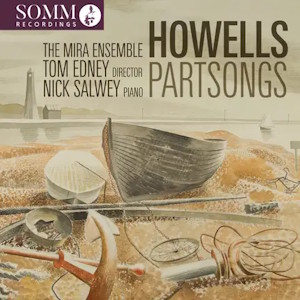
Herbert Howells (1892-1983)
Partsongs
Nick Salwey (piano), The Mira Ensemble / Tom Edney
rec. July 2025, St. George’s Headstone, Harrow, London, UK
SOMM Recordings SOMMCD0725 [60]
Herbert Howells “composed a significant body of lyrical, often pastoral part-songs characterized by rich harmony and expressive text-setting”, according to the advertising for this remarkable disc. Over the past few decades, much of his catalogue has found its way onto disc: the organ works, the orchestral scores, the sacred canticles, services and anthems. Performers have also explored his piano, chamber and solo vocal music. This substantial anthology of his part-songs reveals a facet of his output that has long been underrepresented, both in the record shops and the recital rooms. In fact, all but one of these are premiere recordings.
What has never been in doubt is Howells’s affection for the English lyric tradition – exemplified by his settings of Walter de la Mare, William Blake and the older English poets – and his skill in handling words, whether sacred or secular. If there is a unifying undercurrent to the repertoire on this disc, it is the subtle balance between a kind of pastoral ease and an emotional shadow that hangs over some of these songs, especially those written after Howells’s son Michael’s death in 1935.
Even though Howells composed several of these songs with a children’s chorus in mind, they are all performed here by the Mira Ensemble (the name means “admirable”). The group, formed in 2025, brings together professional upper‑voice singers from across the United Kingdom. For this debut album, the ensemble appears in an octet of four sopranos and four altos. They are directed by the Newcastle‑born conductor, composer, academic, editor and orchestrator Tom Edney. Nick Salwey supplies the demanding piano accompaniment.
I have aligned the dates of the songs with the List of Works in Christopher Palmer’s Herbert Howells: A Celebration, Thames Publishing 1996.
The earliest songs on this disc are The Shepherd and A Croon, An Old Man’s Lullaby and, particularly, The Tinker’s Song. They are characterised by Tudor modality, with the occasional false relation. This may have derived from Howells’s then current interest in Thomas Tallis and the English Renaissance. There is also a healthy respect for his teacher Charles Villiers Stanford. One thing in common is the assured pianism of the accompaniments.
There are two unison songs on this album, The Wonderful Derby Ram setting an old rhyme and Spanish Lullaby, to an early text. Both are still in Howells’s earlier style. A slightly more advanced mood is heard in the Golden Lullaby. The liner notes say that My master hath a garden is influenced by Gustav Holst: “Shifting metres, subtle polyrhythms and parallel fourths with modal inflections evoke Holst’s distinctive sound world.” Tune Thy Music, to words by Thomas Campion, looks to Howells’s later music; the notes suggest it is precursor to the Collegium Regale Te Deum (1945).
Moving into the next decade, a particular favourite of mine is the vibrant Sea Urchins. This is a set of ten songs for children’s or ladies’ voices preceded by a vivid Overture. Gladys Balcomb’s verses evoke holiday scenes with a charm that recalls Robert Louis Stevenson’s A Child’s Garden of Verses, seasoned at times with the light lyrical touch of John Betjeman. The collection offers considerable variety: some songs are in unison, others in two parts, and the level of difficulty ranges widely; several are written for “alert youngsters”. Among the images conjured are a child’s first trip to the beach, the ubiquitous landlady, a holiday express train, a knitting grandmother settled on the sand, and an adventurous clamber along the cliffs. The liner notes omit a pleasing detail: this cycle was composed especially for the Reigate and Redhill Music Festival and was first performed there in March 1936 under Walter Stanton.
A Yuletide number is included, George Wither’s A Christmas Carol: “So now is come our joyful feast / Let every man be jolly”. It is shaped into a form that moves beyond the typical carol sung by wassailers. There is a melancholic edge to these otherwise jolly words. This was one of Howells’s last contributions to the genre. The final piece was The Summer is Coming from 1964, not included on this disc.
Pink Almond is a setting of a verse by Katharine Tynan, Irish poet and novelist. Once again, its mood is introverted and reticent.
This is not a disc to hurry. I agree with Nick Barnard that the repertoire is best heard in discrete, chronological sections; a uniform listening approach can easily obscure the individuality of the pieces. The vibrant Sea Urchins cycle, however, uniquely benefits from being taken in at a single sitting.
The Mira Ensemble’s performance is marvellous, poised and consistently engaging. Little needs to be said about Tom Edney’s excellent liner notes, the splendid recording quality, and the overall presentation of this album. Full texts of all the songs are included, and everything is produced to the characteristically exacting standards of Siva Oke and SOMM Recordings.
I look forward to Mira Ensemble’s follow-up album. The above-mentioned catalogue in Christopher Palmer’s study shows that there is certainly sufficient material for at least one more volume.
John France
Other review: Nick Barnard
Buying this recording via the link below generates revenue for MWI, which helps the site remain free
Previous review: Nick Barnard
Contents
The Wonderful Derby Ram (1921)
Sweet Content (1931)
Piping for the valleys wild (1938)
A Croon (1916)
My master hath a garden (1923)
The Key of the Kingdom (1948)
Sing Ivy (1924)
To music bent (1933)
A Golden Lullaby (1920)
Bunches of grapes (1933)
Pink Almond (1957)
A Christmas Carol (1957)
The Shepherd (1916)
Spanish Lullaby (1923)
Sea Urchins (1935)
– Overture
– Happy Street
– Many Rainbows
– The Sea-Side Landlady
– Granny sits beside the sea
– The Barrel-Organ
– A Seaside Lullaby
– The Lair on the Cliff
– Lindy’s Ballet Shoes
– The Musical Train
– The Open Air
An Old Man’s Lullaby (1917)
The Tinker’s Song (1917)
Tune thy music (1927)
First recordings, except Sweet Content













