
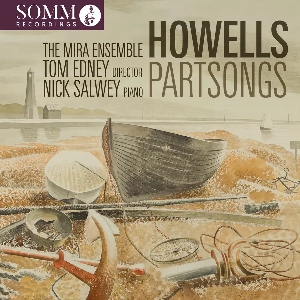
Herbert Howells (1892-1983)
Partsongs
Nick Salwey (piano), The Mira Ensemble / Tom Edney
rec. July 2025, St. George’s Headstone, Harrow, London, UK
SOMM Recordings SOMMCD0725 [60]
Any brand-new disc wholly dedicated to the music of Herbert Howells is a cause for celebration, all the more so when 27 of the 28 tracks are first recordings. Add the fact that the area of repertoire, partsongs for upper voices, is rare – and the value of this disc becomes clear, especially when SOMM presents it with the usual technical, musical and presentational excellence.
The performers are the newly-formed Mira Ensemble, eight female voices – four sopranos and four altos – conducted by founder Tom Edney and accompanied by pianist Nick Salwey. Edney also contributes the excellent and informative liner notes, particularly valuable given the unfamiliar repertoire. Full texts, in English only, along with the usual performer biographies complete the booklet. SOMM’s usual production team of producer Siva Oke and engineer Adaq Khan ensure the technical quality of the project. Balances across the choral group and piano are ideal, set within the supportive but not too resonant acoustic of St. George’s Headstone, Harrow.
Edney makes the valid point that Howells was a master of the miniature. He was in part affected by the neo-classical European composers, and by the poetic influence of Walter de la Mare whose concise verses he often set. None of the songs recorded here last longer than 3:41; thirteen others are less than two minutes long. It is also important to acknowledge the role and function of such partsongs, clearly not intended as vehicles for great emotional statements or complex musical creations. Again, as Edney suggests, one of Howells’s particular skill was the ability to establish a mood or atmosphere with a few deft sweeps of the compositional brush. That is repeatedly on display here. All I would note is that this is probably a disc best experienced in portions. Despite the quality of the music and performances, there is an understandable sameness across the disc. That can diminish the appreciation of individual works which in isolation are revealed as musical gems.
The Mira Ensemble is an accomplished group of professional singers with secure intonation and clear diction. The timbral quality of the group is not as light and youthful as some. Yet the balance across and within the group is very well managed. Edney ensures all the performances are expressively effective and musically sensitive. Accompanist Nick Salwey is also excellent. Some of the piano parts are quite simple and discreet, others demand considerable dexterity and clarity. Salwey finds a perfect balance between accompanying and musically contributing.
The songs range across some four decades, from 1916 (The Shepherd and A Croon) to 1957 (Pink Almond and A Christmas Carol). Howells he lived for another quarter century; why he moved away from the genre is not clear. Christopher Palmer’s wonderful book Herbert Howells – A Celebration (Thames, 2nd edition, 1996) names one later work, The Summer is Coming from 1964. His list of works makes it clear that this collection is simply a selection: a rough estimate would suggest a second volume would be possible.
Many of these upper-voice works were clearly conceived for children, either as unison songs or with relatively simple part writing. The clearest example is the Sea Urchins set. It consists of a piano-only Overture followed by ten unison or two-part songs. These act almost as musical “picture postcards” from a holiday. Howells wrote this work in 1935, when the tragic death of his son Michael became the defining event of the composer’s personal and musical life. There is open-air lightness of spirit here; A Seaside Lullaby on track 21 is a gently lilting delight. That would suggest it must have been composed before that emotionally scarring event. This delightful set is very well performed here, although I can imagine a children’s choir sounding even more idiomatic and affecting.
How Howells transformed this personal grief into universal art is best captured in his genuinely great Hymnus Paradisi and in the earlier Requiem. It is interesting to hear the William Blake setting of Piping down the valleys wild as the completion of the vocal score of Hymnus. This is a perfect example of the expressive and technical precision of Howells’s writing, and a fine example of just how good these performances are. Other personal favourites on the disc include An Old Man’s Lullaby and Tune thy music. The latter concludes the programme with a work that perfectly encapsulates Howells’s genius. The recital is not in chronological order – no reason it should be – but it is not exactly clear why the works have been ordered as they are.
I do not feel any of these partsongs approach the greatness of Howells’s finest music, and certainly not his major contributions to Anglican Church music in his various sacred settings. But this disc is very valuable: it broadens one’s appreciation and understanding of his range and musical sensitivity. The hope must be that the Mira Ensemble will explore more of this enjoyable repertoire.
Nick Barnard
Other review: John France
Buying this recording via the link below generates revenue for MWI, which helps the site remain free
Contents
The Wonderful Derby Ram (1921)
Sweet Content (1931)
Piping for the valleys wild (1938)
A Croon (1916)
My master hath a garden (1923)
The Key of the Kingdom (1948)
Sing Ivy (1924)
To music bent (1933)
A Golden Lullaby (1920)
Bunches of grapes (1933)
Pink Almond (1957)
A Christmas Carol (1957)
The Shepherd (1916)
Spanish Lullaby (1923)
Sea Urchins (1935)
– Overture
– Happy Street
– Many Rainbows
– The Sea-Side Landlady
– Granny sits beside the sea
– The Barrel-Organ
– A Seaside Lullaby
– The Lair on the Cliff
– Lindy’s Ballet Shoes
– The Musical Train
– The Open Air
An Old Man’s Lullaby (1917)
The Tinker’s Song (1917)
Tune thy music (1927)
First recordings, except Sweet Content













