
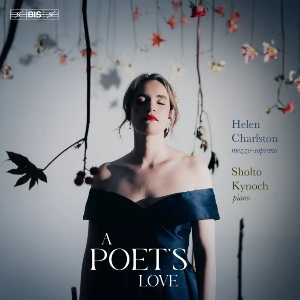
A Poet’s Love
Helen Charlston (mezzo-soprano)
Sholto Kynoch (piano)
rec 2024, Wyastone Concert Hall, Monmouth, UK
German texts and English translations included
Reviewed as a download
BIS BIS-2704 SACD [63]
The British mezzo-soprano Helen Charlston has been performing with prestigious orchestras and musicians for a number of years, and has already made several CDs, of works in the Baroque repertoire (one of which was reviewed by my colleague in 2025), but also of contemporary art songs, often written specifically for her. This recording continues this trend: it combines Schumann’s Dichterliebe with other settings of Heine poems, including a new work by Héloïse Werner written especially to accompany Dichterliebe. The result is an interesting compilation, given life by Charlston’s characterful voice and Sholto Kynoch’s flexible accompaniment on the piano.
The first song is Die Lotosblume, not the famous setting by Schumann, but Carl Loewe’s very interesting version. Schumann (whose version follows three tracks later) creates a flowing song in which the accompaniment is similar in each verse, and the vocal line plays with subtle variations. Loewe, on the other hand, follows more closely the psychological states of the poetic voice, writing three distinct verses, in each of which the melody and accompaniment change radically. After the lilting first verse, we have a surprising modulation to a more serene, flowing second stanza depicting the (at least visual) contact between the flower and her lover, the moon. Then, in the final verse, the triplets move to the left hand of the piano, but now in the form of throbbing chords, producing a feeling of disquiet. This is mirrored in various details of the vocal line, like, for example, the long gaps between the three verbs “Sie blüht”, “und glüht” and “und leuchtet”, or like the extreme length of the note on the word “Höh,” representing the huge distance separating the symbolic lovers. It is fascinating to be able to compare these very different visions of the same poem by two different composers being given such sensitive treatment here by Charlston (with, for example, very delicate control of the vibrato on the final note), and Kynoch.
There is a handful of songs by other composers contemporary of Heine and Schumann, some of which are also not particularly well-known. We have one song by Josephine Lang, a couple by Fanny Mendelssohn, and one by brother Felix. The Lang setting of Wenn zwei von einander scheiden, with its hymn-like introduction, while not being as psychologically precise as the Loewe song, is charming and melodic, and Charlston sings it expressively. Fanny Mendelssohn’s Schwanenlied, the first work she published under her own name, is set to a very touching poem characterised by downward movement and images of extinction and death. The musical setting is appropriately melancholy, and is once again performed beautifully, with some lovely sustained notes. Her Fichtenbaum und Palme, depicting two very different trees in two very different lands, which are clearly characterised in the music, and brought together musically in the end, is also phrased nicely by Charlston, though some hardness does creep into the voice at times. The final song of this group is Felix Mendelssohn’s famous Reiselied, with its virtuoso accompaniment played with impressive lightness by Kynoch. It is reminiscent of Schubert’s setting of Goethe’s Willkommen und Abschied, though in the case of the Heine poem, the meeting with the beloved is revealed in the final verse to be a fantasy, a “foolish dream”.
The poem that Héloïse Werner has chosen to set to music is the prologue to Heine’s Lyrisches Intermezzo, of which no published musical setting exists. It tells the story of a knight “with hollow, snow-white cheeks,” whose ghostlike beloved comes to him at midnight and spirits him away to a marvellous underwater domain, where their marriage is celebrated, before he suddenly finds himself back, alone, in his “gloomy little poet’s room”. What I have summarised is Heine’s whole poem, but Werner uses only verses one to three in their entirety (in songs 1 and 2); the remaining three verses are only present in fragments in the rest of the songs, which also quote snippets from verses 1 and 2. The last song is really an elegiac piano postlude, accompanied by some melancholy vocalising by the singer.
While the poem is reminiscent of Keats’ La Belle dame sans merci, since they both exploit the same medieval imagery, Heine’s aim is really rather different, and is connected with the irony which he used increasingly in his later writing, but which can already be seen in the Lyrisches Intermezzo from which Schumann chose the poems for Dichterliebe. Here, the knight finds himself abandoned, not in some desolate fictitious landscape, but in a banal little “Poetenstübchen,” thus mocking the Romantic poet’s flights of imagination.
It is worth bearing this in mind when listening to Werner’s musical setting, since what I hear as a very detached treatment (the tapping on the wood of the piano, the reduction of the text to individual words and even isolated consonants in song 3, and the general impression of something disjointed in the singing line and the accompaniment) could be said to be a response to Heine’s ironic approach. I will leave it to listeners more versed in contemporary music than I to arrive at an informed opinion on this composition, though I will say I found it intriguing.
The pointing up of Heine’s irony in Werner’s work prepares us to approach Dichterliebe in a somewhat different way, from a potentially refreshing perspective. Can we see traces of Heine’s irony in the poetry itself, in Schumann’s settings, or in the way the Lieder are interpreted? The very first song, Im wunderschönen Monat Mai is often seen as a typical expression of Romantic love, but its tonal uncertainty, and the fact that it finishes without closure, would suggest that Schumann is sensitive to Heine’s intentions, and the hesitancy of Kynoch’s accompaniment underlines this idea. To jump to the famous seventh song, Ich grolle nicht, there is clearly a contradiction between the speaker’s insistence that he/she “bears no grudge” and the energy that he/she spends expressing it. Schumann increases the repetitions of the key affirmation from three in the poem to seven in the song, making the disparity even clearer. The heavy left-hand chords in the piano, and the obsessive way in which the melodic line moves higher and higher make it more obvious yet. Charlston’s use of vocal colouring, and an almost parlando tone at times, makes her interpetation far more anguished than stoic. The other song in which the irony is well expressed by poem, song and artists is Ein Jüngling liebt ein Mädchen. Heine’s surprising use of language – the repetition of “andre”, and the choice of familiar expressions like “übel dran” and “Und wem es just passieret” – give it a flippant tone which undercuts the emotion. Schumann adds a dancing but grotesquely heavy rhythm which he continues into the postlude, and Charlston’s rather arch delivery completes the picture.
The whole of Dichterliebe is performed to an extremely high standard by both artists. There is delicacy employed in Aus meinen Tränen sprießen, flexibility in Wenn ich in deine Augen seh, and warmth in Ich will meine Seele tauchen, matching the beautiful richness of Schumann’s piano writing. Charlston can put gravitas into her voice for Im Rhein, im heiligen Strome, and also capture the awe with which the lover notes the similarity between the picture of the virgin in the cathedral and his beloved. In Und wüßten’s die Blumen, die kleinen, the flexibility of her voice marries well with the flowing accompaniment, and Das ist ein Flöten und Geigen, where the ironically cheerful accompaniment is at cross purposes with emotions of the voice, is also excellently performed by both partners. Hör’ ich das Liedchen klingen is taken very slowly, bringing out the fragmentary nature of the accompaniment, including in the touching postlude, while the pianissimo voice expresses unbearable sadness. Am leuchtenden Sommermorgen, with its equally drooping movement, is given similarly sensitive treatment. In Ich hab’ im Traum geweinet the slow tempo is very effective, as is the forte at the end. The more serene tone of the voice in Allnächtlich im Traume is appropriate to the fantasy vision being described. The fantasy continues in Aus alten Märchen, until the final two verses, where the impossible escapism becomes explicit, and the singer lingers significantly on the word “Traum”. The final song, Die alten, bösen Lieder, is sung with suitable bitterness and intensity, and the postlude played with delicate transparency.
Comparison with other recordings of these songs can, of course, be only partial. Dichterliebe has been overwhelmingly performed by men, with a series of what are to me often either rather thin tenor voices, or rather unattractive baritone ones. Aksel Schiøtz and Fritz Wunderlich are notable exceptions, as are the young Dietrich Fischer-Dieskau and the classy Gerald Finley. There is also an interesting recording by a smooth-voiced Siwoung Song, accompanied by the excellent Helmut Deutsch, reviewed here. Among the women, Brigitte Fassbaender’s dramatic intensity probably produces the best recorded performance, reviewed here.
But there is, of course, much more to this album than just Dichterliebe. The interest of this compilation lies in the idea of combining a number of Heine settings, including the contemporary creation, with the famous cycle. Helen Charlston makes intelligent use of the text and interprets the songs expressively. There are moments when a certain hardness, an edge – maybe for reasons of expression – is present in the voice, but there is much delicate phrasing, suppleness and warmth too. These qualities, in combination with Sholto Kynoch’s sensitive playing of the accompaniments and the many postludes make this recording compelling listening.
David James
Contents
Carl Loewe (1796–1869)
Die Lotosblume, Op. 9-I/1
Josephine Lang (1815–80)
Wenn zwei von einander scheiden, Op. 33/6
Fanny Mendelssohn-Hensel (1805–47)
Schwanenlied, Op. 1/1
Robert Schumann (1810–56)
Die Lotosblume, Op. 25/7
Fanny Mendelssohn-Hensel
Fichtenbaum und Palme (1838)
Felix Mendelssohn (1809–47)
Reiselied, Op. 34/6
Héloïse Werner (b. 1991)
Knight‘s Dream (2023)
Robert Schumann
Dichterliebe, Op. 48
Buying this recording via the link below generates revenue for MWI, which helps the site remain free













