
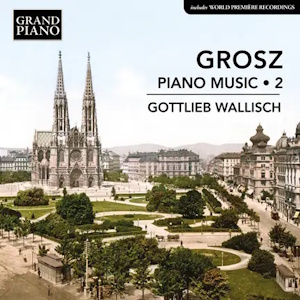
Wilhelm Grosz (1894-1939)
Piano Music 2
Gottlieb Wallisch (piano)
rec. 2025, Klaus von Bismarck-Saal, WDR Funkhaus, Cologne, Germany
Grand Piano GP956 [69]
In my review of Volume 1 of Wilhelm Grosz’s piano music, I wrote I was itching to hear more. Now I can say that Volume 2 amply lives up to my expectations. We have here a little (kleine) sonata whose imagination is bigger by far than its dimensions; three pieces that show off Grosz’s pianistic acumen; two waltz transcriptions, a joyous celebration of a homeland that was being lost to Nazism; and an impressive variation set which shows that Grosz could construct a large-scale work with a clear structure and a palette of richly varied colours and textures.
The Kleine Sonate is anything but: at sixteen minutes, longer than some more famous sonatas, it explores a vivid range of dynamics and textures. Perhaps it was a bit of modest humour on Grosz’s part, to echo the humour found in much of the writing. The work begins with a comic march that soon gives way to a lovely lyrical theme; these two are entwined skilfully throughout this short movement. A motoric scherzo, with insistent repeated notes and well-wrought growing intensity, leads to a schmoozy, bluesy trio.
Grosz leaves humour aside for the slow movement, the most serious of the four. A melody in the form of a lament is draped in a beautiful gauze of sound. It reaches a dynamic climax just before the end. The most magical for me is the moment when Grosz turns to three staves to add a counter-melody to the lament and accompaniment. The finale is a mix of march, scherzo and country minuet, a clever collection of scenes seamlessly connected. The false closing chords – finish… well, maybe one more… and another… maybe just one more – reprise Dudley Moore’s wonderful Beethoven parody. For all that Grosz sidesteps into a kaleidoscopic range of keys and produces a score that looks to be full of glaring clashes of harmony, this is actually a tonal and very approachable piece. It could be a winner if introduced into a recital.
The Symphonic Variations, at least as impressive, may take several listening sessions to reveal all the riches. The work was completed by 1920 and premiered at the house of Arthur Schnitzler, a noted Viennese author and dramatist. It was played there three times, twice by the composer and once by Helene Lampl-Eibenschütz. Grosz’s affair with Schnitzler’s soon-to-be ex-wife Olga doubtless put an end to further performances. Grosz played the official premiere in 1921 at a concert that also included works by Ernst Krenek and Alois Hába. That may seems an odd coupling at first sight but this was Hába’s late-romantic first quartet and Krenek’s lyrical and playful clarinet serenade. Both fit well with Grosz’s wonderfully tonal, grandiose, imaginative half-hour piece.
The fifteen variations are divided into roughly four sections: an opening theme and variations, a slow movement comprising three variations, three more forming a scherzo, and variation 15 as the finale. There is an element of Reger in the grandeur of the writing, but with more immediacy, lightness and humour. The first eight variations have enough variety for a work on their own but Grosz changes the mood completely in the extended and reflective ninth variation. That leads into a funeral march with echoes of Mahler, and a magical variation that channels Korngold at his most cinematic. The scherzo variations feature a delicate music box musette. They lead into the upbeat finale, almost a set of variations on its own; it closes with music similar to the grand chordal opening. After repeated hearings, I find this work’s neglect hard to understand. To be fair, it needs a champion, and it demands effort to fully appreciate its treasures.
The Three Pieces required extensive research to track down. Printed copies are thin on the ground, almost to non-existence. Persistence paid off: a copy was found in the British Library. Grosz premiered the three pieces in 1932. One wonders if they have been heard since. The first is an insistent phantastic scherzo with a rather dreamy central section, in slightly impressionist mood with added jazzy chords. Viennese elegy finds something of the blues in its writing though its mournful tone gives way to a more lyrical and nostalgic section. It shows off Grosz’s abilities in the field of light music. The third piece is a perpetuum mobile, light-hearted, bustling and, like much of the music here, highly virtuosic.
Pianist Gottlieb Wallisch remains in Vienna for the last two items, transcriptions of Johann Strauss’s Acceleration Waltz and evergreen Blue Danube (should that be everblue?), both utterly delightful. They inhabit the world of Alfred Grünfeld’s Viennese waltz transcriptions rather than the more note-heavy and intricate reworkings by Godowsky or Cziffra.
This volume has convinced me even more than the first: Wilhelm Grosz was a piano composer to be reckoned with. He has an unerring sense of pianistic texture and colour, and a consumate artist’s feel for balance, growth and atmosphere. He also has a grip of the highest order on the piano’s abilities and how best to highlight them. His light may have dimmed considerably, but what a champion he now has in Gottlieb Wallisch, a pianist of rare talents who completely inhabits this music.
I would love to hear more but there may be few piano solos to discover. Can we hope that Wallisch will now bring us the Symphonic Dance, Grosz’s work for piano and orchestra?
Rob Challinor
Buying this recording via the link below generates revenue for MWI, which helps the site remain free
Contents
Kleine Sonate Op.16 (1923)
Symphonic Variations on an Original Theme Op.9 (1920)
Three Pieces for Piano Op.33 (publ. 1933)
Johann Strauss II (1825-1899) arr. Wilhelm Grosz
Accelerationen Op.234 (publ. 1934)
An der schönen, blauen Donau Op.314













